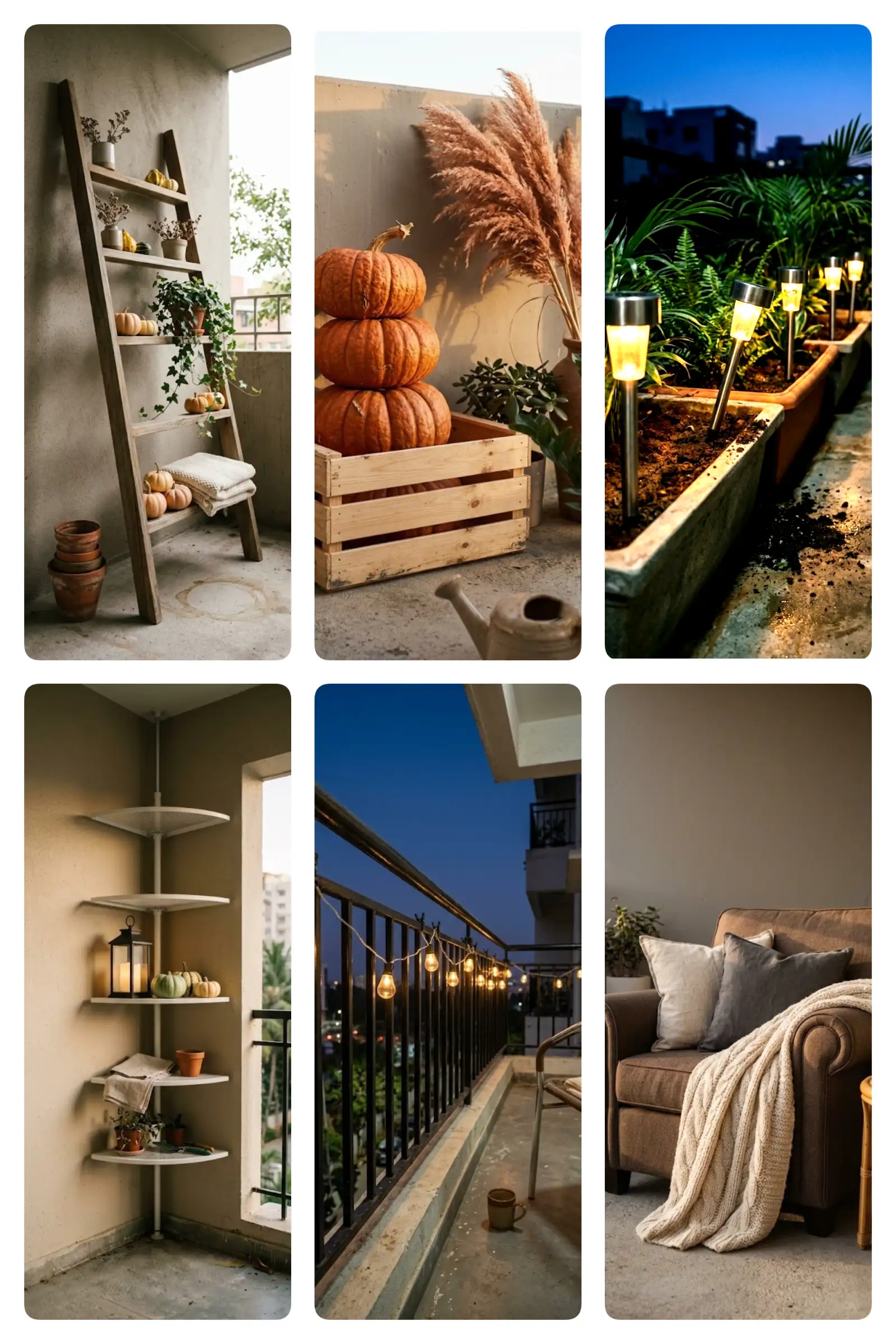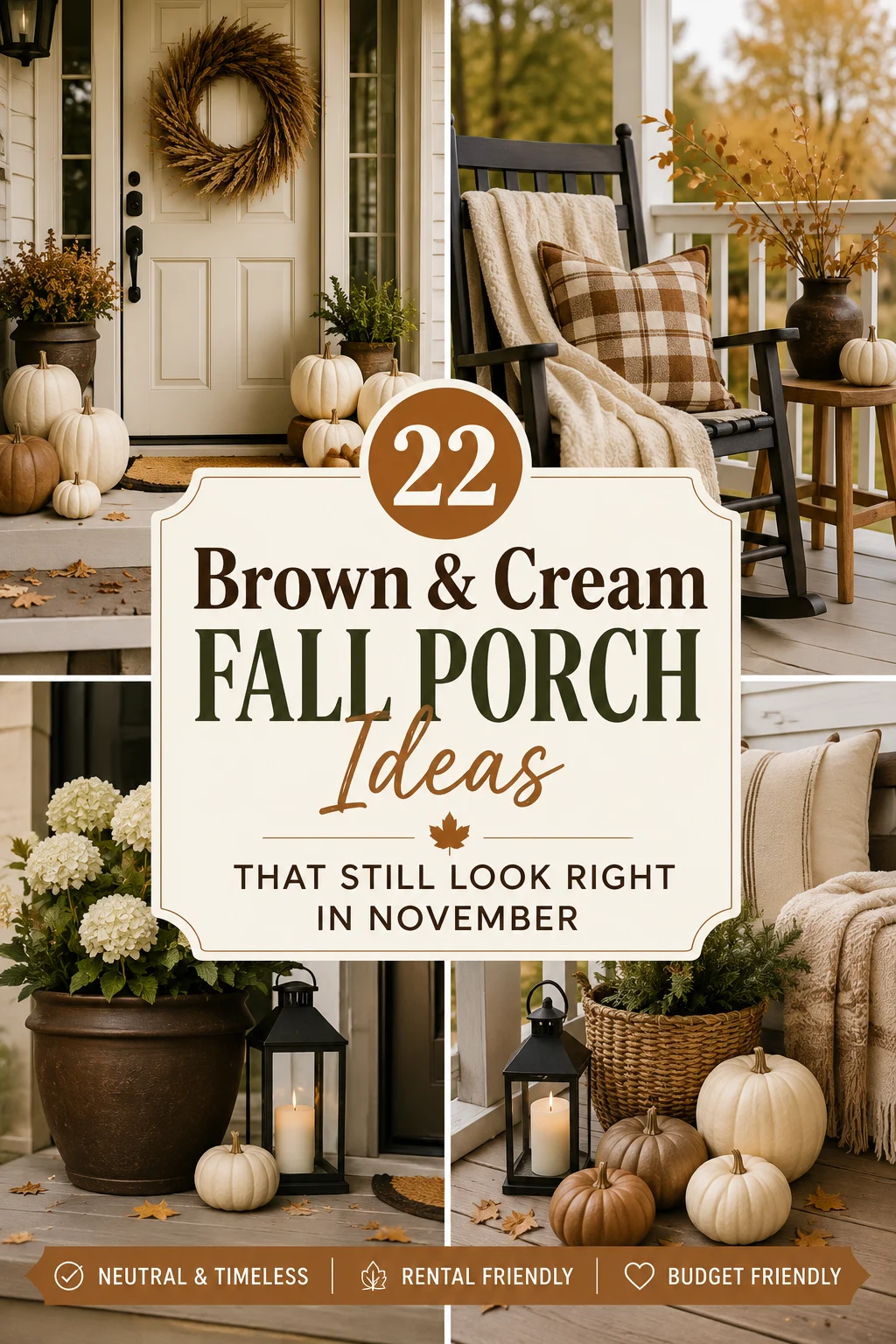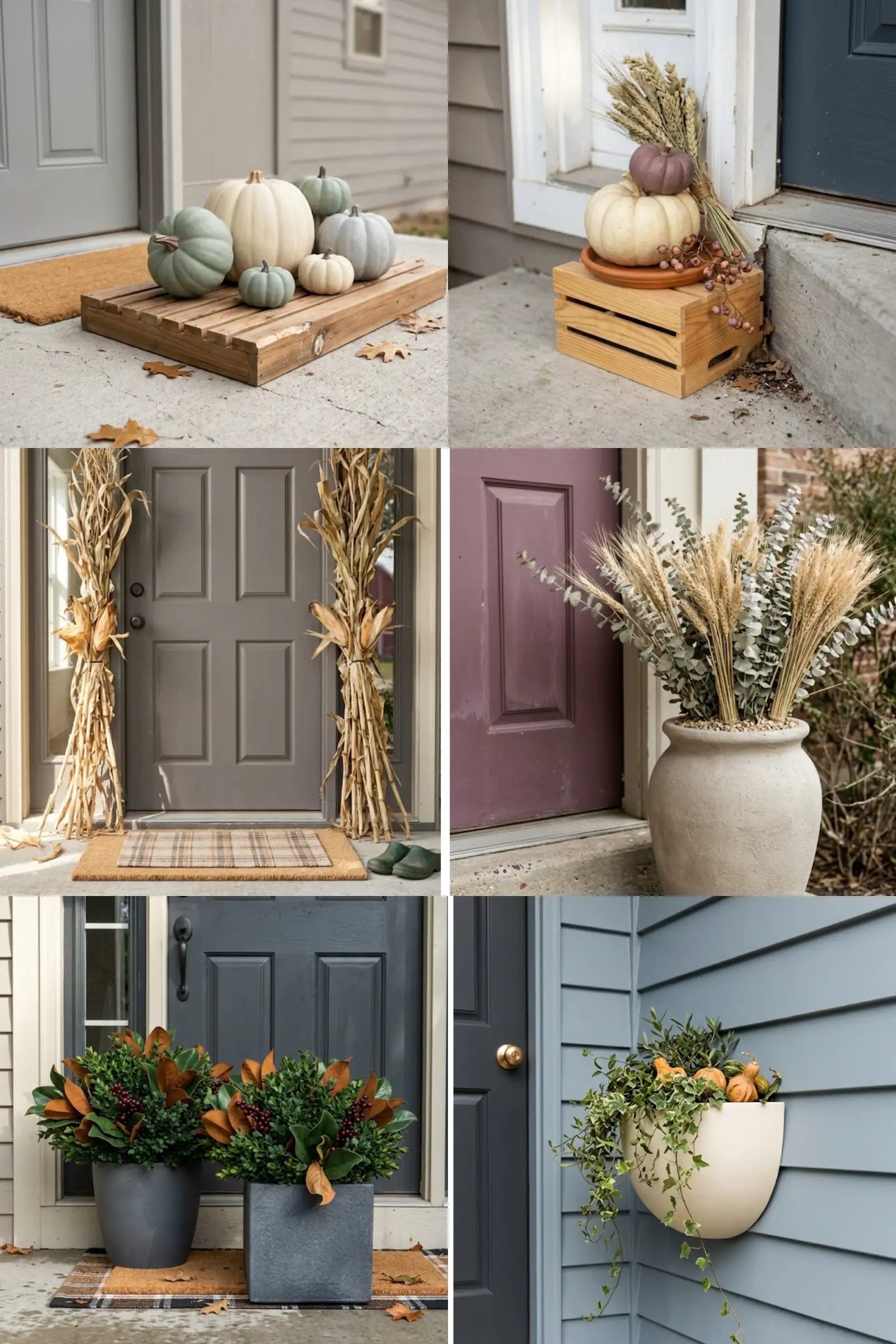
Most small front porch fall decor ideas online are a photo tour of somebody's covered, railed, three-step entry, and that is not what a townhouse stoop is. My porch is a 4 by 4 concrete rectangle with no steps, no railing and no roof. After three Octobers of finding my setup face down on the lawn, I stopped collecting pretty pictures and started sorting ideas by constraint instead. This post is organized that way: no steps, no cover, no railing, ultra-narrow, and shaded north-facing. Every idea carries the weight, drainage or no-drill mounting detail that decides whether it is still standing in November. Save this to Pinterest so you have it when you are standing in the seasonal aisle.
1. Oversized Layered Doormat Sized to the Whole Concrete Pad
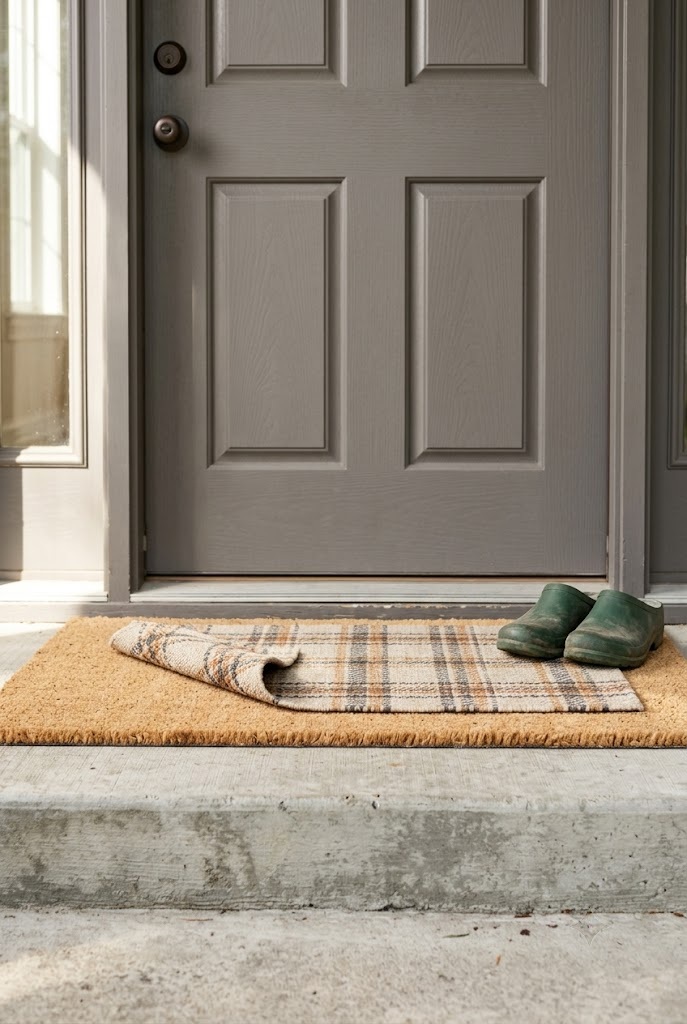
On a flat pad the doormat is the only element that reads as a threshold, so buy one sized to the pad instead of to the door. Measure the width and choose a coir base that covers roughly two-thirds of it, then set a smaller patterned fall mat on top, pushed back a few inches so the coir edge shows. Layered outdoor doormats hold their shape better than one thin mat because the bottom layer takes the water and the top stays flatter through October damp. A layered doormat setup also gives the rest of your decor a visual anchor to gather around. Check clearance with the door open first: you want at least 2 inches under the swing.
2. Two Weighted Planters of Faux Mums Flanking the Door
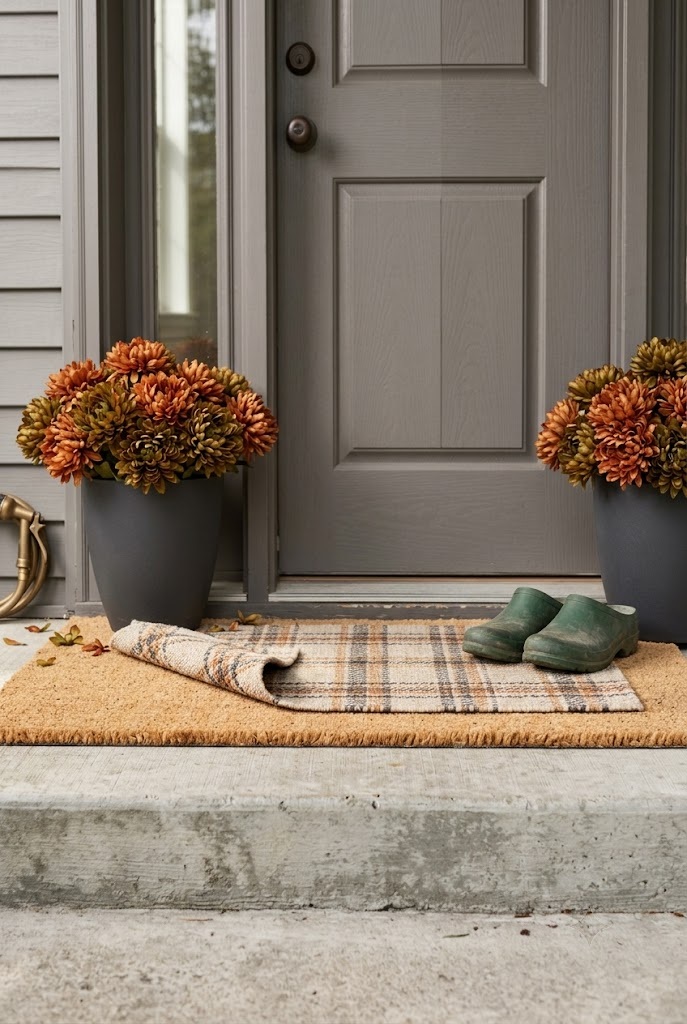
Faux mums do the heavy visual lifting on a small stoop because real ones need daily water and go leggy by mid-October, and nobody can tell the difference from the sidewalk. Buy two lightweight planters, then fill the bottom third with paver sand or gravel before the mum goes in. A 14 inch resin planter weighs almost nothing empty and will travel across the pad in a 30 mph gust. Sand adds roughly 15 pounds for about 5 dollars. Place them tight against the wall on either side of the door rather than centered on the pad, because anything sitting out in open concrete becomes a trip hazard and a wind target at the same time.
3. A Stacked Wooden Crate Column That Fakes a Step
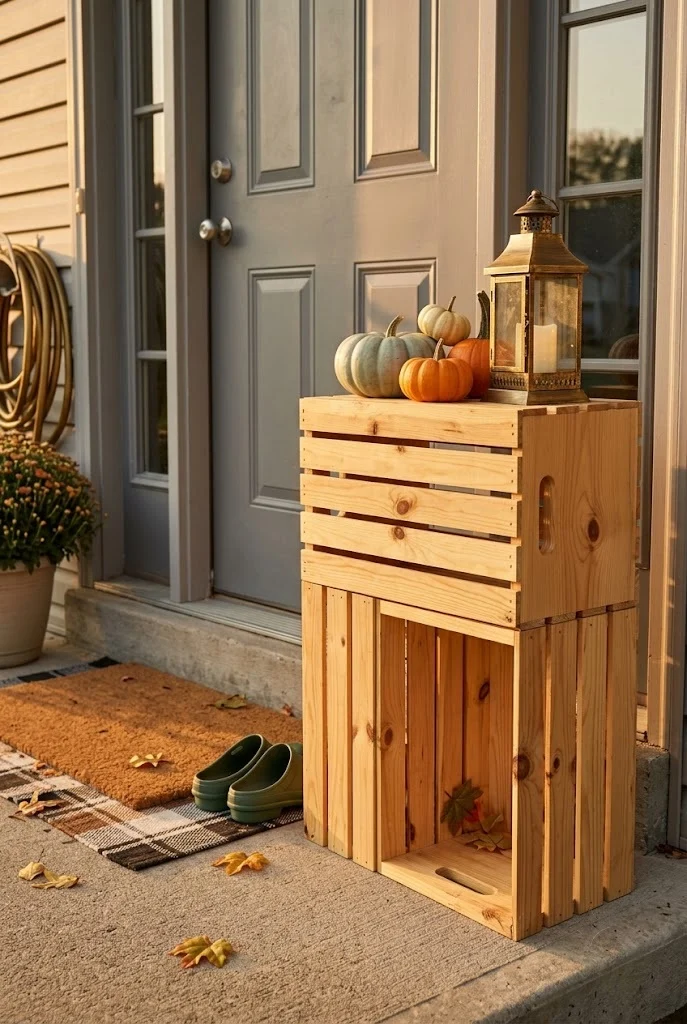
Stacked wooden crates give a one-level pad the tiered look that steps would have provided, at roughly knee height. Two crates on their sides with a third laid across the top creates a stepped silhouette you can stage pumpkins and a lantern on. Use untreated pine crates sealed with exterior spar urethane, or accept that raw pine will gray out and swell within one wet season. Keep the whole column under 24 inches tall so it does not compete with the door, and screw the crates to each other rather than trusting friction to hold them. On concrete, add stick-on rubber or felt feet so water does not wick up into the exposed end grain.
4. Tall Corn Stalk Bundles Zip-Tied to the Door Frame
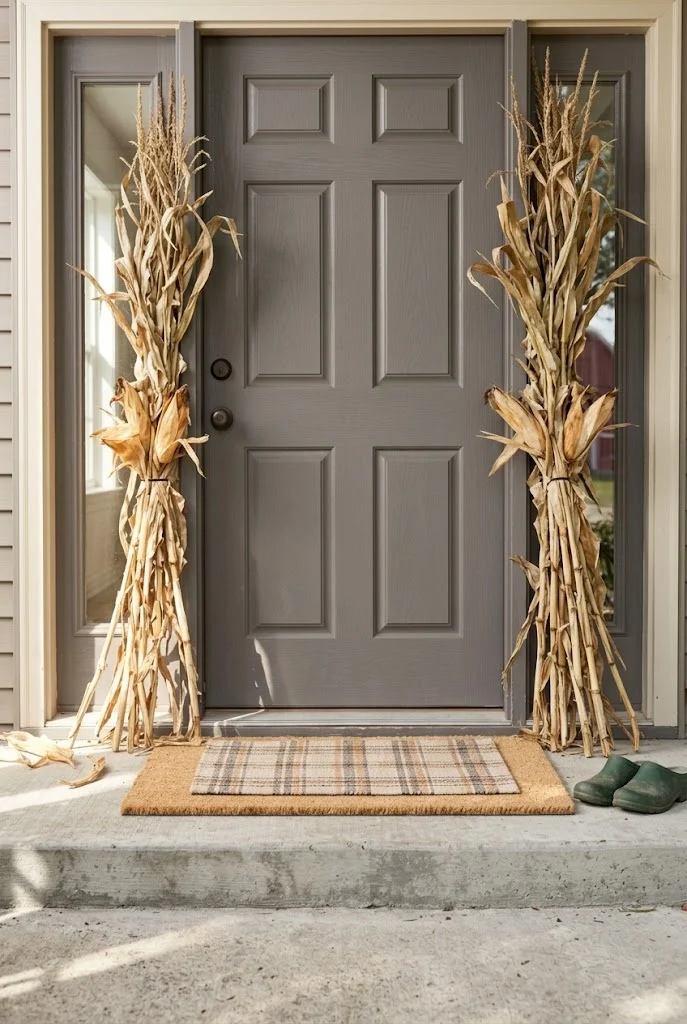
Corn stalk bundles read as fall from thirty feet away and cost almost nothing, but on a stoop with no railing they need a hard attachment point. Zip-tie two bundles to the door frame trim or to a downspout bracket, one on each side, with the cut ends resting on the pad and the tops at about door-handle height or slightly above. Trim the bases square so they stand flat instead of splaying. Real stalks shed constantly in wind and turn to mush after two heavy rains, which is fine if you are refreshing everything in November anyway. Faux stalks cost more upfront, survive about three seasons, and do not bring mice with them.
5. A Three-Height Gourd Cluster on One Side of the Door Only
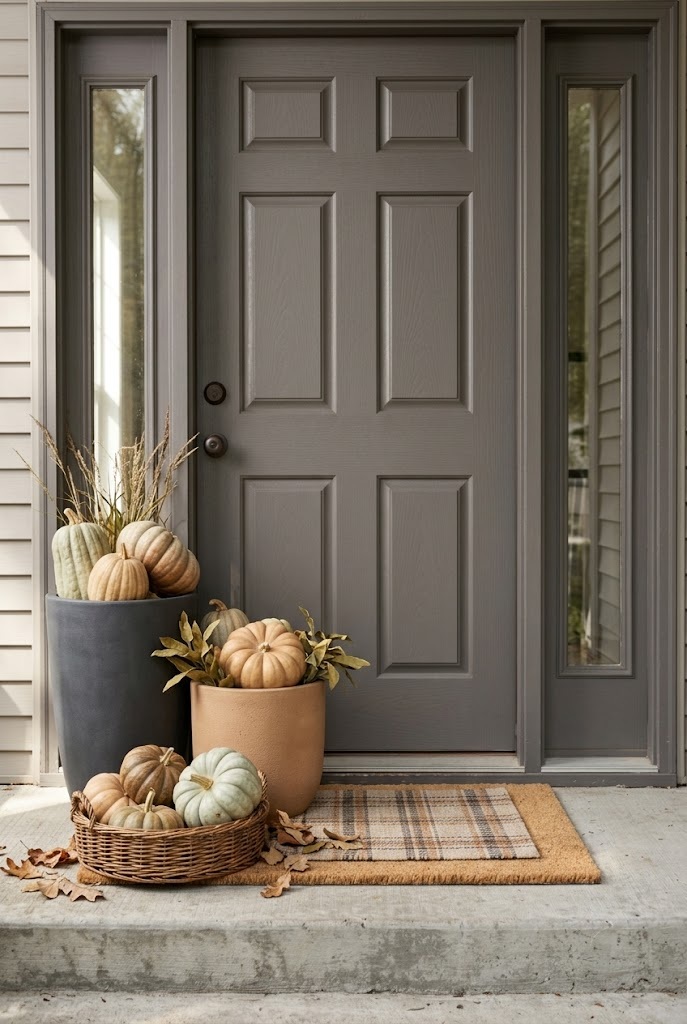
Grouping everything on one side of the door works better than symmetry when the pad is under five feet wide, because two matched piles eat the walking space you do not have. Build one cluster with three heights: something knee-high like a planter, something mid-calf like a stacked gourd pair, and something low and wide like a shallow basket. Keep the tallest piece closest to the wall and step down toward the open pad so the silhouette leans inward instead of sprawling outward. Leave the other side of the door completely empty. That emptiness is what makes the cluster look deliberate rather than like storage overflow, and it keeps a clear path for anyone carrying a package.
6. A Full-Sun Rated Faux Wreath on an Over-Door Hook
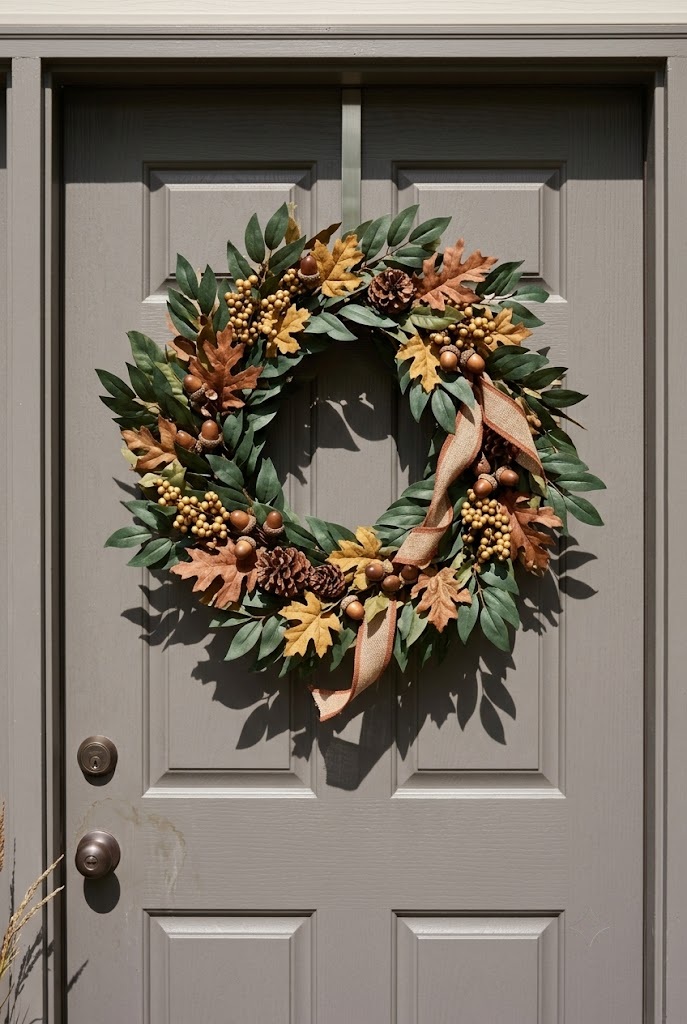
An uncovered door takes direct rain and UV all day, so the wreath there has to be built for it rather than adapted to it. Look for polyester or polyethylene foliage instead of dried naturals, and check that the base ring is plastic or fully wrapped, not bare wire that will rust-stain the door. Size it to about two-thirds of the door width, which on a standard 36 inch door means a 22 to 24 inch wreath. Hang it from an over-door hook so the load sits on the top edge of the slab rather than on adhesive. If you already tied stalks to the frame as in idea 4, keep the wreath simple so the two do not compete.
7. Sealed Resin Planters That Survive Freeze-Thaw on Bare Concrete
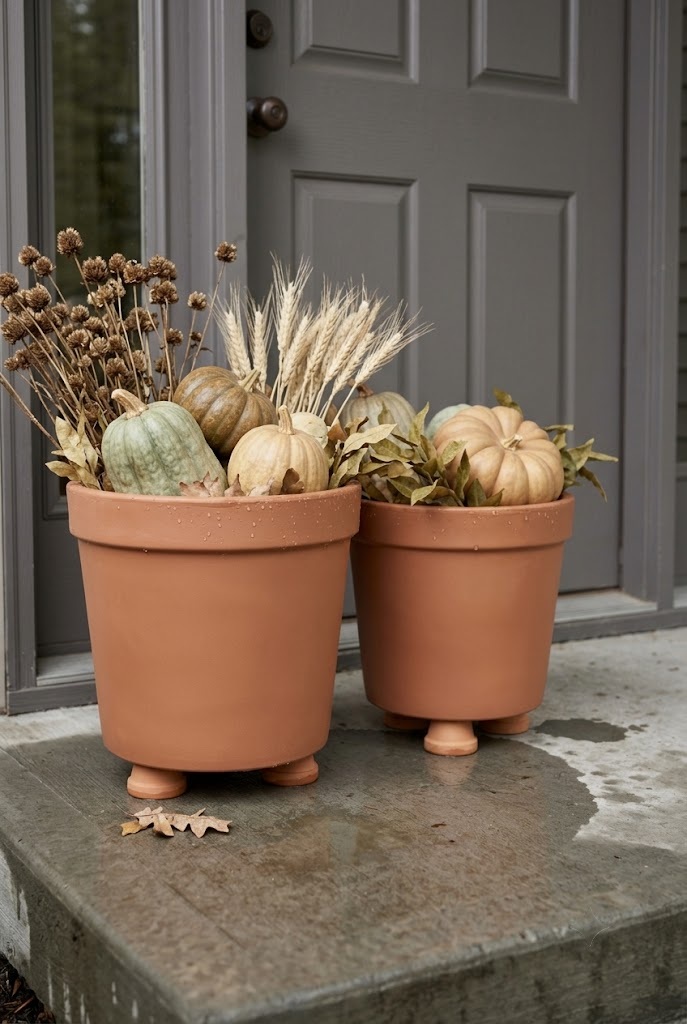
Freeze-thaw cracking is what kills porch planters on an uncovered stoop, and it happens because water sits in the soil and expands, not because the pot was cheap. Fiberglass and thick resin flex enough to survive it; unsealed terracotta and thin ceramic do not. If you want the terracotta look, buy resin with a matte terracotta finish, or seal real terracotta inside and out with a masonry sealer. Either way, raise the pot on feet so the drainage hole never sits in a puddle. A set of three pot feet costs about 8 dollars and saves a 40 dollar planter. Drill a second drainage hole if the pot only came with one.
8. Matte Faux Pumpkins in Three Sizes Instead of Real Ones
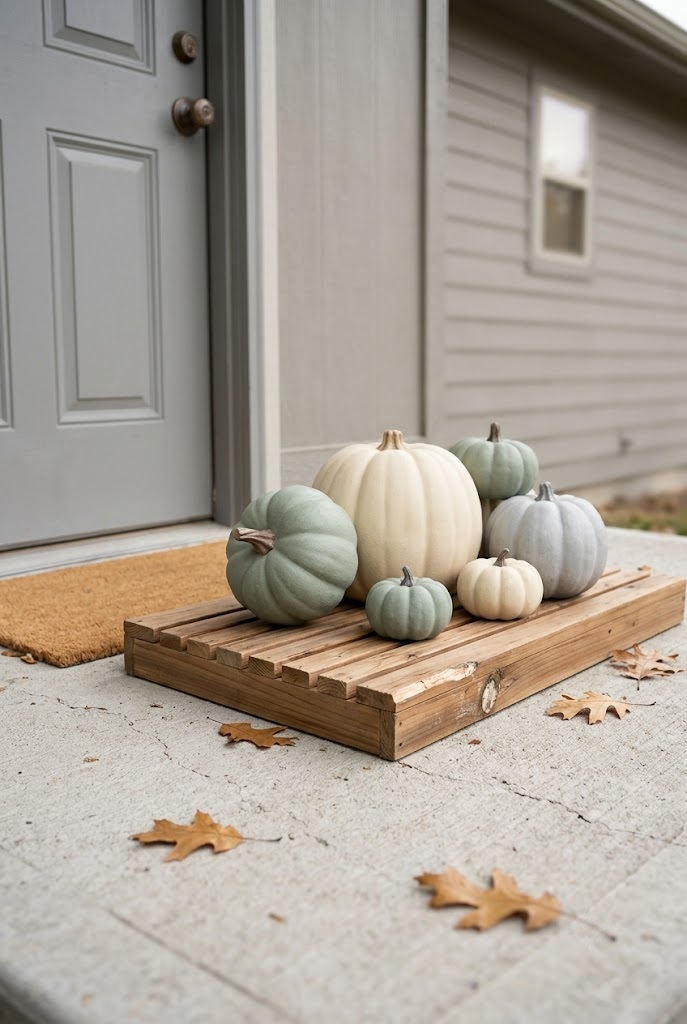
Matte faux pumpkins beat real ones on an exposed pad for one reason: real pumpkins sitting on damp concrete rot from the bottom within two to three weeks. Even uncarved pumpkins go soft where the skin meets the pad, because concrete holds moisture against them. If you want real, set them on a slatted tray or a folded burlap round so air moves underneath, and rotate them a quarter turn weekly. If you want the display to run from Labor Day through Thanksgiving, buy matte-finish faux in a mix of three sizes so the grouping has scale. Glossy faux is the tell that reads as plastic from the sidewalk; matte with slight surface texture does not.
9. A Flat-Weave Poly Rug Under the Mat for Rain Days
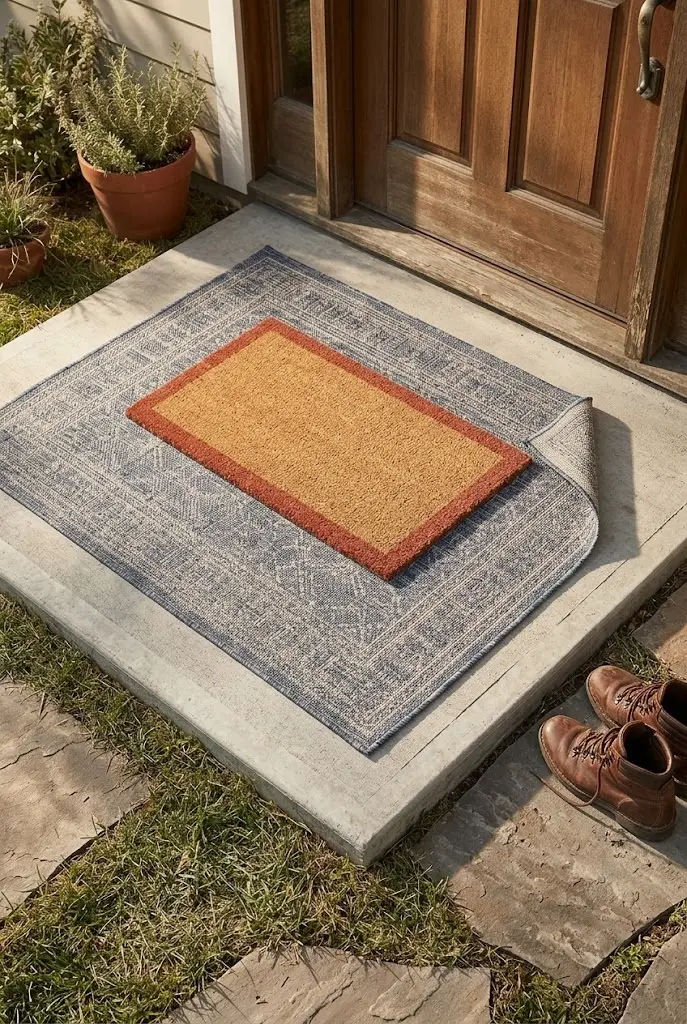
A flat-weave polypropylene outdoor rug under the doormat gives a small pad a defined floor and hides the concrete staining that no pressure washer fully removes. Polypropylene drains and dries in hours, where jute and cotton hold water and grow mildew against concrete. Size it so 4 to 6 inches of bare pad shows on every side, which keeps it from reading as wall-to-wall carpet in a 4 by 4 space. Rugs slide on smooth concrete, so use a rubber-backed pad or run a bead of exterior silicone in a few spots on the underside and let it cure overnight. Lift it after heavy rain so the concrete beneath can actually dry out.
10. Two Battery Timer Lanterns at Different Heights
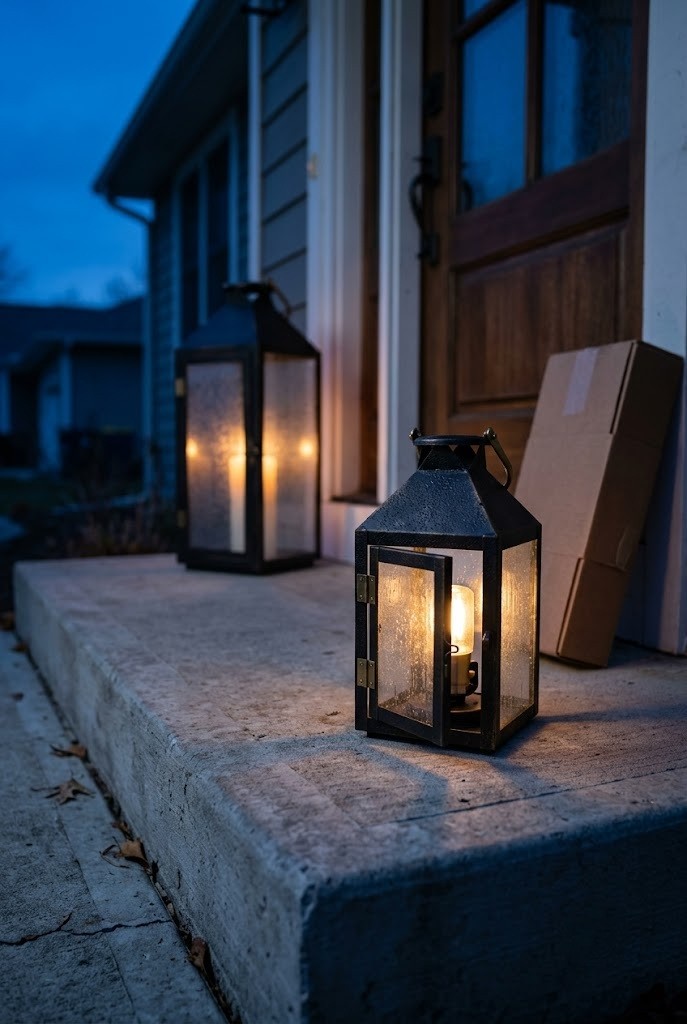
Battery timer lanterns do more for a small stoop after 6pm than any amount of daytime styling, because by late October most arrivals and most package drops happen in the dark. Set them to a 6-hours-on timer so they fire at dusk without you touching anything. Use warm white LED in the 2200 to 2700 kelvin range, since cool white reads as security lighting rather than welcome. The proportion that works on a narrow pad: one taller lantern around 16 to 20 inches, one shorter around 10 to 12, set at different depths instead of side by side. That depth difference is what stops them from looking like a matched pair of bookends.
11. Dried Wheat and Preserved Stems in a Drainage-Hole Urn
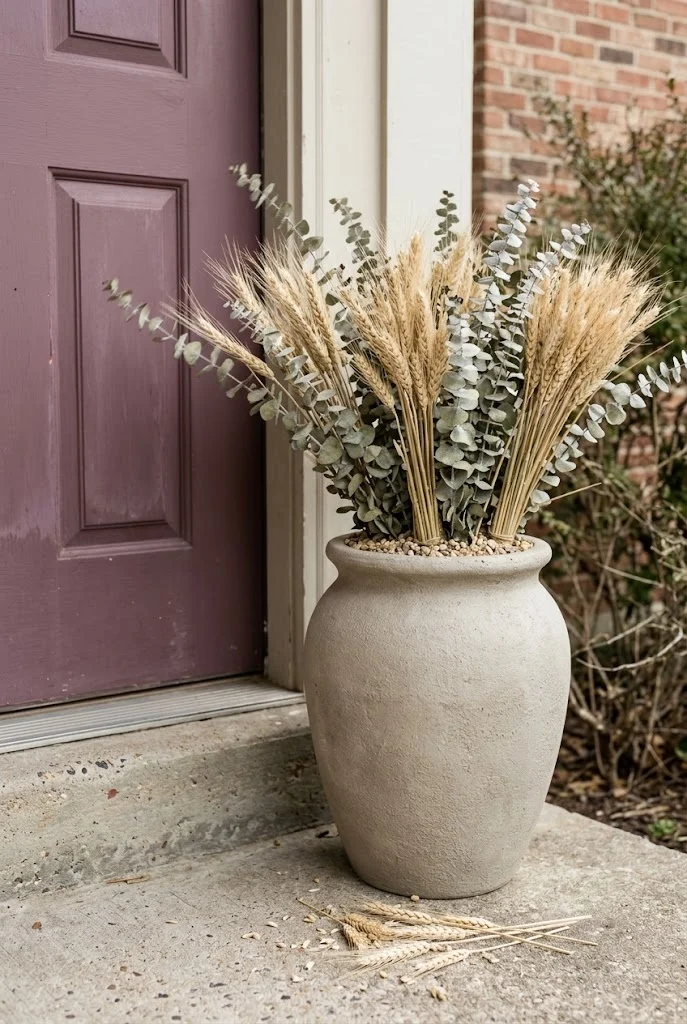
Dried wheat sheaves and preserved stems hold up outdoors far better than fresh florals, but only in a container that actually drains. Wheat goes limp and molds fast if water collects around the stem ends, so use an urn with a drainage hole and pack the base with gravel to hold everything upright. Expect one season out of a wheat bundle on an uncovered pad, since the heads shatter after enough wind. Bittersweet and preserved eucalyptus give you two seasons if you bring them in ahead of a forecast storm. The same matte-versus-glossy logic from idea 8 applies here: dusty, muted stems read real, anything with shine reads synthetic.
12. An Over-Door Wreath Hook Instead of Adhesive Strips
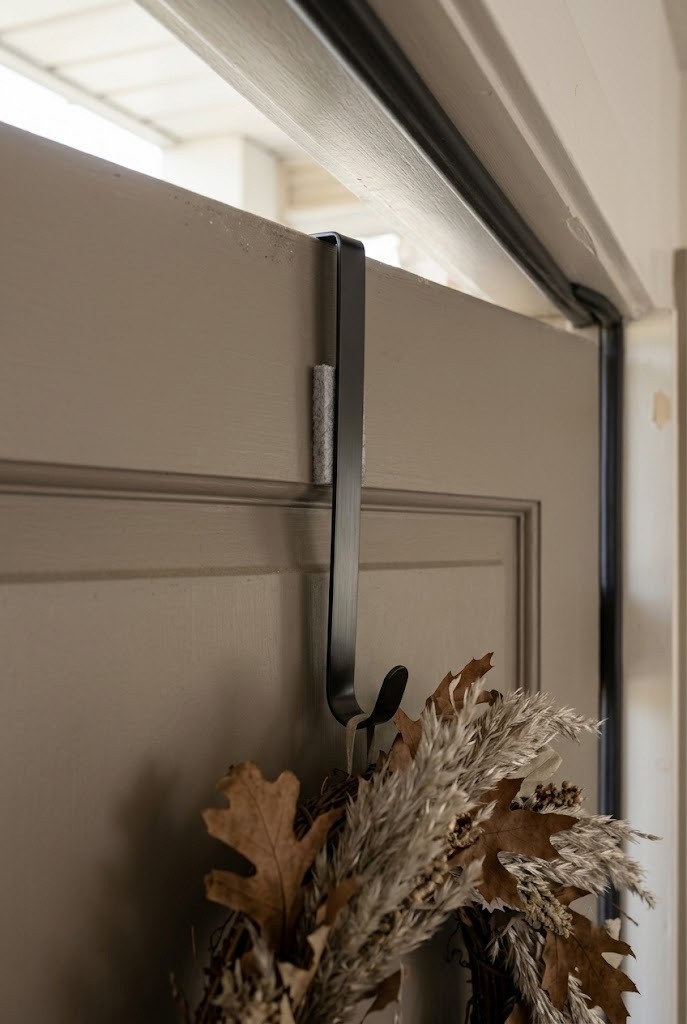
Over-door wreath hooks are the only no-drill mount that reliably holds through fall weather, because they carry the load on the top edge of the door slab rather than on adhesive. Adhesive strips fail on exterior doors once temperatures swing between 40 and 80 degrees in a single day, and they fail worst on textured or painted metal. Choose a hook with a rubber or felt pad on the inside leg so it does not scar the paint, and confirm the door still closes flush before you hang any weight. Standard hooks fit slabs up to about 1.75 inches thick. Storm doors are the catch: if you have one, the hook has to go on the storm door instead.
13. Brick Clip Hangers and Vinyl Siding Hooks for a No-Drill Facade
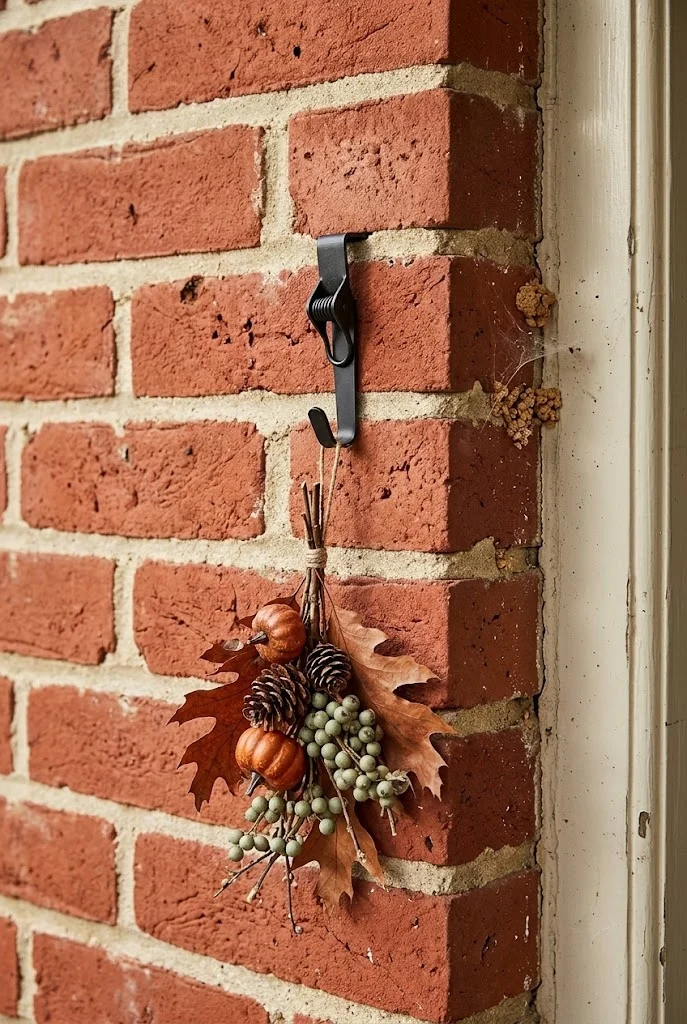
Brick clip hangers grip the lip of a standard brick course with spring tension and hold 25 to 30 pounds without a single hole. They only work on brick roughly 2.25 inches thick with visible mortar joints, so check yours before buying, because painted brick and thin brick veneer often fail the fit. Vinyl siding has its own version, a hook that slips into the horizontal seam between courses and locks in place. Both cost about 8 to 15 dollars a pack. Stucco and fiber cement have no equivalent, and those are the facades where a freestanding solution beats anything wall-mounted. Never put masonry screws in an HOA-governed townhouse facade without written approval.
14. Sand-Weighted Container Bases Hidden Under Sheet Moss
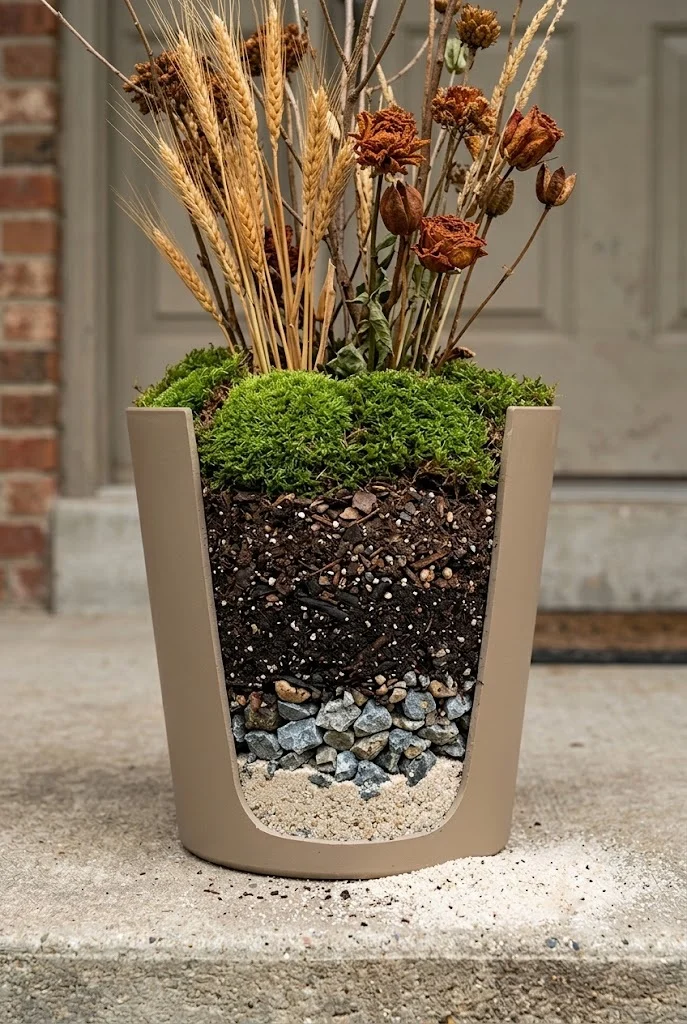
Weight low and hidden is the rule that keeps a no-railing stoop intact through October wind. Fill the bottom quarter of every container with paver sand or pea gravel, then add a layer of packing peanuts or an upturned nursery pot as filler, then soil or faux stems on top. Roughly 25 percent weight, 60 percent filler, 15 percent visible material is the ratio I settled on after three seasons of cleanup. Cover the soil line with sheet moss so nothing reads as filler from above. The weighted planters in idea 2 use exactly this build. Swap the moss for dark bark chips and the same grouping reads woodland instead of farmhouse.
15. A Wooden Ladder Leaned at Fifteen Degrees Against the Wall
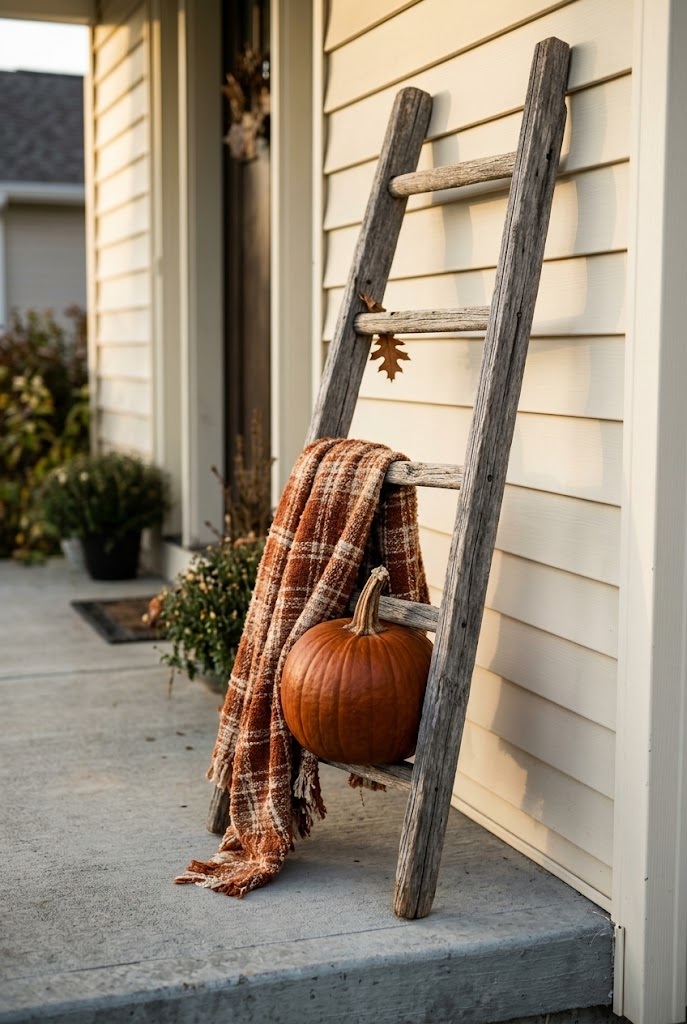
Leaning a wooden ladder against the wall gives vertical interest on a stoop where you cannot hang anything, and the lean angle is what decides whether it stays up. Fifteen degrees off vertical is the working number: steeper and it slides on smooth concrete, shallower and it eats floor depth you do not have. Set the feet on rubber pads and load weight onto the bottom rung, a heavy pumpkin or a filled planter, so the whole thing is bottom-heavy. Do not hang a wreath from the top rung on an uncovered pad, because wind catching the wreath turns the ladder into a lever. Decorate the lower two rungs and leave the top bare.
16. One Oversized Weighted Pumpkin at the Base of the Door Frame
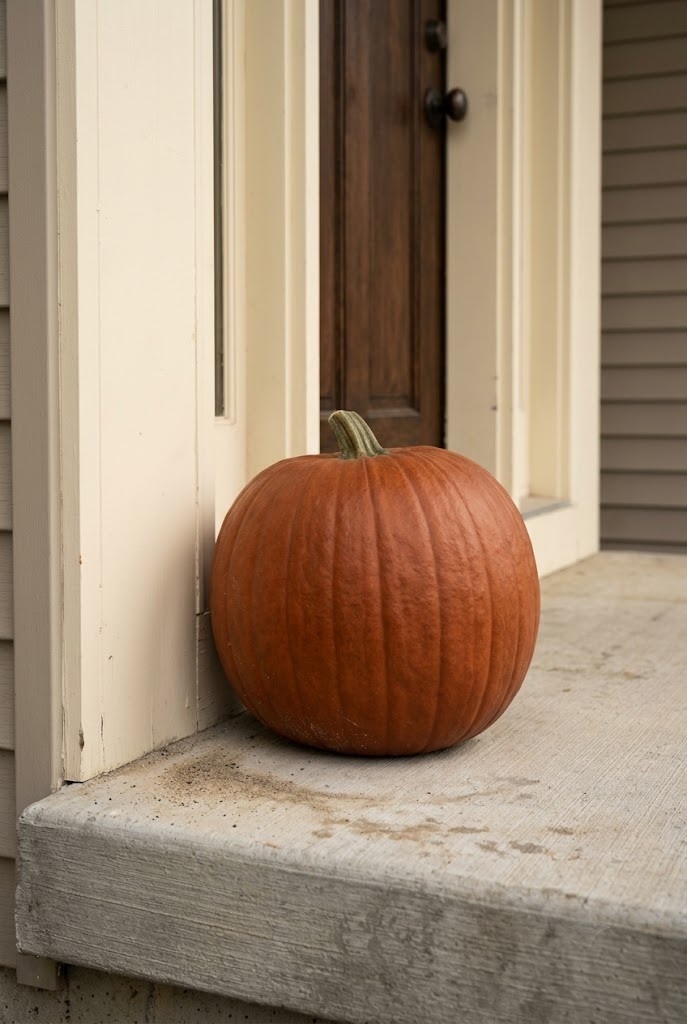
A single large weighted pumpkin at the base of the door frame is the lowest-maintenance fall marker there is, and on a stoop with nothing to attach to it may be the only piece that never moves. Go for a faux pumpkin with a sand-fillable base, or weight a real one by setting it on a wide flat tray so it cannot roll. Sizes around 12 to 14 inches across read clearly from the street; anything smaller disappears against the concrete. Upkeep is a damp wipe every few weeks, because road grit settles fast on horizontal surfaces at ground level. Cream and buff faux pumpkins show that grit far more than dark ones.
17. A Single Narrow Trough Planter Pushed Against the Wall
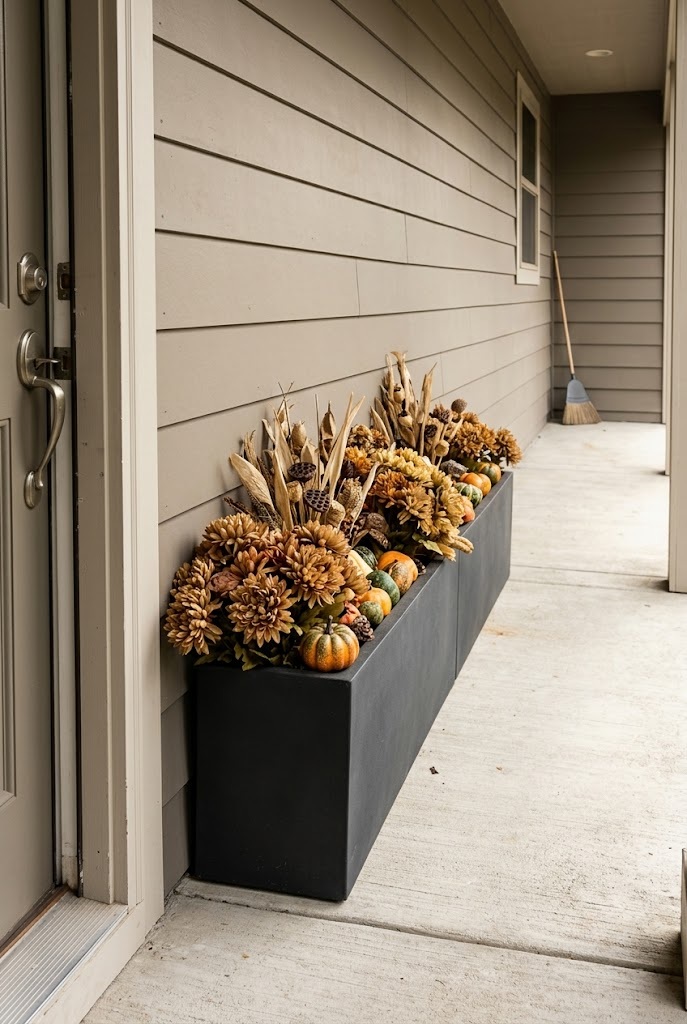
One rectangular trough planter against the wall solves an ultra-narrow pad better than two round pots, because it uses length instead of depth. Look for a lightweight planter around 24 to 30 inches long and no more than 8 inches deep front to back, in resin or fiberglass so you can still lift it once filled. Set it on the hinge side of the door where the swing never reaches. Fill it with faux mums, dried stems and a few small gourds packed tight so nothing rattles loose in wind. Measure your actual walking path before buying: you need 32 inches of clear passage minimum, and 36 if anyone uses a stroller or a walker.
18. Flat-Back Half Planters That Sit Tight to the Siding
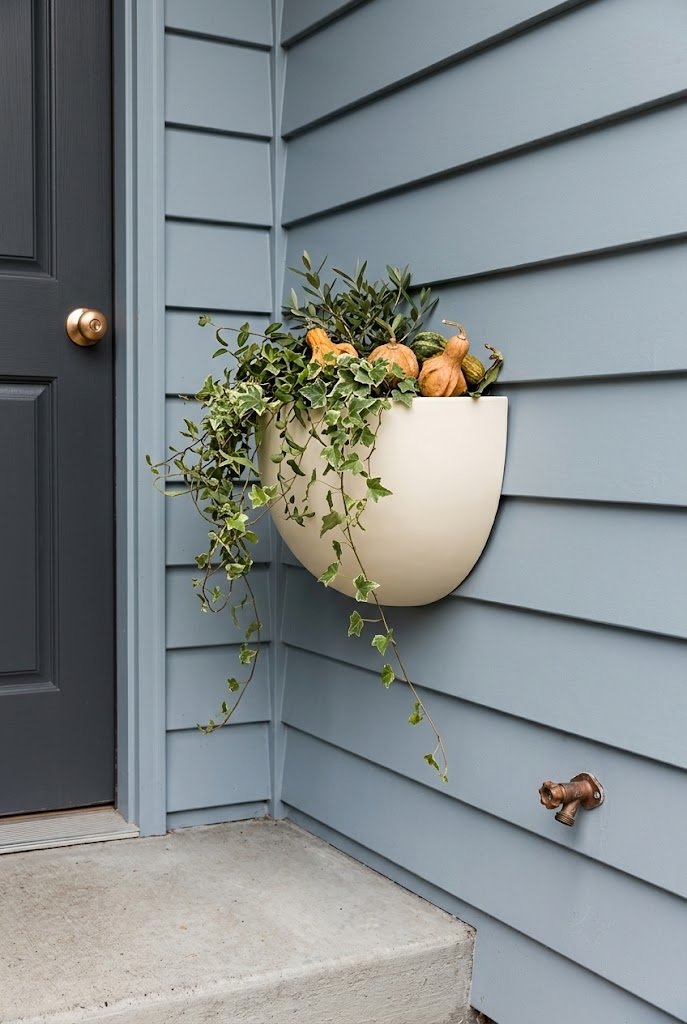
Flat-back half planters sit within about 6 inches of the wall and give you the mass of a full pot at half the footprint, which matters when the pad is barely deep enough for the door to open. They run roughly 20 to 35 dollars each in resin. Cheaper swap: cut a standard round nursery pot in half, cable-tie it to a scrap board, and paint the whole thing with exterior masonry paint for under 10 dollars. Either version needs a quarter inch spacer behind it, otherwise moisture gets trapped against the siding and stains it. Pair one with the trough from idea 17 rather than duplicating the same shape twice.
19. A Vertical Wall Basket Hung Above the Doormat Line
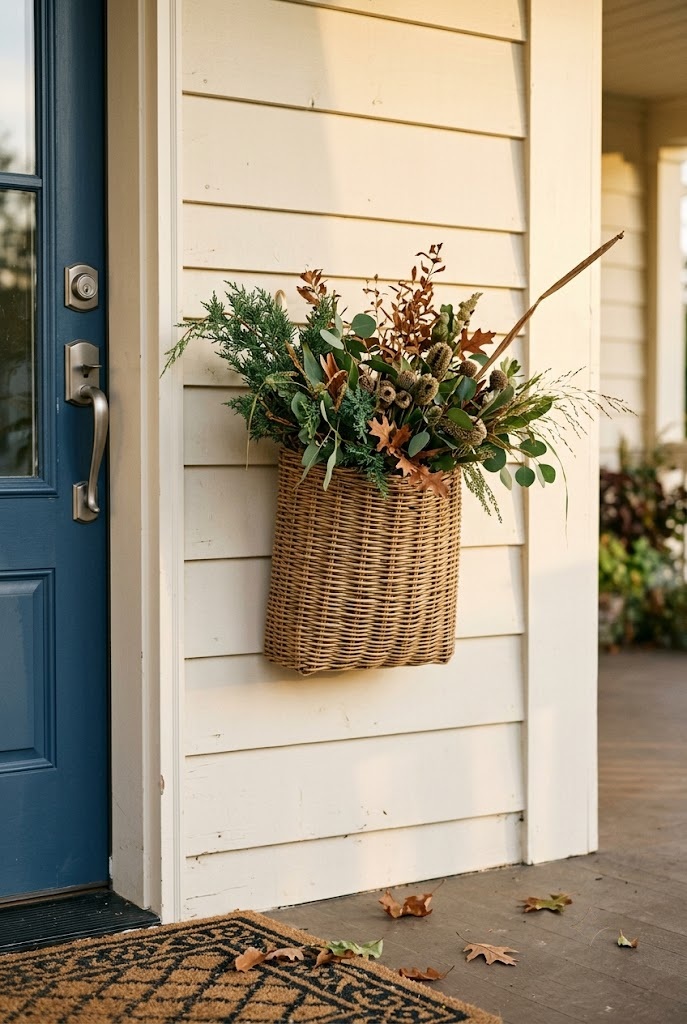
Going vertical is how a narrow stoop gets real fall decor without giving up floor, and a flat-back wall basket above the doormat line is the cleanest way to do it. Mount it so the bottom of the basket sits at least 48 inches off the pad, well above head clearance for anyone bending to pick up a package. Fill it about 70 percent structural greenery, 20 percent seasonal stems and 10 percent something with a hard edge like a small gourd or a dried lotus pod. Let roughly a third of the material spill down past the rim so it does not read as a box screwed to the wall.
20. A Corner Triangle Stack in the Dead Space Beside the Door
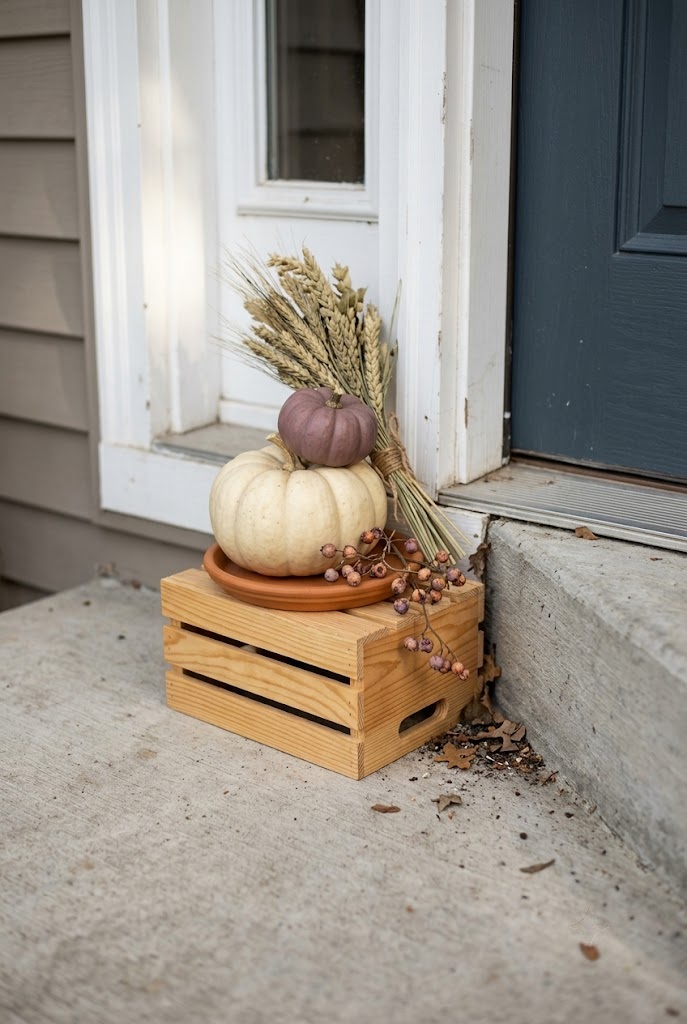
The dead triangle between the door frame and the outer corner of the pad is usually the only truly unused space on a narrow stoop, and it takes a stacked arrangement well. Build it with a footprint no wider than about 14 inches on each side so it stays inside the corner rather than creeping into the walking path. The common failure is stacking loose items that shift: set every piece so it rests on a flat surface rather than on a curve, and put a dot of removable outdoor mounting putty between layers. Anything that wobbles when you nudge it with your foot will be on the lawn by the second windy night.
21. Warm White Light Running During Daylight on a North-Facing Pad
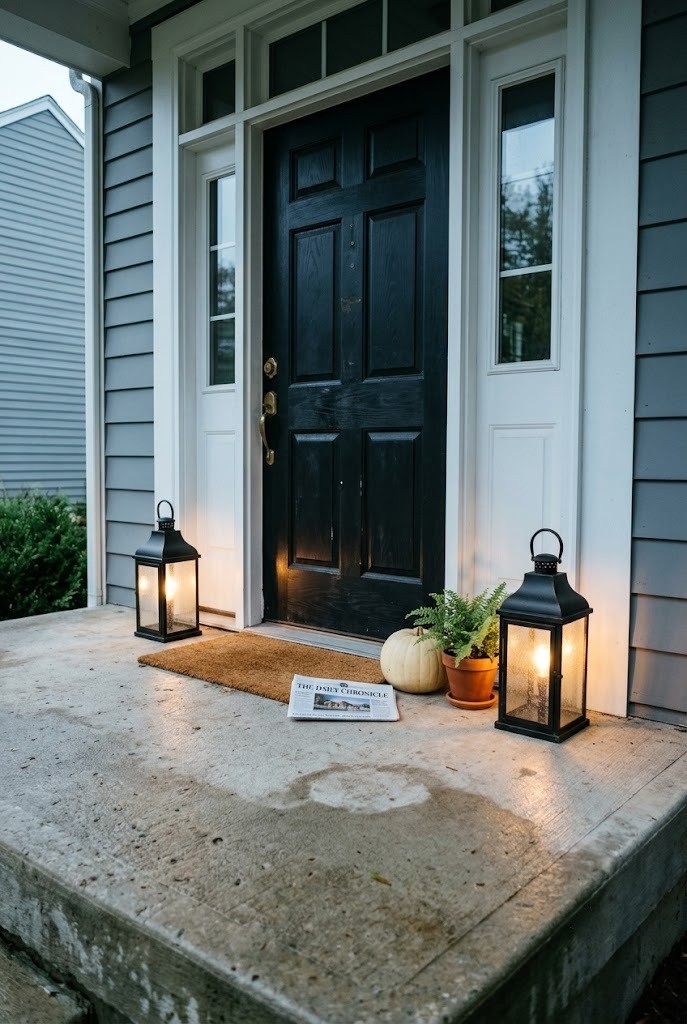
North-facing stoops get flat, blue-tinted light all day, which drains the warmth out of oranges and makes browns look muddy from the street. Warm light is the correction, and it works during daylight hours too, not just after dark. Run lanterns or a warm white string on a timer through the afternoon as well as the evening. Against a black front door the effect reads stronger, because the dark slab absorbs what little ambient light there is and the warm points stand out clearly. Shade also means slower drying, so wipe condensation off lantern glass weekly or it clouds permanently, and check battery contacts monthly for corrosion.
22. Cream, Buff and Rust Instead of Deep Burgundy in Low Light
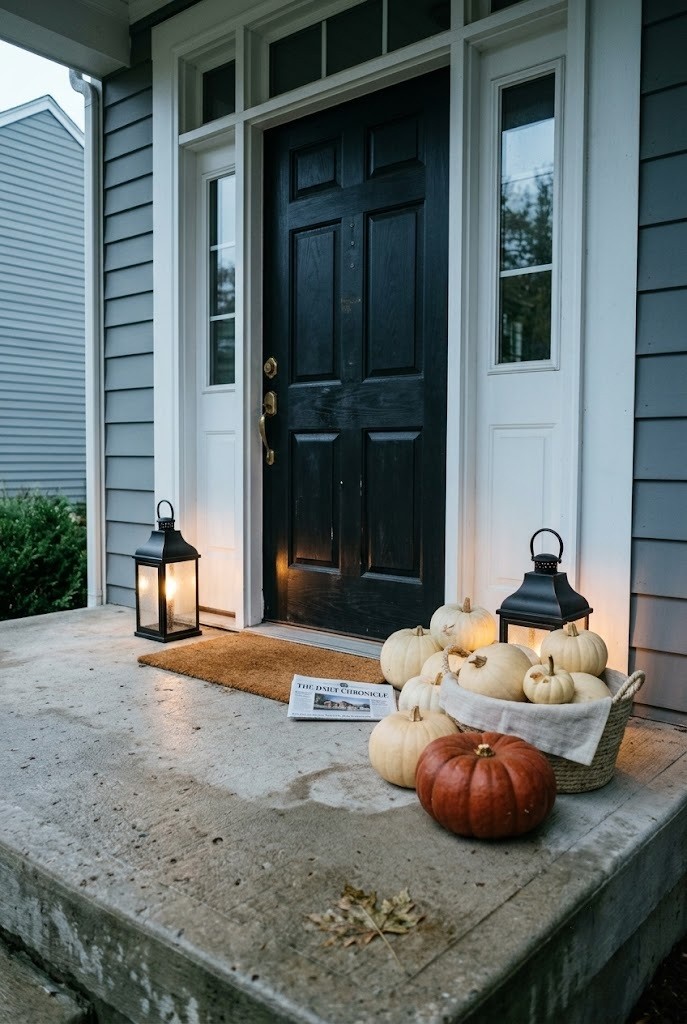
Light warm colors carry in shade where saturated ones die: cream, buff, rust and warm ochre stay readable on a north-facing pad, while deep burgundy and eggplant collapse into dark blobs seen from the sidewalk. Build the grouping around the palest material first and let one or two rust pieces do all the accent work. A brown and cream base with a single rust element is the safest version of this in low light, and the easiest to keep looking intentional. Apply it to the three-height cluster in idea 5 by swapping the darkest piece for the palest one, and the whole arrangement gains apparent brightness without adding a single light.
23. Slatted Base Trays Under Every Container to Stop Green Film
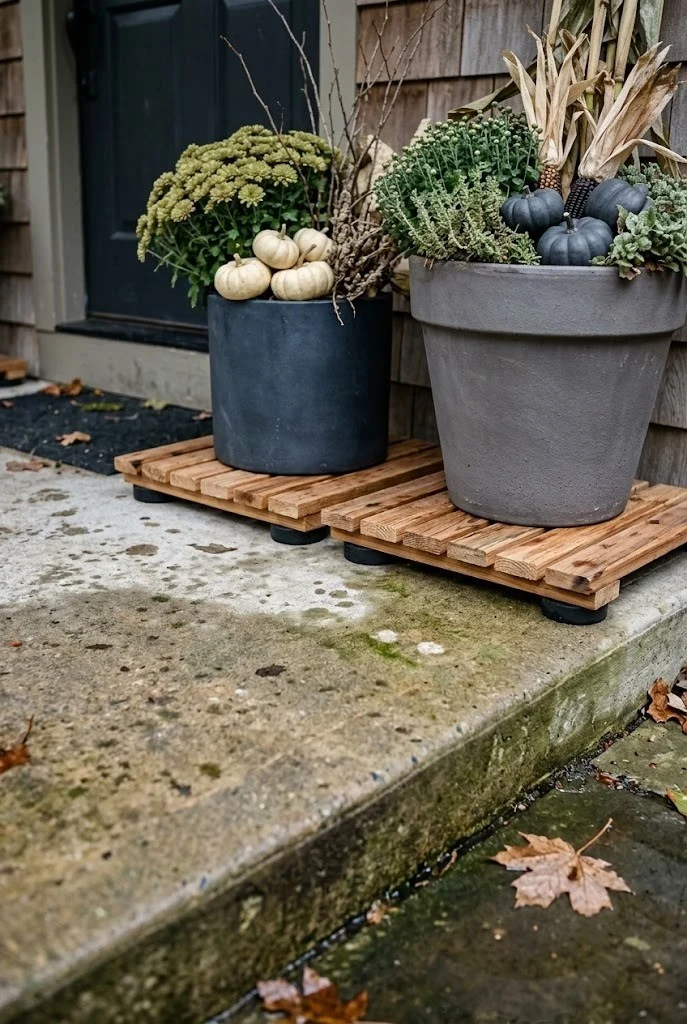
Shaded concrete stays damp, and damp concrete grows a green film under anything that sits on it for six weeks. Slatted or footed trays break that contact and let air move underneath, which is the whole fix. Cedar slat trays run about 15 to 25 dollars each; the cheaper route is a set of rubber pot feet at roughly 8 dollars for three, or three flat stones from the yard for nothing. Whatever you use, lift each piece and sweep under it every two or three weeks. Green film left to set becomes a genuine slip hazard on a wet pad, and then it needs an oxygen bleach scrub rather than a rinse.
24. UV-Treated Faux Boxwood and Magnolia That Will Not Yellow in Shade
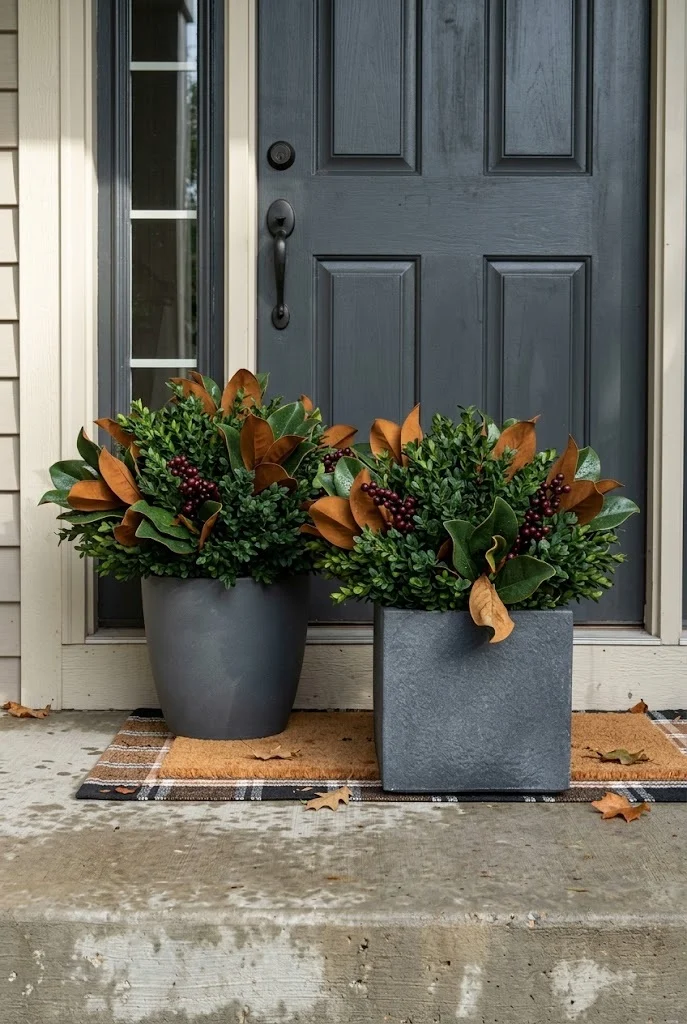
Faux greenery in shade has an enemy that faux greenery in sun does not: it does not fade, it yellows, because damp and low light let a surface film build on the leaves. Choose UV-treated polyethylene in deep green rather than the bright spring greens that go sallow fastest, and rinse the whole thing with a hose every few weeks. A mix that works is 60 percent boxwood or cedar for structure, 30 percent magnolia leaf for the brown reverse side that reads as fall, and 10 percent berries or seed pods. The matte-finish rule from idea 8 holds here too.
Final Thoughts
The pattern across all 24 is the same: weight low, mount without holes, and go vertical instead of wide. A stoop with no steps and no railing is not a small version of a real porch, it is a different problem, and it rewards decisions about drainage, wind and mounting far more than decisions about color. Start with the mat and two weighted planters, then add height only after those two have held through the first storm week. Pin this to your fall board so it is there when you start pulling bins out of the closet.
Frequently Asked Questions
how do i decorate a front porch with no steps or railing?
Anchor everything to the wall and the door instead of the floor. Use an over-door hook for the wreath, weighted planters pushed tight against the siding, and a mat sized to the pad rather than to the door. Height comes from stacked crates or a leaned ladder, not from tiered steps. Keep 32 inches of walking path clear.
will fall decor survive on an uncovered porch in the rain?
Faux and preserved material will, fresh will not. Real pumpkins on damp concrete soften within two to three weeks, fresh mums need daily water, and dried wheat molds if its container holds water. Use matte faux pumpkins, UV-treated foliage and a drainage hole in every pot, and lift the mat after heavy rain so the pad dries.
how do i hang a wreath on brick without drilling?
Use a brick clip hanger, which grips the lip of a brick course with spring tension and holds 25 to 30 pounds. It needs brick around 2.25 inches thick with open mortar joints, so painted brick and thin veneer often will not take it. On vinyl siding, use a siding hook that slips into the horizontal seam.
how much space do i actually need for a fall porch display?
About 12 to 18 inches of depth along the wall is enough if you build upward instead of outward. Keep at least 32 inches of clear walking path and 2 inches under the door swing. The same weighting logic works on an apartment balcony, where floor space is tighter and the wind is usually stronger.