Peg rail entryway ideas usually stop at the build — cut the board, space the pegs, screw it up — and leave you staring at a bare rail with no clue what goes on it. This one picks up where those tutorials quit: what to actually hang, how to style a rail so it reads designed instead of dumped-on, and how the layout shifts by wall length. I planned these for a narrow hallway, where a bench blocks the door, so every idea is wall-only. There's a buy-don't-build path too, and a renter section for walls with no studs. If your entry has no closet to fall back on, a rail is the only storage that fits. Save this to Pinterest so it's here when your coats pile up.
1. A Single Shaker Peg Rail Mounted Above Coat Height
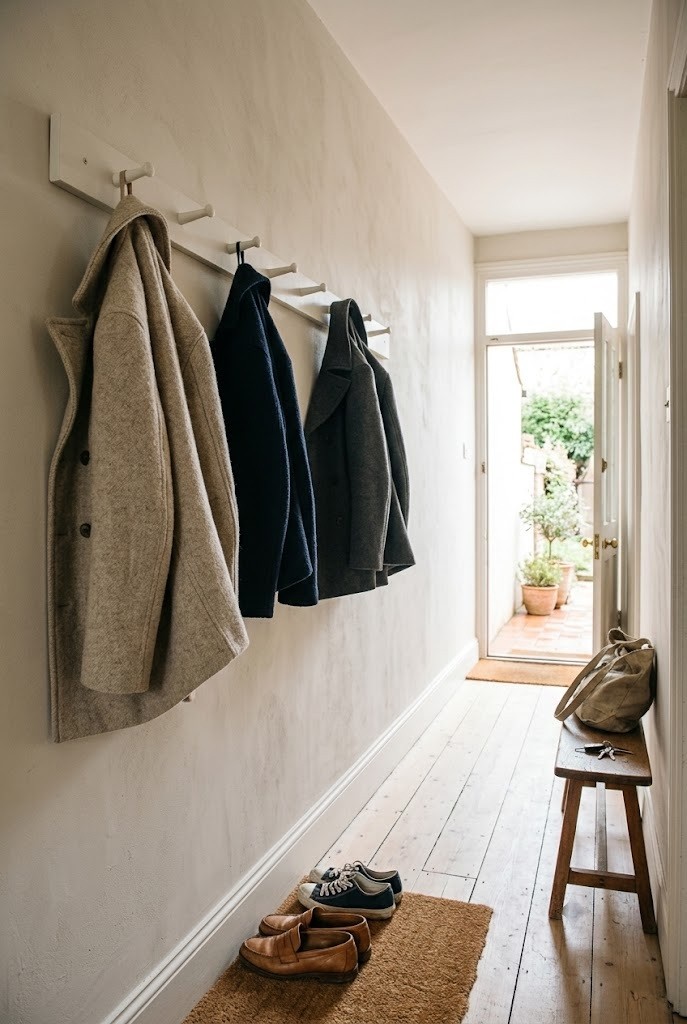
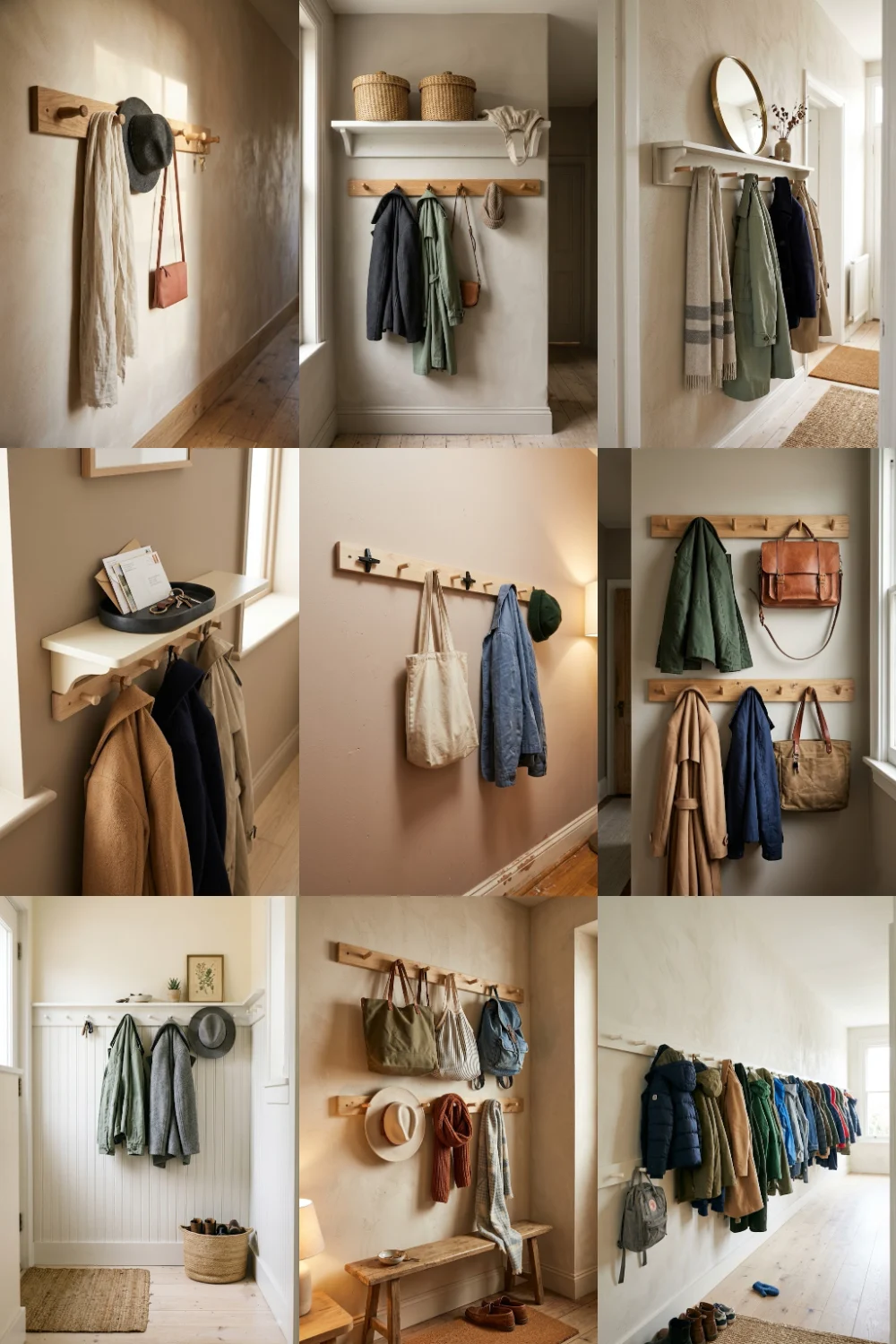
A single Shaker peg rail set about 66 to 68 inches off the floor gives a narrow hallway full coat storage while keeping the whole wall below it clear for a slim tray or nothing at all. Mounting it high matters more than people expect: hang a rail at shoulder height in a 36-inch corridor and every coat becomes something you brush past sideways. Up high, the coats hang above the traffic zone and the wall reads calm instead of crowded. Screw into at least two studs, or into solid blocking, because a loaded rail pulls hard once four wet coats land on it. Keep the pegs to four or five so you're never tempted to double-hang.
2. One Rail, Three Things: The Under-Filled Look That Reads Designed
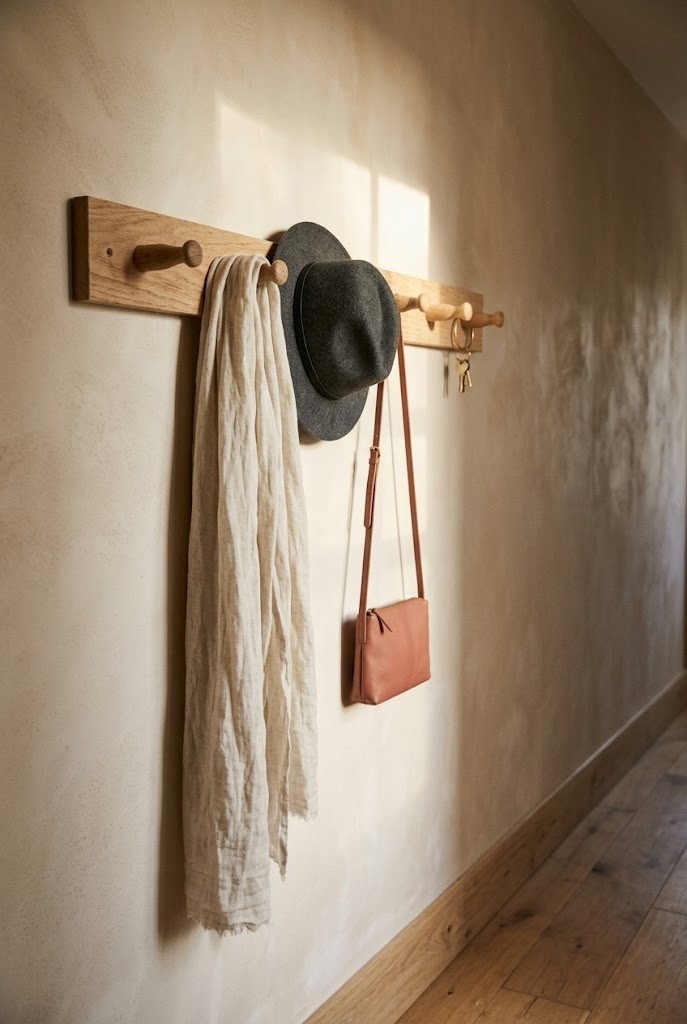
Hanging three well-chosen items on a five-peg rail looks more intentional than filling every peg, because negative space is what separates a styled rail from a coat pile. Pick one soft item like a scarf or a canvas tote, one structured item like a felt hat or a small crossbody, and leave two pegs bare or holding a single ring of keys. The eye needs the gaps to register the rail as a decision rather than a dumping ground. This is the opposite instinct from idea 16's full-wall run, where volume is the point. In a tight entry, restraint does the styling work for you, and it costs nothing to try both ways before you commit.
3. A Rail With Two Woven Baskets Hung for Keys, Mail, and Gloves
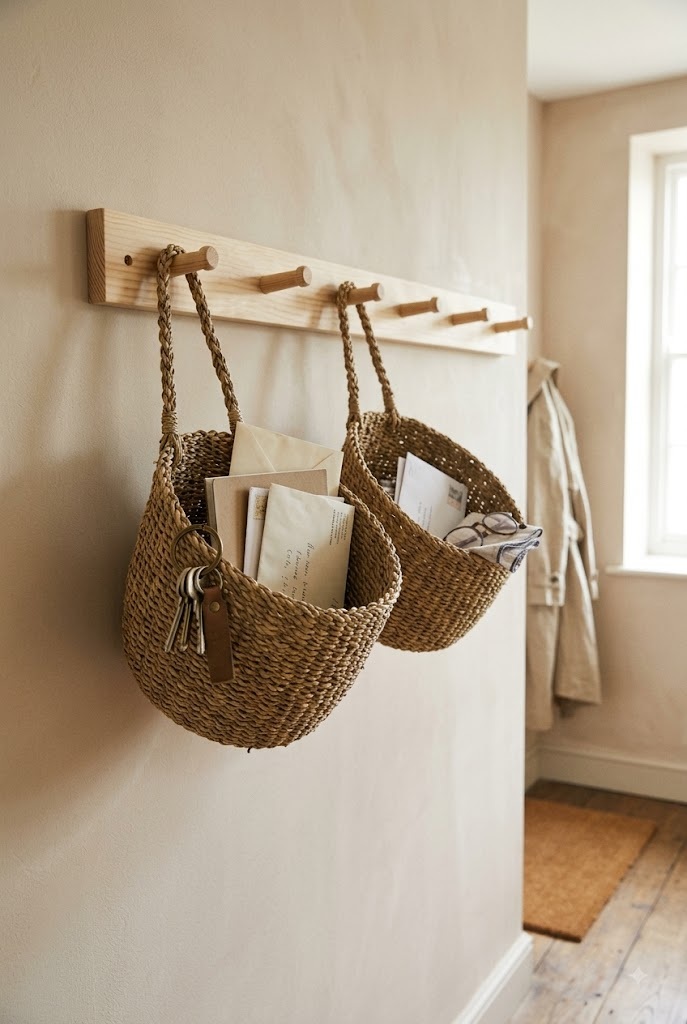
Two shallow woven baskets hung straight off the pegs turn a coat rail into the small-stuff catch-all a narrow entry usually lacks, no shelf required. The trick is weight and depth: choose shallow baskets with sturdy handle loops, because a deep basket loaded with mail levers the whole rail away from the wall. Woven bins or hanging pocket baskets that sit flat against the board work best; keys and gloves go in one, outgoing mail and sunglasses in the other. Look for baskets with a flat back rather than a rounded belly so they don't push coats off the neighboring pegs. This solves the same clutter problem as a console table, minus the 12 inches of floor a console would eat.
4. A Rail Painted the Same Color as the Trim So It Disappears
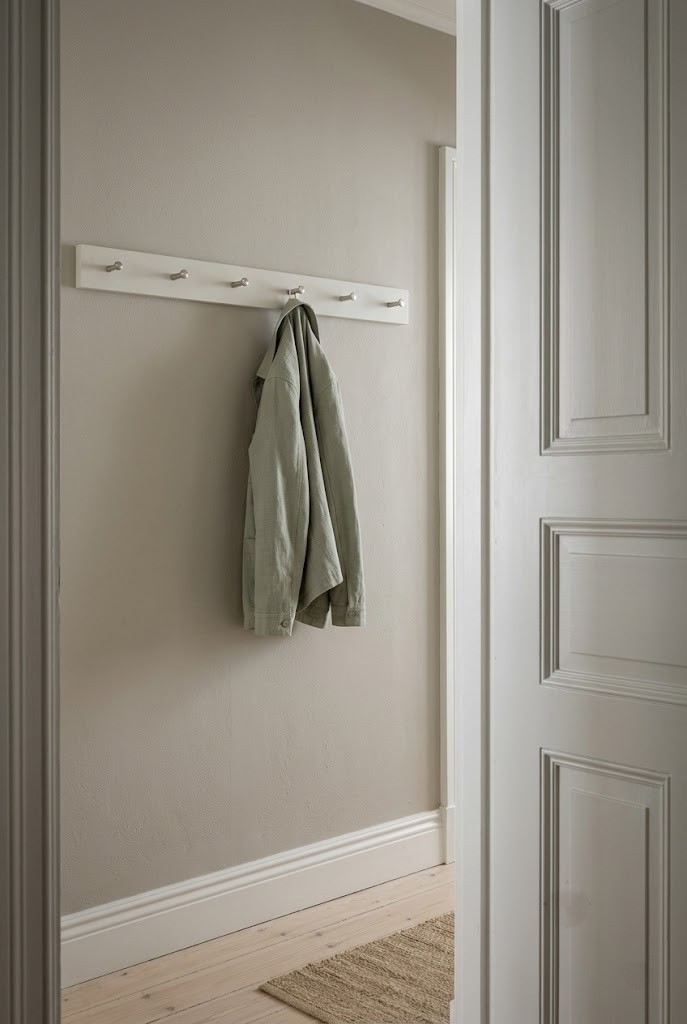
Painted the exact color of your baseboards and door casing, the peg rail reads as built-in architecture rather than an added object, which visually widens a cramped hallway. Match the trim's sheen too, usually a satin or semi-gloss, so light hits the rail and the woodwork the same way and the eye glides past. This is the move when the wall is already busy with a door, a light switch, and a thermostat; a contrasting rail would add one more thing to look at. White-on-white is the classic disappearing act, but a deep trim color like blackened green works if your casing is already dark. Prime bare wood first, or the pegs will drink the paint unevenly and the match won't hold.
5. A No-Stud Rail Mounted on Drywall Anchors for Renters
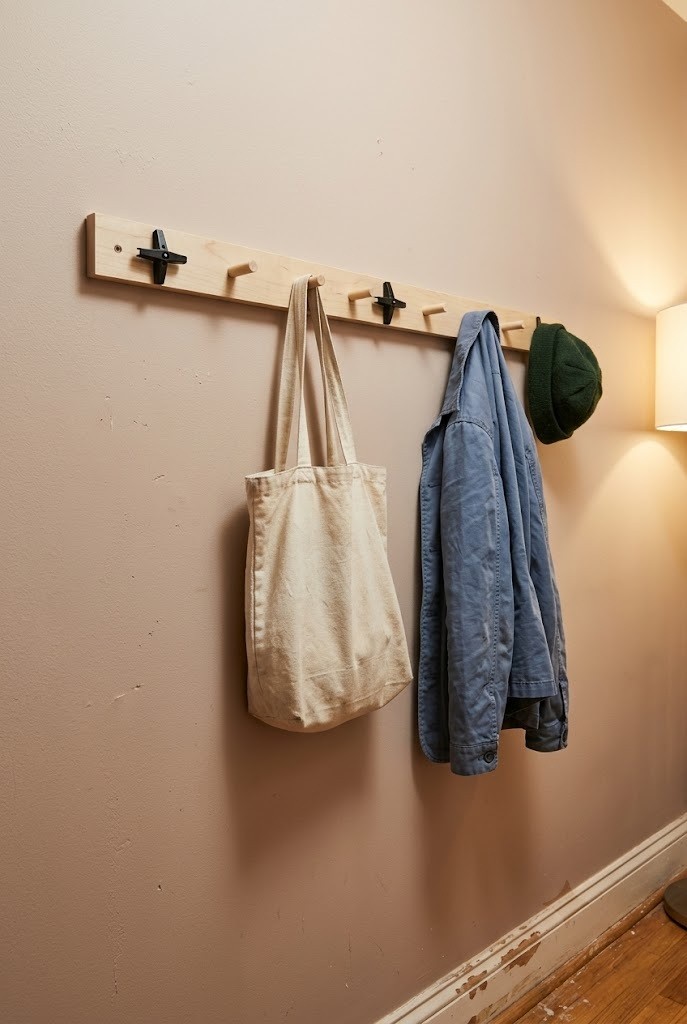
Mounting a peg rail into drywall anchors, not studs, is what makes this work in a rental where the studs never land where you need them, and it holds far more than people fear when you match the anchor to the load. Use rated toggle or self-drilling anchors every 12 to 16 inches along the board and you can safely hang everyday coats; just keep heavy wet winter parkas off a two-anchor rail. Spread the load across four anchors on a 3-foot rail and the weight stops being a gamble. This pairs with the renter thinking in idea 10. When you move out, the anchor holes are small and spackle-and-paint in ten minutes, unlike the crater a floating shelf bracket leaves.
6. A Stacked Double Rail With a Low Row Kids Can Reach
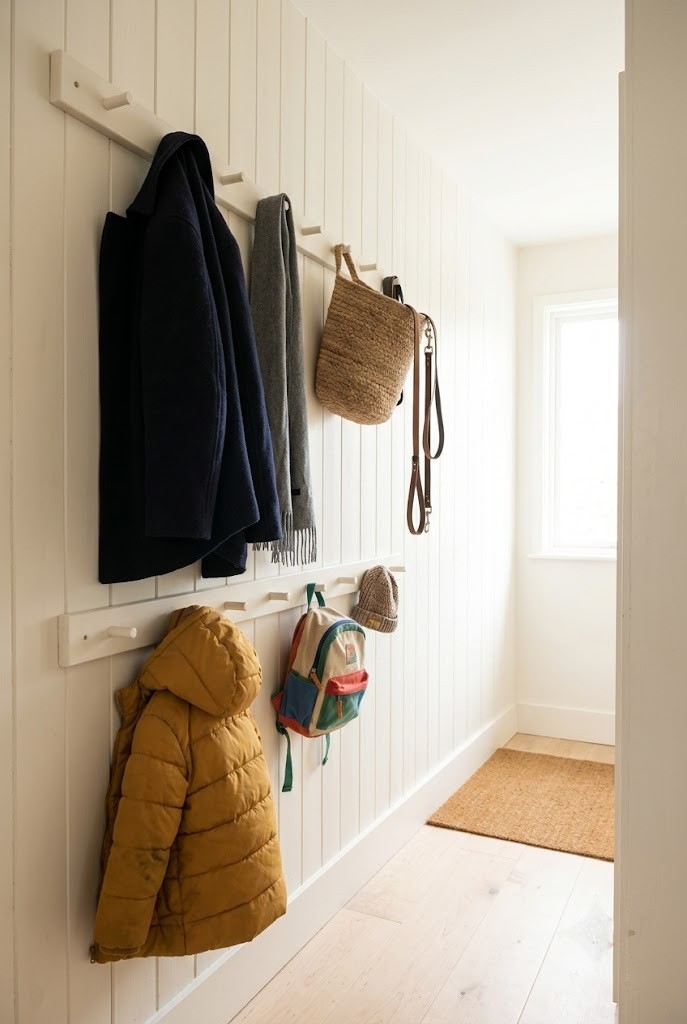
Two stacked peg rails, one at adult height and a second around 40 inches for kids, double the storage on the same slim strip of wall and finally get children hanging their own coats. The lower rail lives below the adult coats, so nothing collides as long as you leave about 20 inches of vertical gap between the two boards. Keep the kid row to three or four pegs; more just invites a floor pile when small coats slide off. The lower rail also doubles as the spot for dog leashes and reusable bags, everything you want grabbable without reaching. Set the kid rail where your child's own arm reaches comfortably, not at a round number, or it won't get used.
7. A Double Rail Split So Each Person Gets Their Own Row
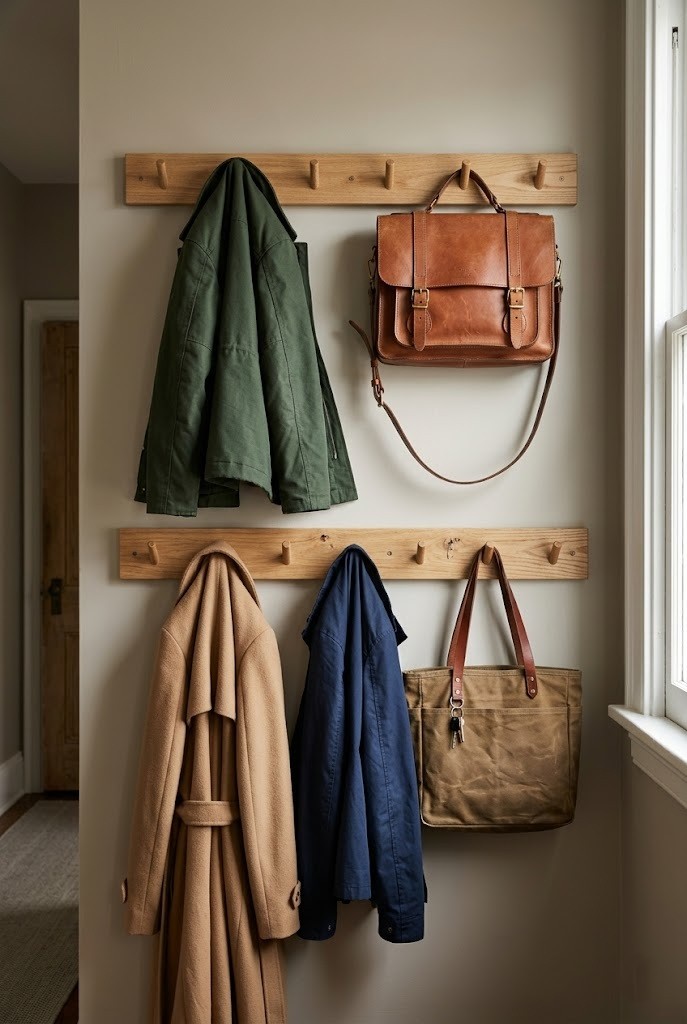
Vertical zoning, one rail per person, kills the daily fight over pegs in a two-adult entry where four coats used to compete for three hooks. It works better than side-by-side in a narrow hall because you're not asking two people to reach across each other in a 36-inch space. Give each rail four pegs and a clear rule: coats and one bag per person, overflow goes to the closet. The most common failure here is uneven load, one person's row jammed and the other bare, which makes the wall look lopsided. A quick weekly reset keeps both rows honest and the wall balanced.
8. A Double Rail Where the Top Row Holds Off-Season Gear
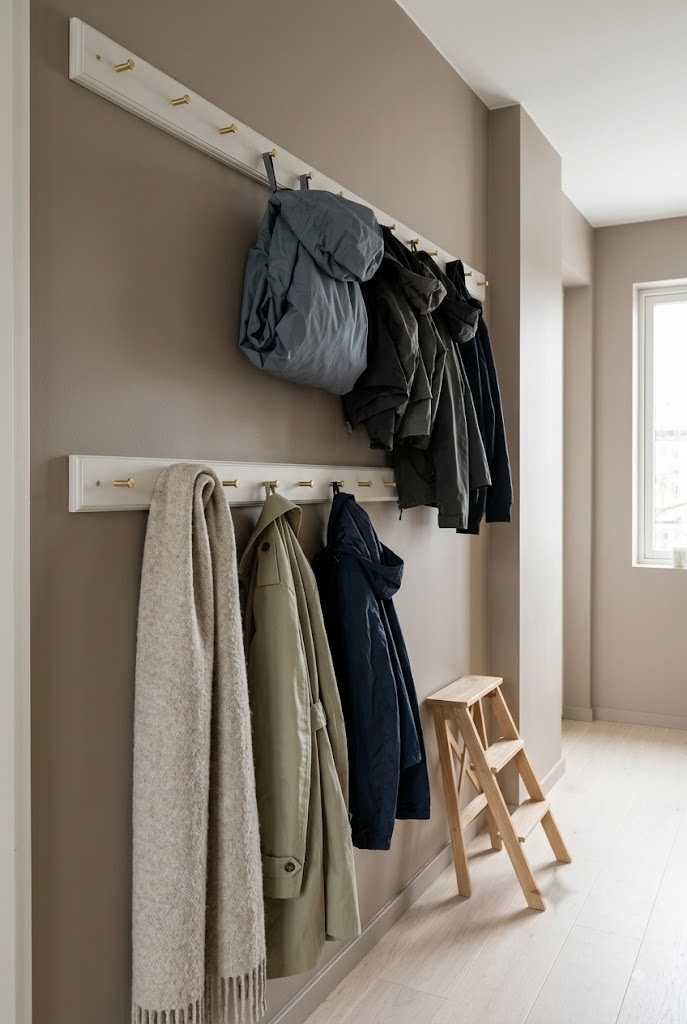
Using the harder-to-reach top rail for out-of-season items keeps the grab-height bottom rail clear for whatever you actually wear this week. In summer the top holds a light rain shell and a spare tote; when the weather turns you swap them down and send the sun hats up. The rail earns its keep once the coats get heavier and the entry works hardest. Rotating by season means the rail never carries more than the current weather demands, which is the real reason narrow entries feel cluttered, since they store twelve months of stuff in a two-week space. Keep a small step stool nearby if your top rail sits above 68 inches. This is the working version of the seasonal thinking behind idea 12, just applied to a two-rail stack instead of a shelf.
9. A Double Rail Zoned by Item Type, Not by Person
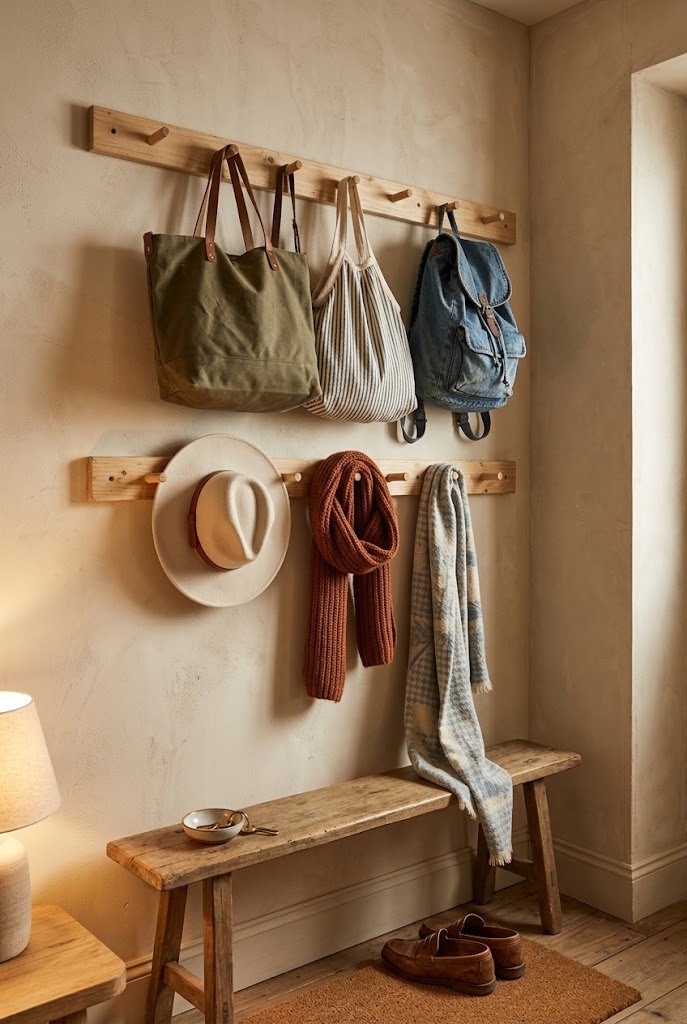
Zone the rail by item type instead of by person, bags up top and hats and scarves below, and every category gets a home, which is what stops a shared entry from sliding back into chaos. Bags are heavier and taller, so they belong up top where they hang clear of the floor; soft accessories sit low where a knocked-off scarf lands harmlessly. Keep like with like and the wall stays legible at a glance, so you know instantly where the reusable totes live. Wool and felt on the lower rail will collect dust and pet hair in a hallway, so this zone needs the most upkeep and the least fussy accessories. Let the grouping itself tell everyone where things go.
10. A Stacked Rail Tucked Into a Stairwell's Dead Wall
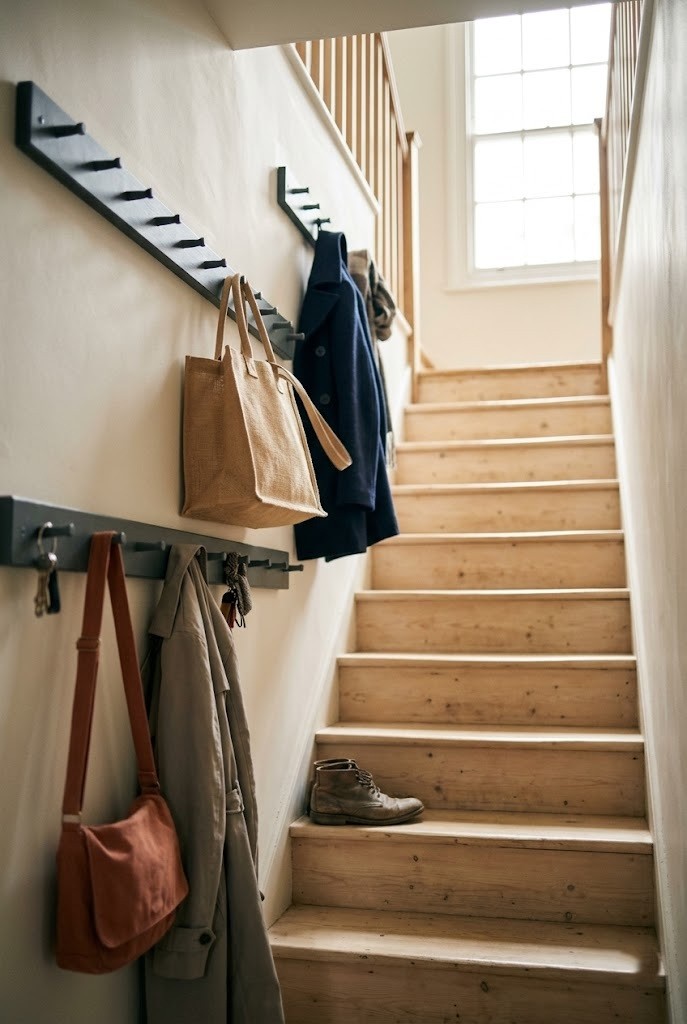
Fitting a double rail onto the blank wall beside a staircase turns genuinely dead square footage into coat storage without stealing an inch from the walkway. Stair walls are usually too short or oddly angled for furniture, which is exactly why a wall-mounted rail wins there. Follow the stair's rise with the lower rail if the wall slopes, stepping each rail to stay parallel with the treads for a deliberate look. Watch head clearance on the descending side so nobody clips a hung bag on the way down. This is about claiming space most people write off, so keep the palette tight and the busy stair zone won't get busier.
11. A Rail With a 6-Inch Shelf Above for Lidded Baskets
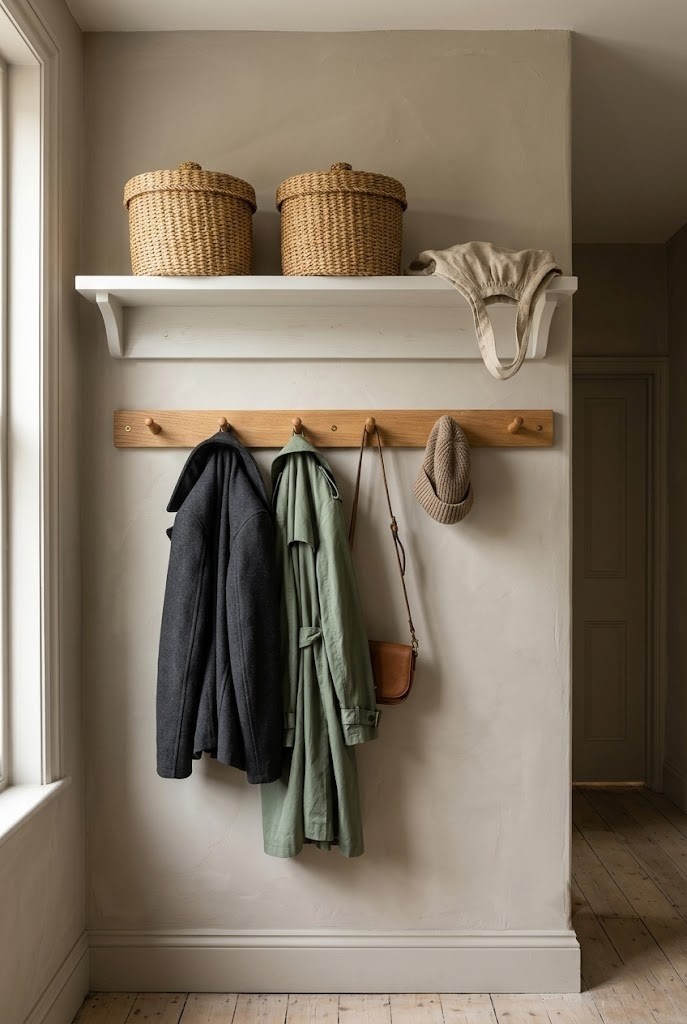
Adding a shallow 5- to 6-inch-deep shelf above the peg rail creates a second storage tier for woven baskets while keeping the whole assembly tight to the wall in a narrow hall. The shelf holds what you don't want swinging on pegs: a basket of gloves and hats, a small tray for keys, a folded market bag. Keep the shelf depth under 6 inches or it starts grabbing shoulders in a 36-inch corridor. Line up two matching lidded baskets on top for a calm, uniform look rather than a jumble of loose objects. This gives you the landing-zone function of a console stacked vertically instead of parked on the floor, and it builds on the single rail in idea 1.
12. A Rail-and-Shelf Combo That Handles the Keys-and-Mail Drop
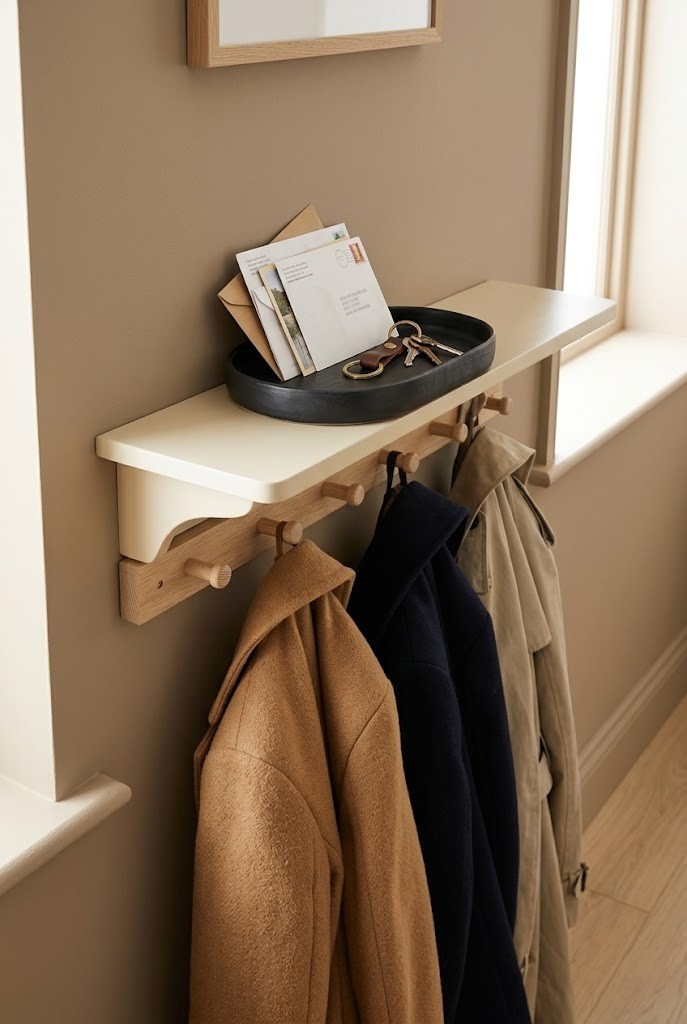
A peg rail plus a small shelf above solves the real reason people want an entry table: a flat surface for the keys, mail, and sunglasses you shed the second you walk in. The pegs take the coats and bags; the shelf takes the pocket dump. Keep a shallow tray on the shelf to corral small items, because loose keys slide to the back and mail fans out into visual noise fast. The classic mistake is letting the shelf become a permanent parking lot, so mail from March is still there in June. A weekly clear-off is what keeps it working instead of collecting.
13. A Rail With a Small Mirror Leaned on the Shelf Above
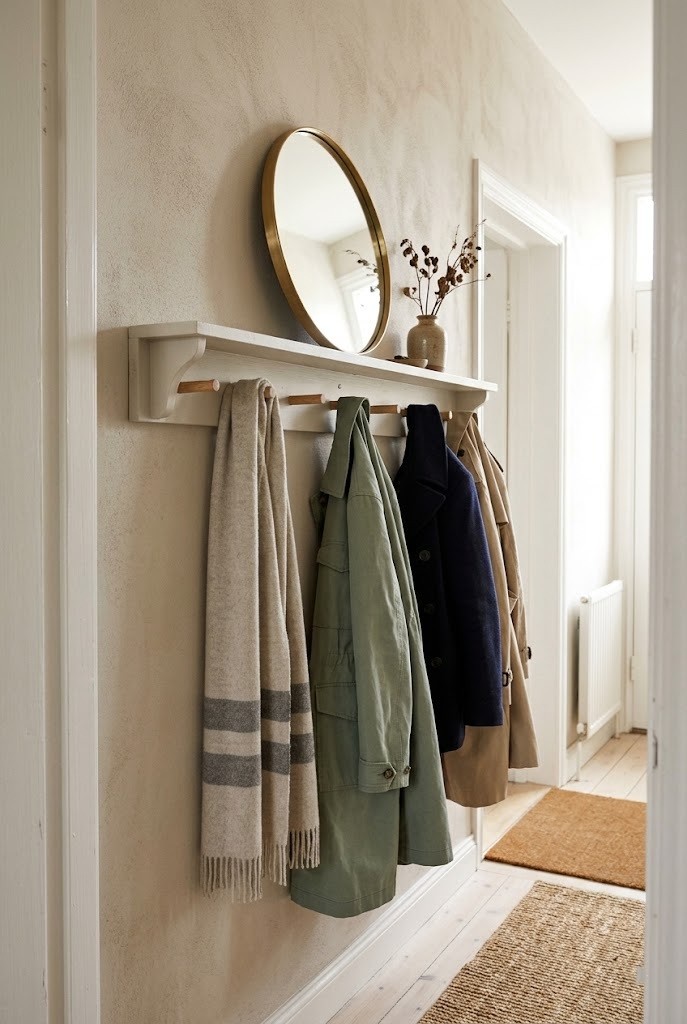
Leaning a small mirror on the shelf above the rail does two jobs at once: a last-look check on your way out and a bounce of light that makes a dim, narrow hallway feel wider. A leaned mirror beats a hung one here because you can angle it to catch the doorway light and reposition it without new holes. Keep it small, roughly 12 by 16 inches, so it doesn't overwhelm the shelf or tip forward when the door slams. Secure the bottom edge against sliding with a bead of museum putty. This borrows the light-widening trick from idea 4's disappearing rail, adding reflection on top of restraint.
14. A Rail-and-Shelf Setup Softened With a Trailing Plant
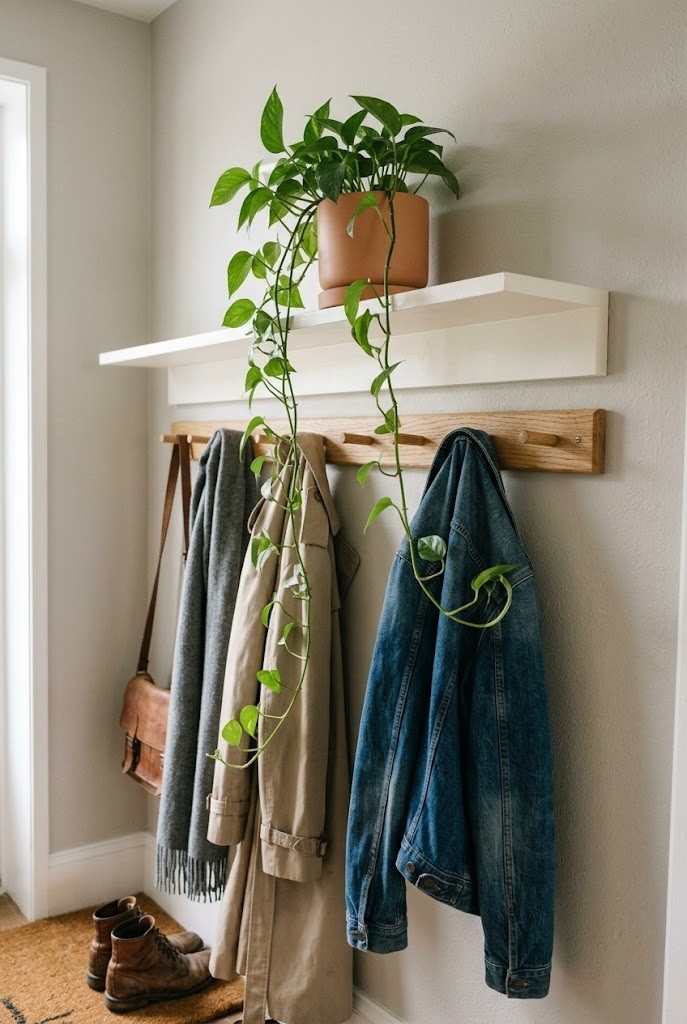
One trailing plant on the shelf above the rail breaks up all the hard horizontal lines a peg-and-shelf combo creates, and greenery is the fastest way to make a utilitarian coat wall feel like part of the home. A pothos or trailing ivy in a small pot works because the vines drape down beside the coats without needing floor space or much light. Pick a plant rated for low light, since most narrow hallways get almost none. Keep the pot under 5 inches so it doesn't crowd whatever else shares the shelf. One living thing does more warming work than three decorative objects, and it asks little in return beyond a monthly water.
15. A Peg Rail Set Into a Beadboard-Backed Entry Wall
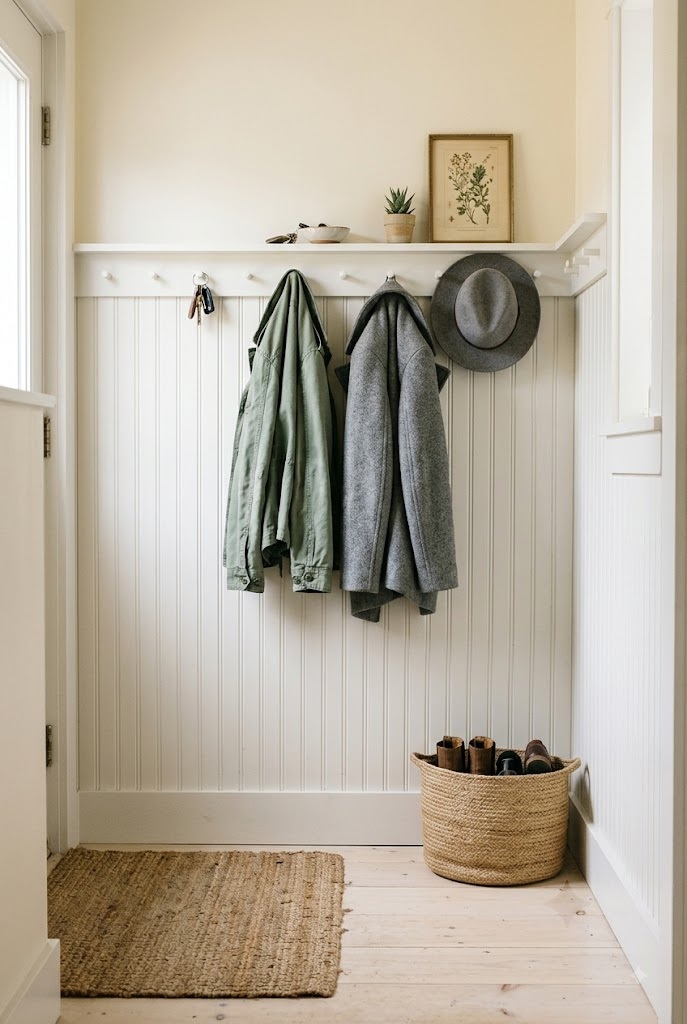
Running beadboard up the wall behind the rail turns a single functional strip into a finished, cottage-style entry feature that looks deliberately built rather than added on. The vertical lines of the beadboard also draw the eye upward, which helps a low or cramped hallway feel taller. Cap the beadboard with the peg rail itself acting as the top ledge, a classic Shaker treatment, and paint both the same color for a disappearing, built-in effect. Keep the beadboard to about 60 inches high so it frames the coats without swallowing the wall. This is the most involved build here, closer to a weekend project than an afternoon, but it's the one that reads most like real millwork.
16. A Full-Wall Rail Run for a Family of Four or More
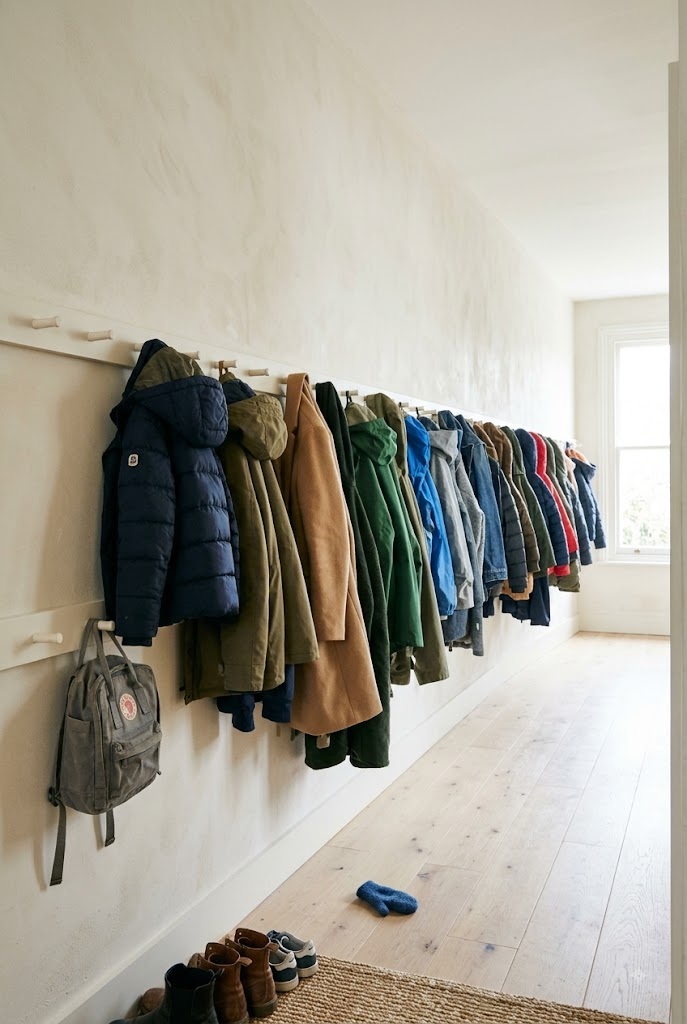
One long peg rail running the full length of the wall gives a big household one peg per person plus overflow, and at this scale volume becomes the design instead of the problem. Where a short rail needs restraint, a full-wall run wants rhythm: space the pegs evenly, every 6 to 8 inches, so the loaded rail reads as an intentional line rather than random clumps. Mount it into every stud you cross for a rail this long, because the cumulative weight of a family's coats is real. Keep everything at a consistent height and the fullness looks styled, the opposite of idea 2's under-filled single rail. This is the workhorse option when capacity, not minimalism, is the actual need.
17. A Full-Wall Rail Mixing Pegs, Baskets, and a Few Hooks
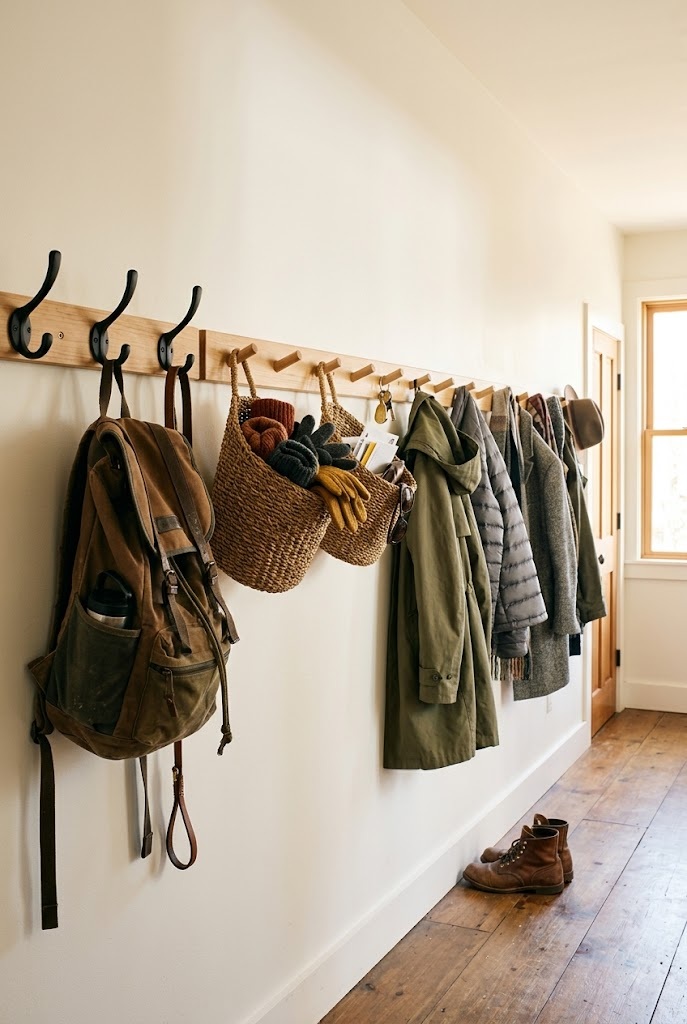
A full-wall rail that mixes plain pegs, a couple of hanging woven baskets, and two or three sturdier hooks handles everything from coats to backpacks to loose gloves on one long run. The mix works because different items need different holders: pegs for coats, baskets for small-stuff, robust hooks for the heavy loaded backpack a peg can't take. Group by type rather than scattering, a basket cluster at one end, coats in the middle, hooks by the door, so the eye finds each zone fast. The common mistake is mixing randomly until the whole wall looks like a hardware sample board. Anchor the heavy hooks into studs even if the pegs sit on the rail alone.
18. A Full-Wall Rail That Doubles as a Rotating Gallery Ledge
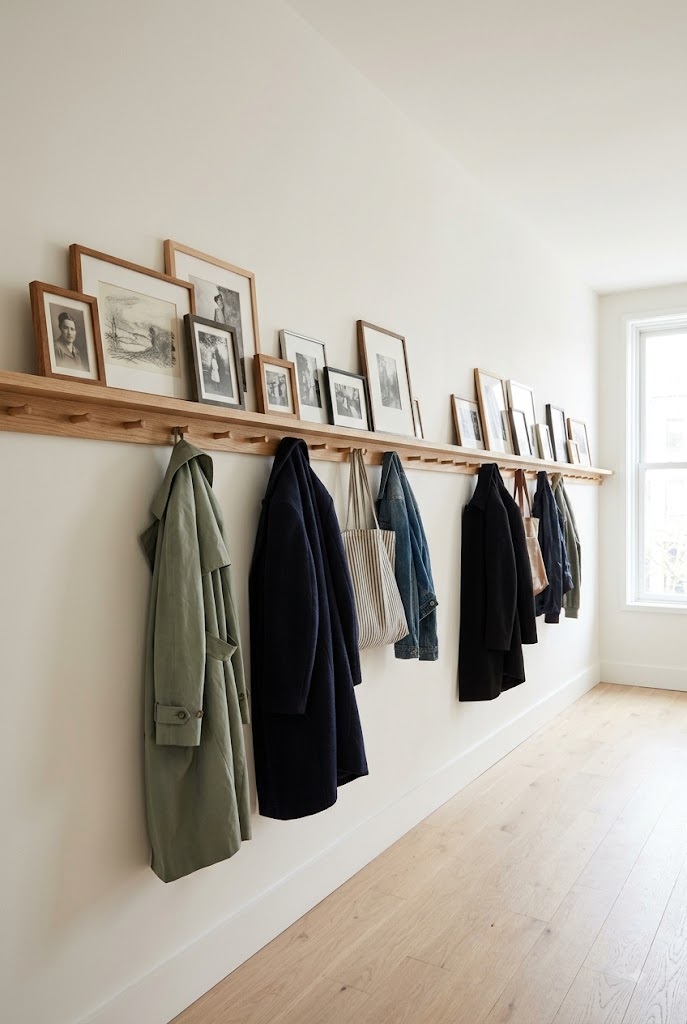
Building the full-wall rail with a slim ledge lip lets you lean small framed art between the coats, so the wall works as storage and gallery at once without two separate installations. Use the pegs for coats at the ends and the middle stretch of ledge for a loose row of overlapping frames, postcards, and a small mirror. The overlap is what makes it feel collected rather than hung by a level and a ruler. Keep frames small, 5 by 7 up to 8 by 10, so they don't compete with hung coats for depth. Rotate the art seasonally and the entry never feels static.
19. A Ready-Made Peg Rack Run You Screw Up in an Afternoon
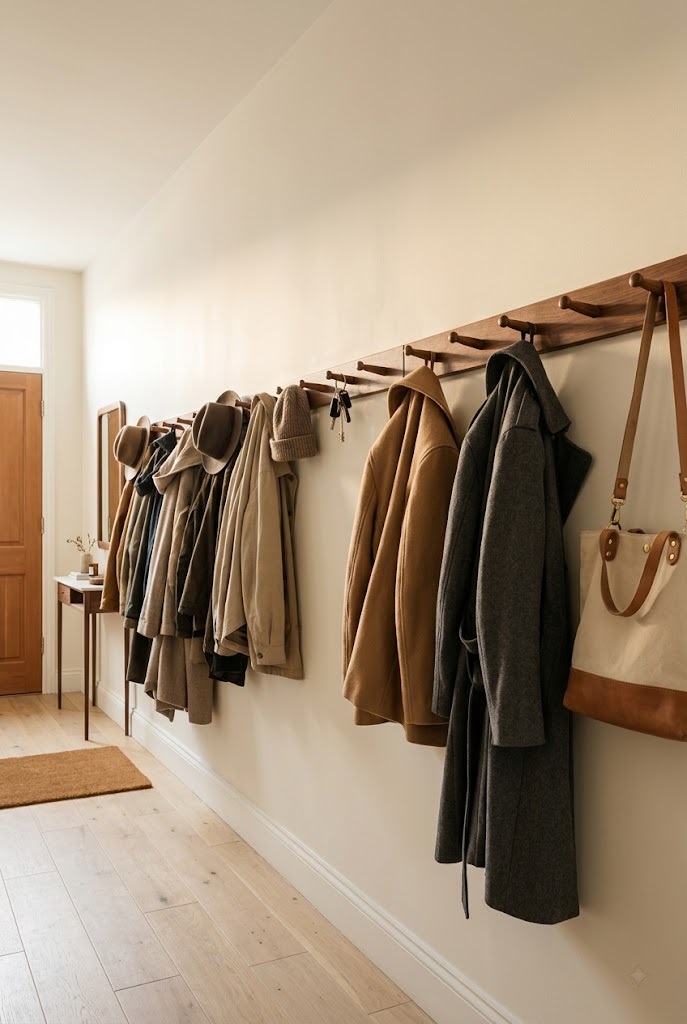
Ready-made wooden peg racks lined end to end skip the cutting, drilling, and peg-setting entirely, which is the honest answer for anyone who wants the look without a build. They come in standard 2- and 3-foot lengths; butt three together and you've got a full-wall run mounted in an afternoon with a drill and a level. The catch is peg spacing is fixed, so measure the coats you own against the rack's peg gaps before buying. It's the low-effort counterpart to a from-scratch build, same wall of pegs, none of the millwork. Match the wood tone across all the racks so the seams read as one continuous piece.
Final Thoughts
The right peg rail setup comes down to your wall, not your Pinterest board: a single rail for a slim stretch, a stacked double when two people compete for space, a rail-and-shelf combo when you miss having a surface, and a full-wall run when capacity is the whole point. Start by measuring your wall and picking the configuration that fits, then style it with restraint until it earns more. Whatever you hang, mount it high enough to clear the traffic in a narrow hall. Save this to Pinterest so the layout you need is here when coat season hits.
Frequently Asked Questions
How high should you hang a peg rail in a hallway?
Mount the rail 66 to 68 inches from the floor in a hallway, high enough that hung coats clear the walking path in a narrow space. If it's a shared rail for kids too, add a second board around 40 inches. Lower than 60 inches and coats start brushing everyone who walks past in a tight corridor.
Can you hang a peg rail without hitting studs?
Yes, rated drywall anchors hold a peg rail fine for everyday coats when you space them every 12 to 16 inches and match the anchor to the load. Use toggle or self-drilling anchors across four points on a 3-foot rail. Just keep heavy wet winter parkas off an anchor-only rail, since soaked wool adds real weight.
What do you actually hang on an entryway peg rail?
Everyday coats, one bag per person, a scarf or hat, and keys are the core of what works on an entryway peg rail. Add hanging woven baskets for mail, gloves, and small stuff. The rule that keeps it looking styled: leave some pegs bare, and send off-season and overflow items somewhere other than the entry.
How narrow a hallway can still fit a peg rail?
Even a 30-inch-wide hallway fits a peg rail, because a mounted rail projects only 3 to 4 inches off the wall, unlike a bench or console that eats a foot of floor. That shallow depth is the whole reason a rail wins where furniture won't. Just mount it high so loaded coats don't narrow the path further.