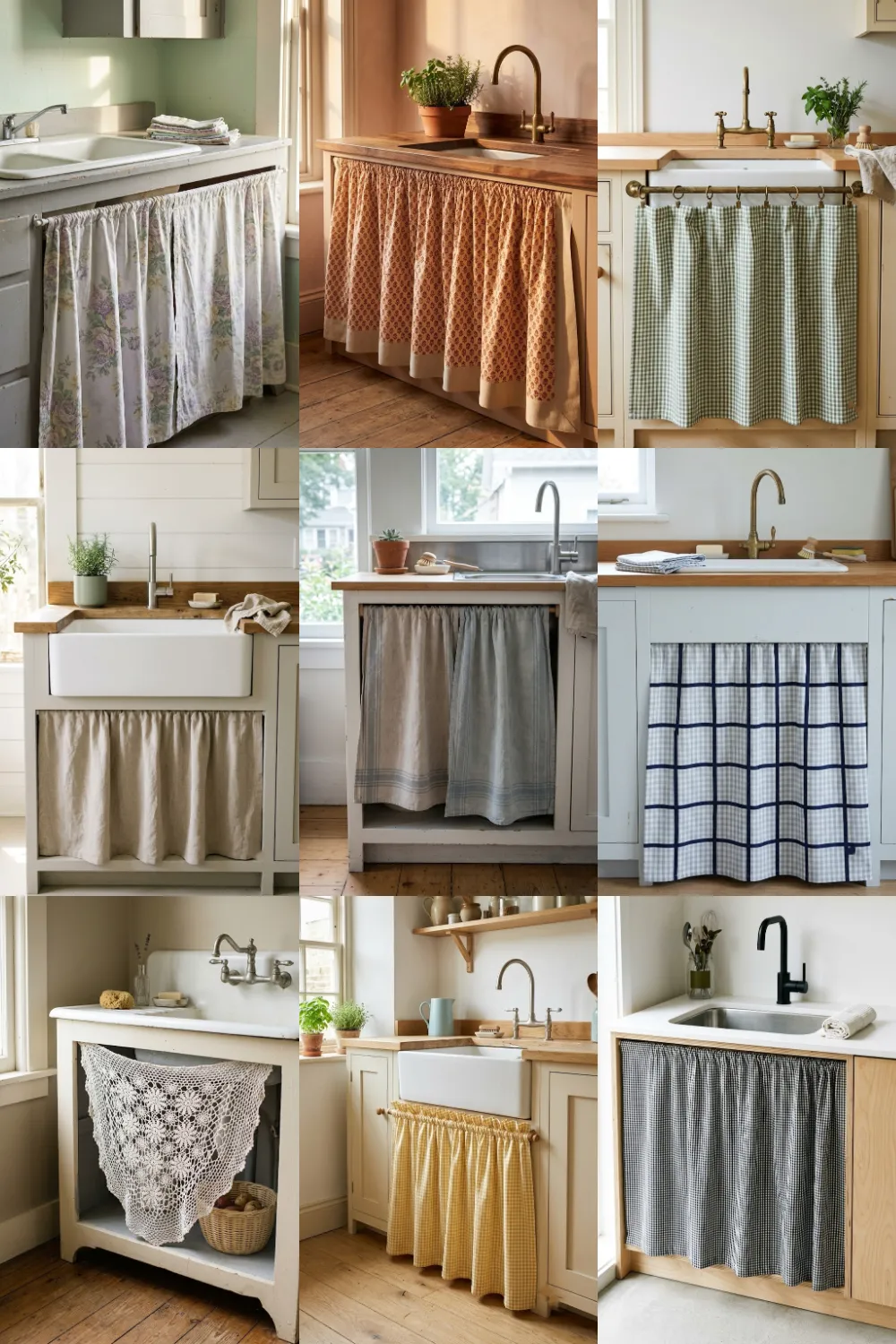
Kitchen sink skirt ideas usually show up online as either a bare product listing with no styling context or one person's single DIY tutorial, so this post does the thing neither does: 23 looks sorted by fabric style, each with the exact no-sew way to hang it. Every method here works without a drill, without a sewing machine, and without anything that costs you a security deposit. Several of them also solve the uglier problem, which is a scratched, split or missing under-sink cabinet door you are not allowed to replace. The fabric families run in order: ticking, linen, block print, gingham, lace, ruffles. Save this one to Pinterest so the mount methods are to hand when your fabric arrives.
1. Blue-and-White Ticking Stripe on a Spring Tension Rod
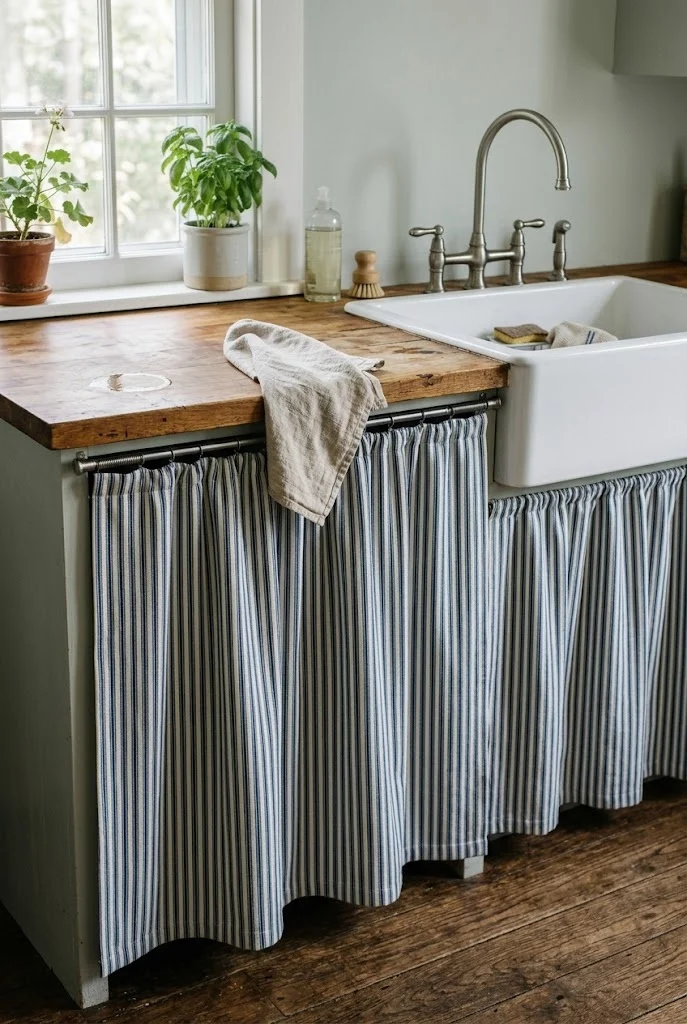
Blue-and-white ticking reads as a classic kitchen textile rather than a curtain hiding something, which is why it survives daily use without looking like a temporary fix. A pair of café curtain tier panels in a 24-inch length covers a standard base cabinet with the rod set about 2 inches below the counter lip. Buy the panels 1.5 times the opening width so the stripes gather instead of stretching flat. Spring tension rods hold well inside a face-frame cabinet because the frame gives the rubber ends something square to bite into. Skip the rod entirely if your opening is melamine-faced particleboard with no frame. There is nothing there to grip and it will slip by week two.
2. Black Ticking Stripe Hung on Clip Rings for a Sharper Edge
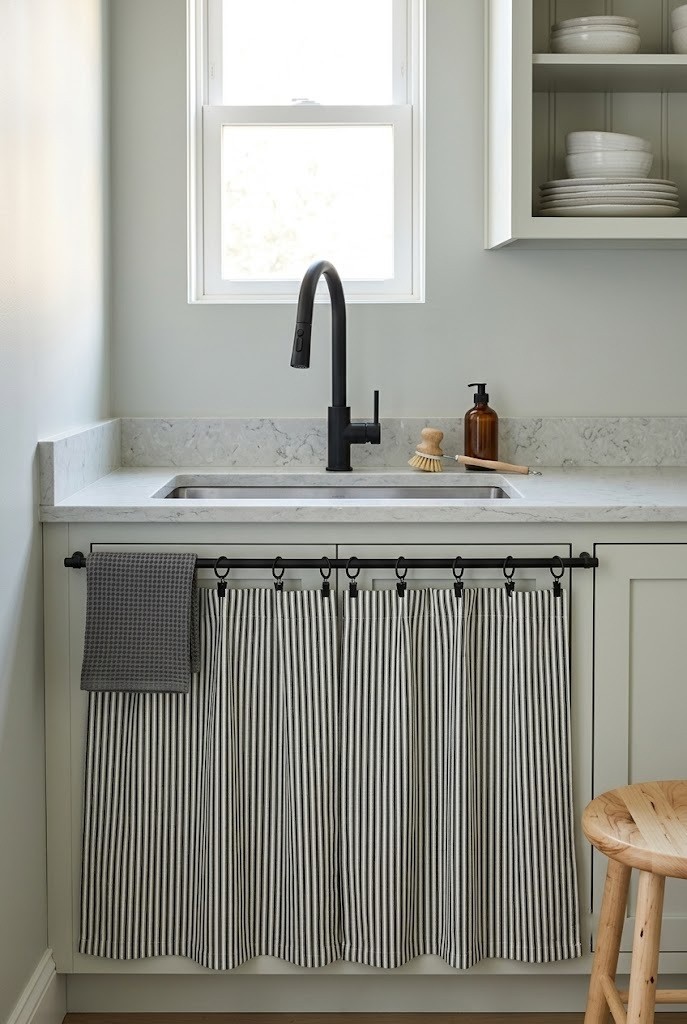
Black ticking on white cotton gives the same striped familiarity as idea 1 but reads modern rather than country, which matters if your counters are quartz and your hardware is matte black. Clip rings change the whole look: the fabric hangs from small metal jaws with an inch of open rod visible above, so the skirt looks deliberate rather than shoved onto a pole. Clip every 4 to 5 inches. Wider spacing makes the top edge sag into shallow scallops, which some people like and most do not. Because the clips add roughly 1.5 inches of drop, cut the panel that much shorter or it pools on the cabinet base and collects crumbs.
3. Faded Red Ticking with an Iron-On Scalloped Hem
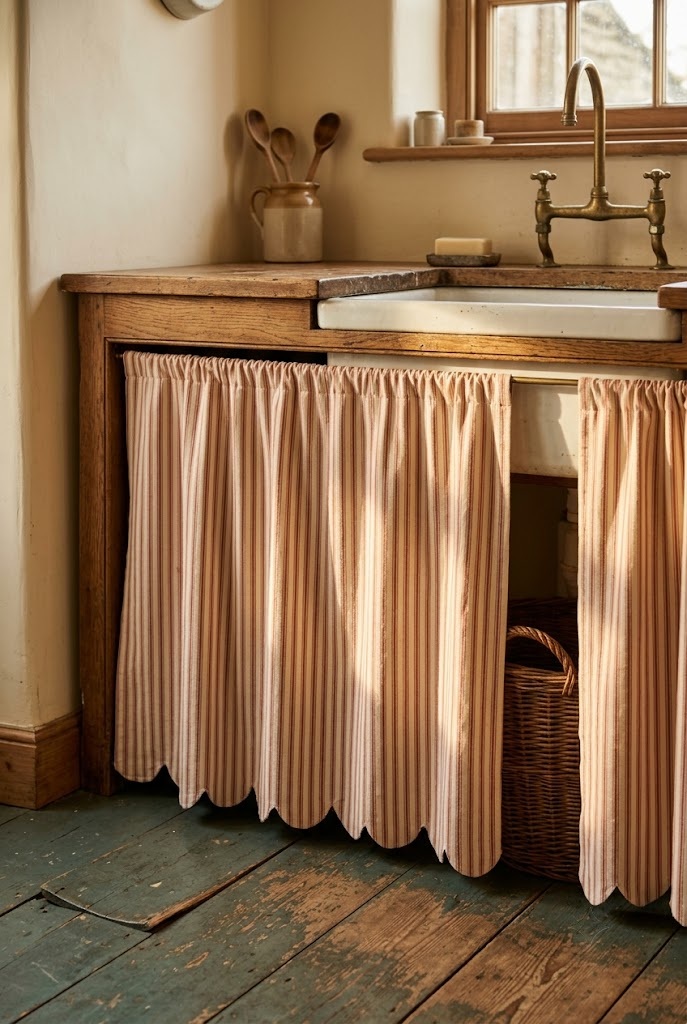
Red ticking cut into a shallow scalloped hem softens the stripe's rigidity, and the scallops are the one place a no-sew skirt can show real craft. Draw the curve with a dinner plate on the wrong side of the fabric, cut, then seal the raw edge with 3/4-inch iron-on hem tape rated for cotton. The tape needs about 10 seconds of firm pressure per section on a cotton setting with no steam. Steam is what makes tape peel three months later. Keep scallop depth under 2 inches, since deeper curves show every wobble in your cutting line. Faded brick red sits better with warm oak than fire-engine red, which fights most wood tones.
4. Grain Sack Wide-Stripe Panel with Leather Tab Tops
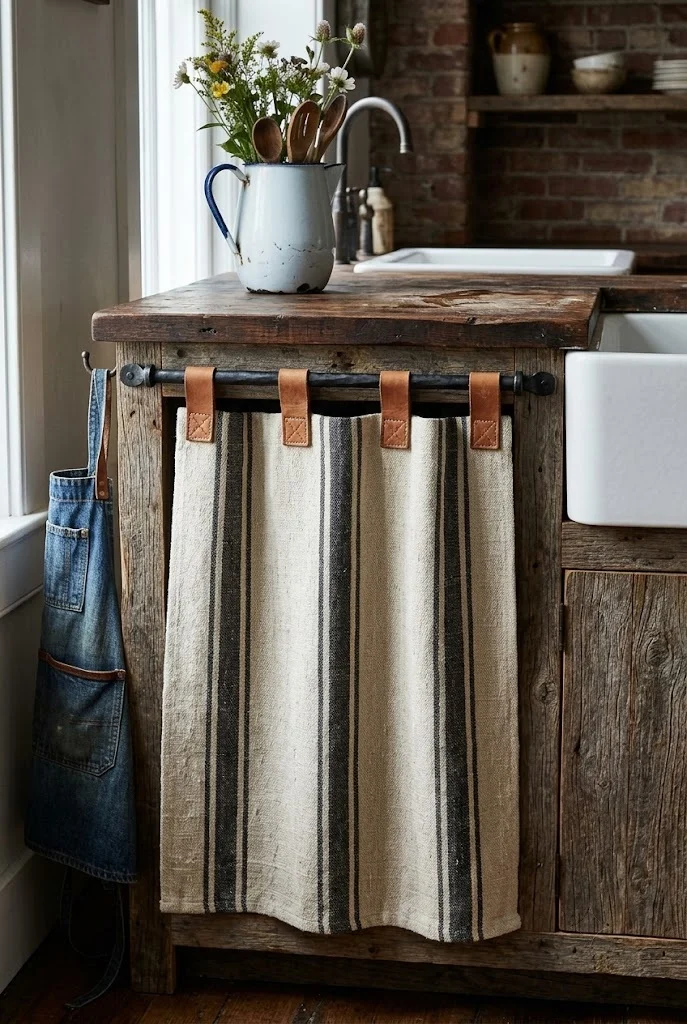
Grain sack fabric brings weight that thin cotton cannot fake, and weight is what keeps a sink skirt hanging straight instead of billowing every time the dishwasher door swings open. Real vintage grain sack costs a lot by the yard, so a reproduction cotton-linen blend in the 8 to 12 ounce range does the same job for less. Leather tab tops, made from strips of scrap leather folded over the rod and fixed with a single rivet or a heavy-duty snap, give the whole thing a workshop honesty that rings true in an old house. Allow five tabs across a 24-inch opening. Fewer than that and the fabric between tabs droops into deep swags.
5. Oatmeal Linen Half-Skirt Stuck On with Velcro
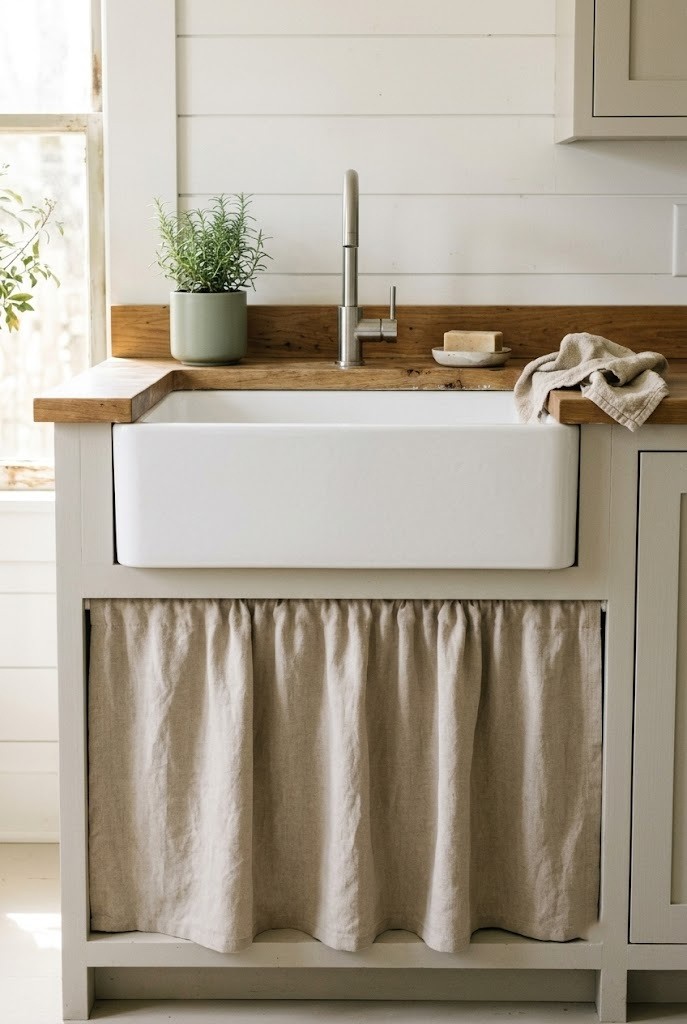
Oatmeal linen mounted on sticky-back Velcro strips is the fastest deposit-safe version of this project, finished in about 20 minutes with no rod and no hardware at all. Press the hook side to the underside of the counter lip or the top rail of the cabinet frame, press the loop side to the folded top edge of the fabric, and let the adhesive cure a full 24 hours before hanging anything. Linen suits this mount because it is light. The ticking panels in idea 1 are heavier and do better on a rod. Wipe the mounting surface with rubbing alcohol first, since kitchen surfaces carry a film of cooking grease that kills adhesive faster than anything else.
6. Flax Linen with a Pinched Header on Clip-On Curtain Rings
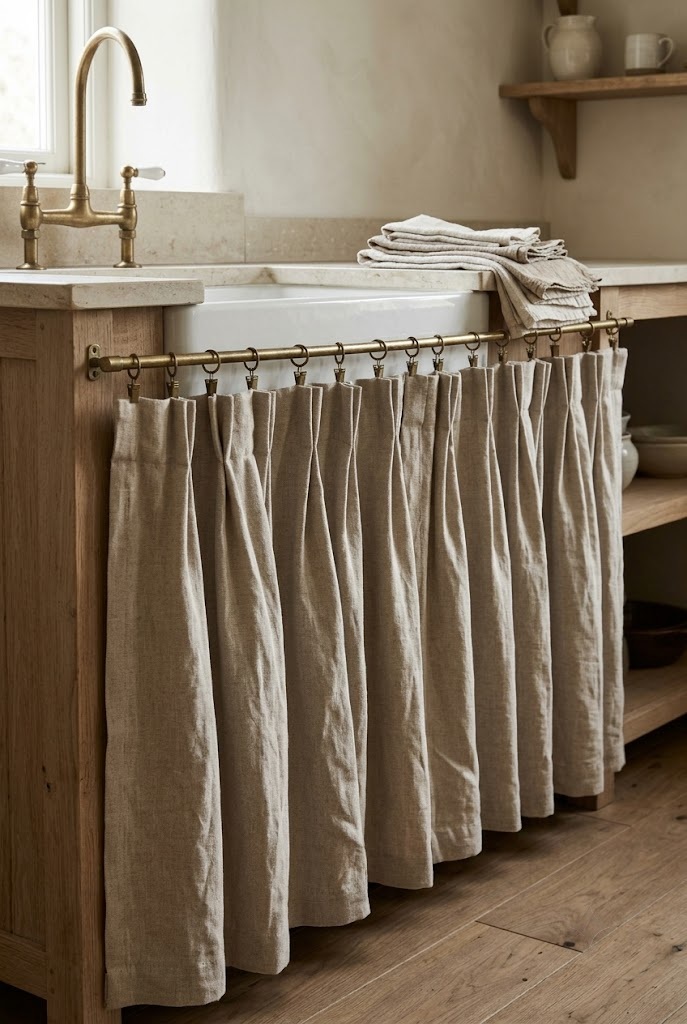
A pinched header turns flat linen into something with structure, and you can fake one without a stitch by pinching three small folds at the top and gripping them all inside a single clip. Clip-on curtain rings do the work here. Space the pinches about 6 inches apart across the panel, and let each pinch eat roughly 3 inches of fabric width, which means buying the panel around twice your opening width. Flax linen wrinkles permanently and visibly, which is either the charm or the dealbreaker depending on your tolerance. If it is the dealbreaker, a linen-cotton blend near 55/45 holds a crease far less and still drapes properly.
7. Two Stone-Washed Linen Tea Towels as a Split Panel
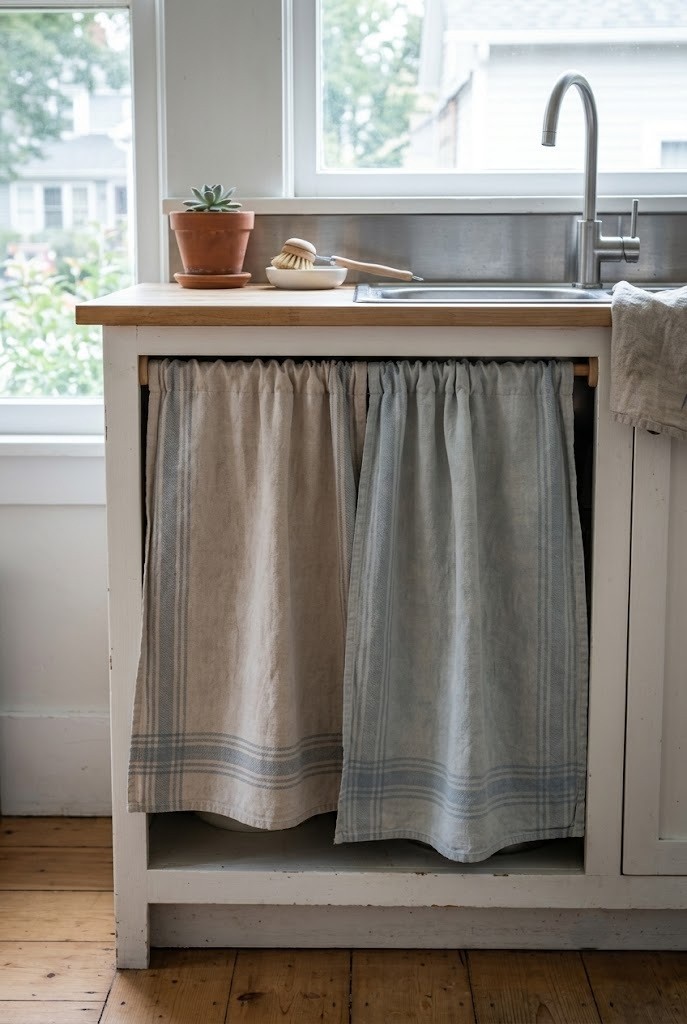
Two tea towels hung side by side make a sink skirt for under fifteen dollars, and the pre-finished hems on all four sides mean zero cutting, zero taping and zero fraying. Standard European linen tea towels run about 20 by 28 inches, which covers a 24-inch opening with a small centre overlap when hung with the long edge vertical. Overlap matters more than it sounds. A centre gap of even an inch shows the pipe trap and defeats the entire point of the project. Use the towel's hanging loop, if it has one, threaded straight onto the rod. Wash them separately the first time, because stone-washed linen sheds lint heavily and it lands on everything.
8. Raw-Edge Linen with a Deliberately Frayed Hem
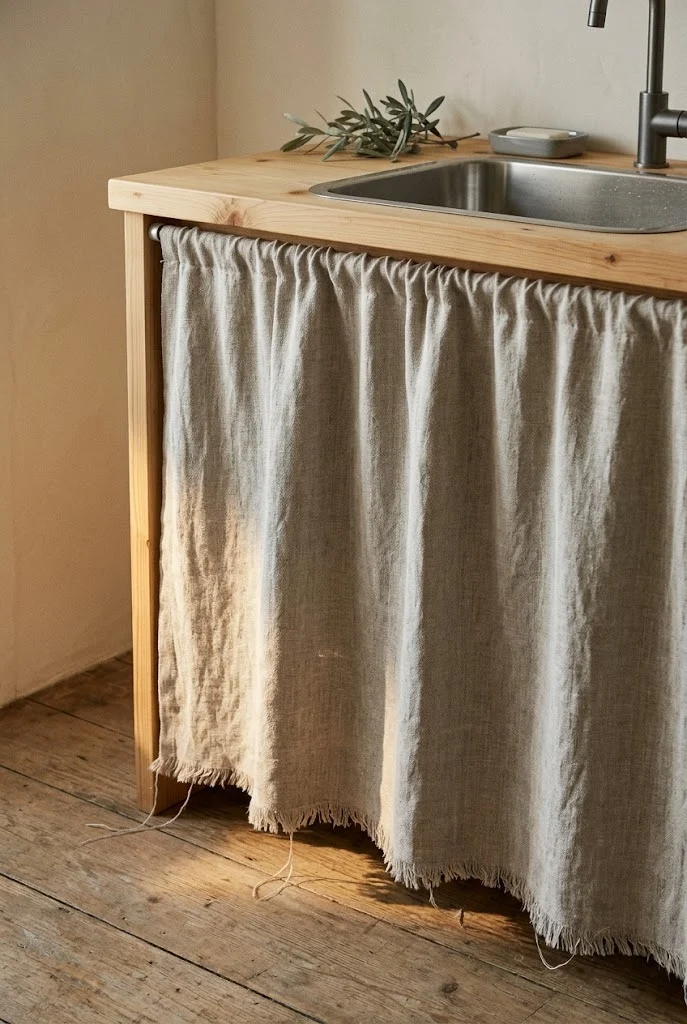
A frayed hem only looks intentional when the fray is even, and evenness comes from pulling a thread rather than letting the fabric shred on its own. Pull one crosswise thread out of the linen about half an inch above the cut edge, then use the gap it leaves as your guide and fray down to it with your fingers. Do this before hanging, standing over a bin, because the loose threads travel everywhere. Loose-weave linen frays fast and keeps fraying in the wash. If the skirt lives next to a dishwasher vent, expect to trim stray threads every few months. Tighter-woven linen frays more slowly and holds the line far longer.
9. Indigo Block-Print Floral on a Cream Ground
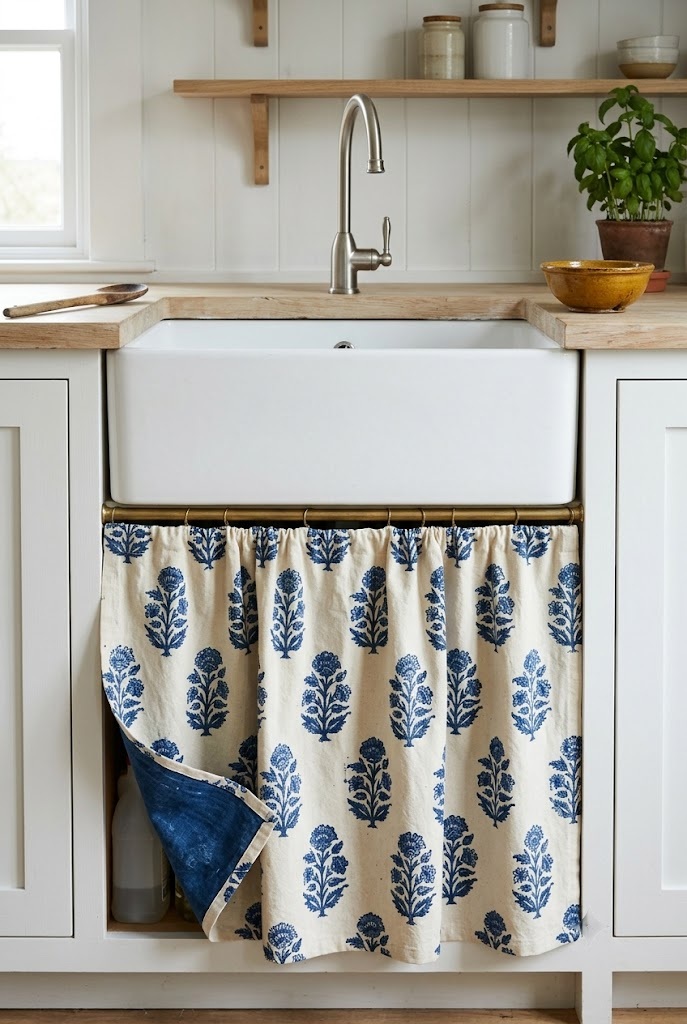
Indigo block print carries pattern without carrying colour risk, since blue on cream sits comfortably against almost every cabinet finish from white shaker to raw oak. Scale is the thing to watch. A print with 4 to 6 inch motifs reads properly as pattern from across the room, while anything larger gets sliced awkwardly by the narrow width of a sink cabinet and you see half-flowers at both edges. Hand-block-printed cotton often bleeds on the first wash, so soak the panel in cold water with a cup of white vinegar before it goes anywhere near the sink. Compared with the flat linen in idea 5, this panel hides splashes and water spots far better.
10. Small-Scale Ditsy Floral on a Tension Rod for Tiny Kitchens
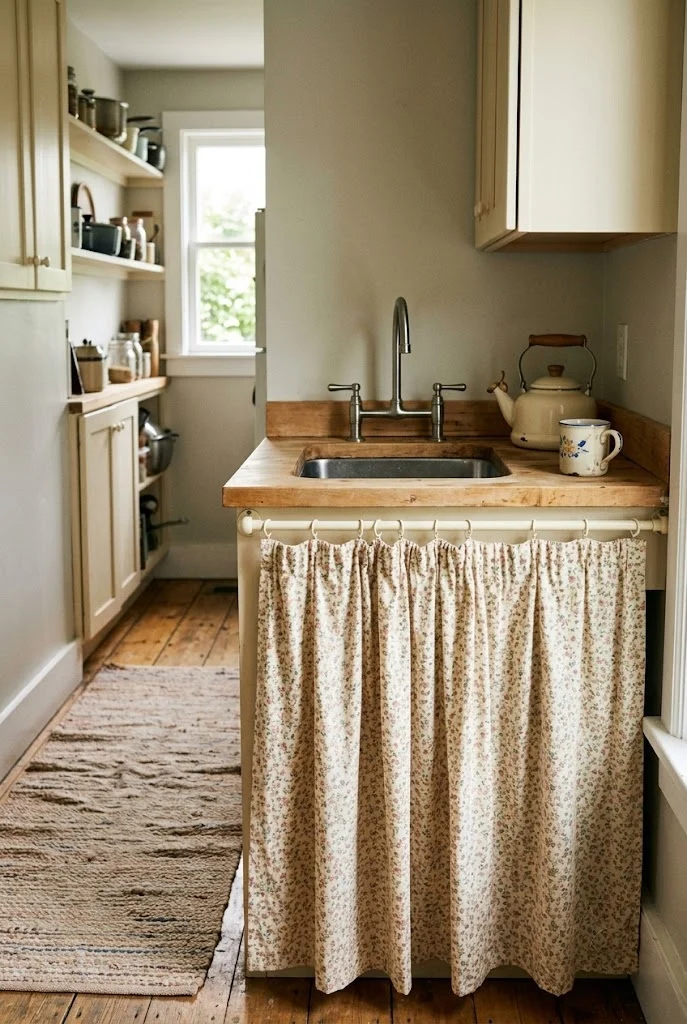
Ditsy florals, meaning motifs under 2 inches across, are the safest pattern for a galley kitchen because small repeats do not visually shrink a room the way large ones do. Ready-made café curtain tier panels come in this print constantly, which saves you cutting anything at all. Set the spring tension rod as high in the cabinet frame as it will sit, so the skirt begins right under the counter and the eye reads one continuous drop. A rod set 4 inches down leaves a visible band of bare cabinet above the fabric that makes the whole thing look like an afterthought. Match the ground colour to your wall, not your countertop, and the pattern stops competing.
11. Terracotta Block Print Bordered with Iron-On Grosgrain
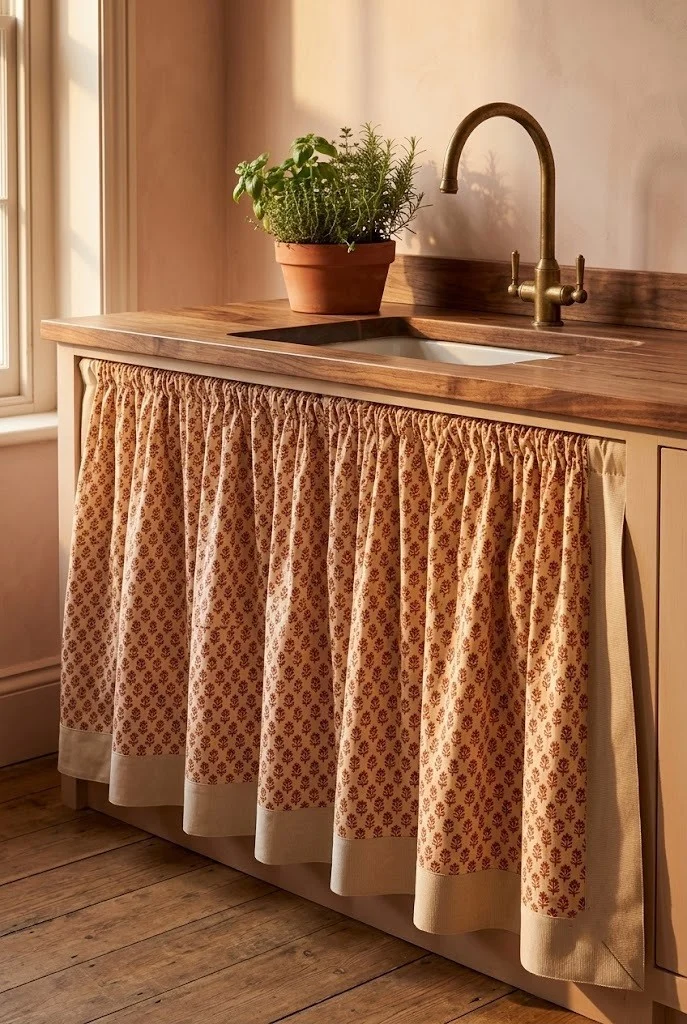
A contrasting border along the bottom edge adds about two inches of visual weight and stops a lightweight printed panel from looking flimsy. Grosgrain ribbon in a 1.5-inch width, fixed with fabric fusing tape, does it in roughly ten minutes. Run the tape in short overlapping sections rather than one long strip, because a single strip shifts as you iron and you end up with a border that wanders off line. Terracotta and rust tones need warmth around them to work, so this one wants brass or unlacquered hardware nearby rather than chrome. Against cool grey cabinets it reads muddy. The border also protects the hem, which is the edge taking every knee and every mop.
12. A Vintage Bedsheet Cut Down into a Sink Skirt
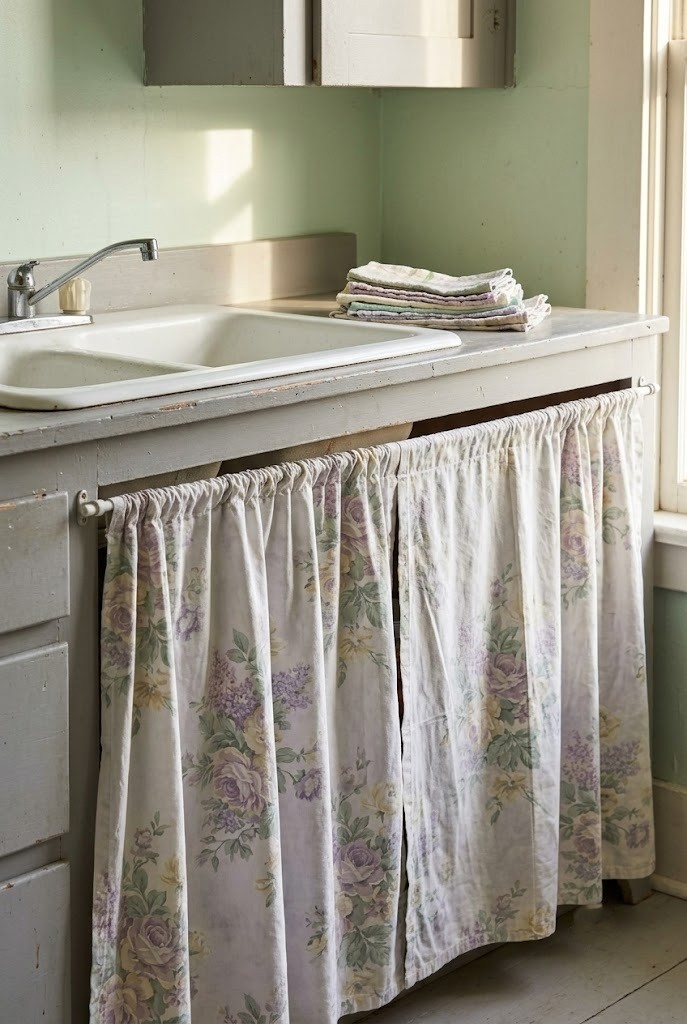
Vintage cotton bedsheets are the cheapest source of genuinely good floral print, usually two to six dollars at a thrift store, and one flat sheet yields three or four sink skirts. Use the sheet's existing wide top hem as a ready-made rod pocket. Snip the side stitching, slide the rod through, and you are done with no sewing and no tape whatsoever. Old sheets are thin from decades of washing, which is exactly why they drape beautifully and exactly why they will not hide a dark cabinet interior on their own. Hang a plain white panel behind if shadows show through. Check for weak spots along the fold lines before committing to any cuts.
13. Sage Gingham on Clip Rings with a Visible Brass Rod
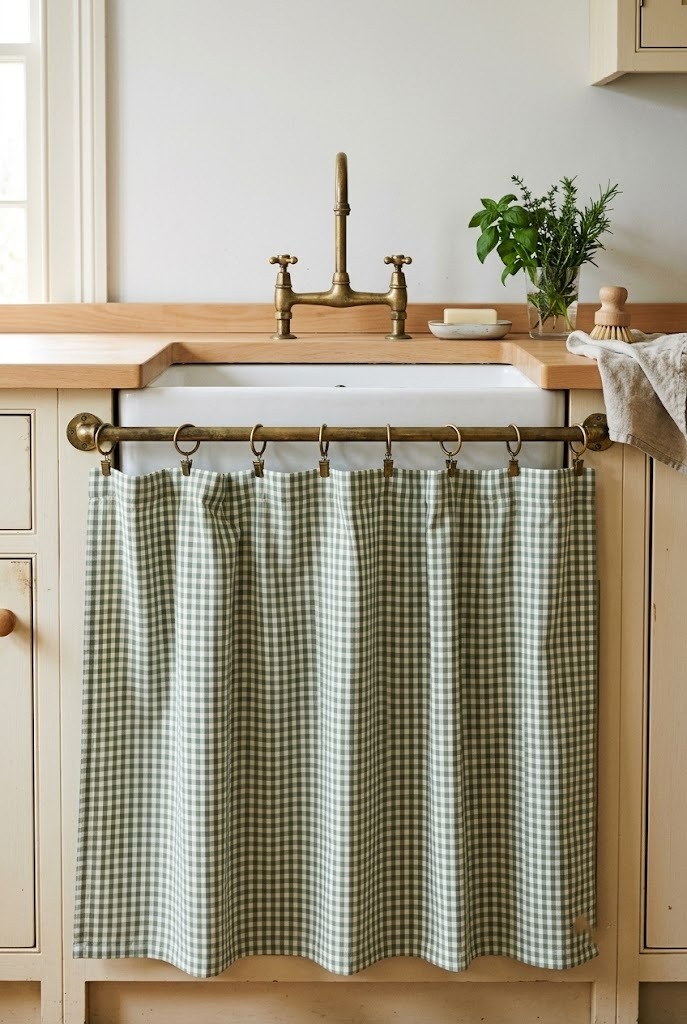
Sage gingham keeps checked fabric from tipping into picnic territory, because the muted green reads closer to a herb garden than a red-check diner. Small checks, a quarter inch or under, suit a narrow cabinet opening, while the inch-wide checks common on tablecloths look coarse at this scale. Hanging it on visible brass with clip rings, the way idea 2 handles the black ticking, makes the rod part of the design instead of something to hide. Brass tension rods exist but are usually brass-toned steel. Real unlacquered brass will patina over a sink from steam, which most people want and some people hate. Decide which camp you are in before you buy.
14. Black-and-White Micro Gingham for a Graphic Kitchen
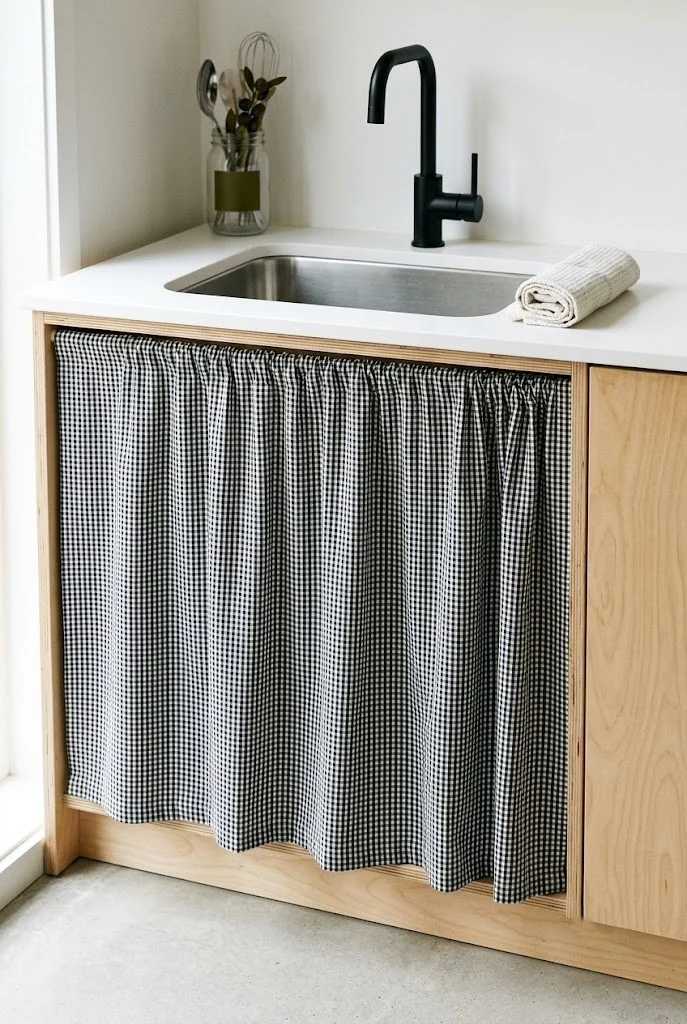
Micro gingham at an eighth of an inch reads as texture rather than pattern from more than a few feet away, which makes it the safest checked option in a kitchen that already has a busy backsplash or a patterned floor. Black and white also handles the one thing gingham struggles with, which is fading. Coloured checks go patchy after twenty washes in a sunny kitchen, while black holds its depth. Keep the rest of the run plain if you use this. Two competing small patterns across a six-foot stretch of cabinetry is where kitchens start to feel noisy. Crisp cotton poplin holds the grid square, while jersey or slub cotton distorts the checks into wobbles.
15. Butter Yellow Gingham with a Gathered Ruffle Header
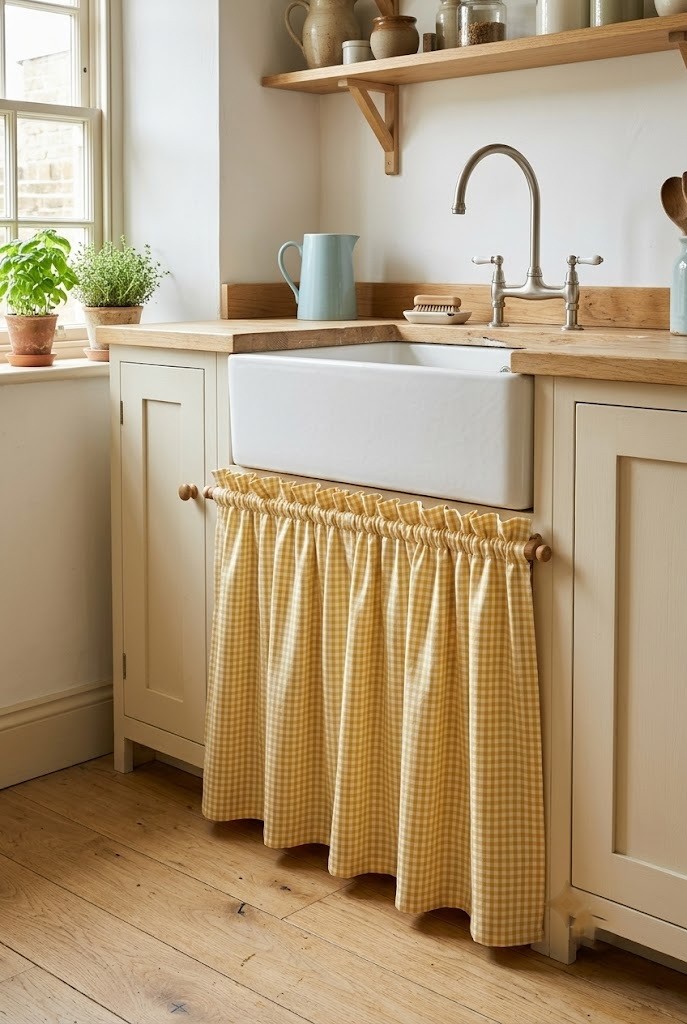
A ruffle header, meaning fabric that stands proud above the rod rather than hanging below it, adds cottage softness and costs nothing but extra length. Hang the panel with the rod pocket set 3 inches down from the top edge so the fabric above the pocket flops forward into a small frill. On a no-sew build, create that pocket with two parallel lines of fusing tape 1.5 inches apart. Butter yellow warms up north-facing kitchens that turn grey by four in the afternoon, and it sits well with cream cabinets that would look dingy next to bright white. Avoid it beside a yellow-toned oak floor, where the two yellows argue rather than agree.
16. Gingham Panel Overlaid with a Contrast Ribbon Grid
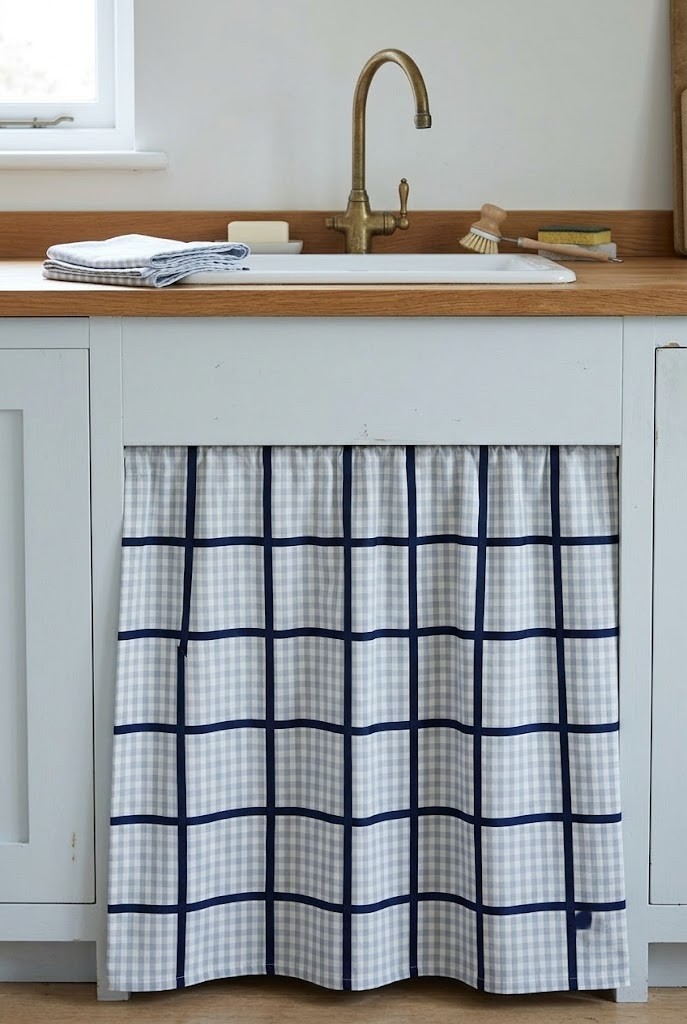
Laying narrow ribbon over gingham in a widely spaced grid gives a custom, almost upholstered look, and gingham's built-in checks act as a ruler so your lines stay straight without measuring anything. Choose ribbon in a quarter-inch width and follow a check line every 4 inches vertically and horizontally. Fix it with fusible web tape, pressing the intersections last so they lie completely flat. This is the most time-consuming look here at around 45 minutes, and it is the one worth doing on a panel you can take down and iron flat on a table. Doing it in place, kneeling on a kitchen floor, is how the lines end up crooked.
17. A Vintage Crochet Tablecloth Repurposed as a Skirt
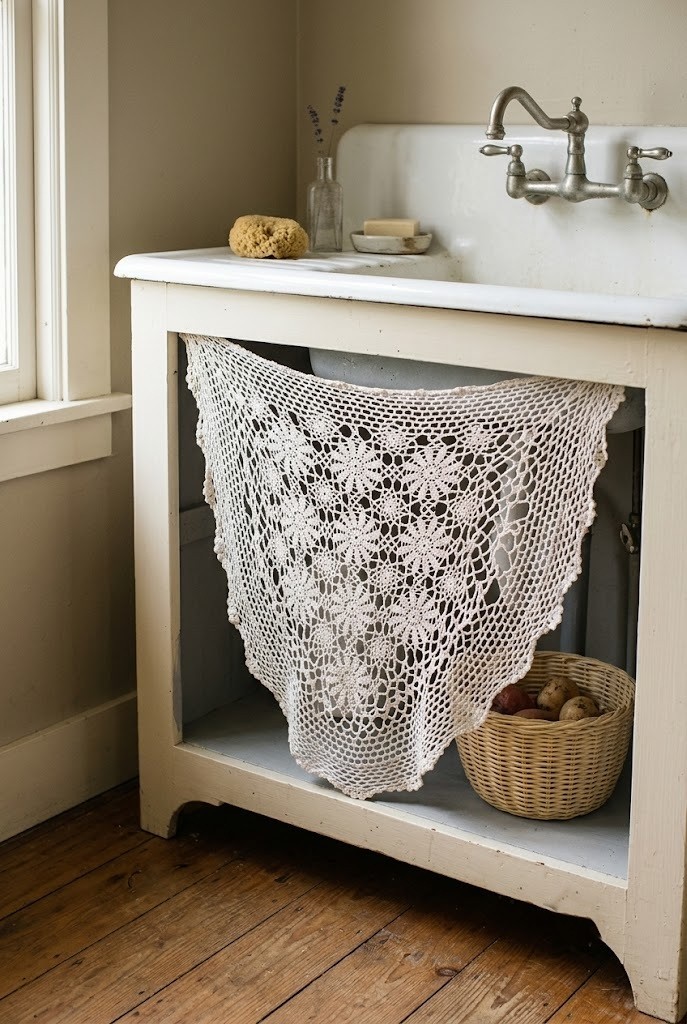
Crochet lets light and shadow through, so it screens the under-sink area without sealing it off, which suits a small kitchen where a solid panel would read as a wall. A round vintage crochet tablecloth cut in half gives two curved-hem panels with the decorative edge already finished for you. Cotton crochet stretches when wet and stays stretched, so keep the hem at least 2 inches clear of the cabinet base and never let it sit in a puddle. Unlike the opaque grain sack in idea 4, this one shows whatever is behind it, which means one plain bin and a single basket rather than a jumble of bottles.
18. Cotton Lace Layered Over a Solid Linen Panel
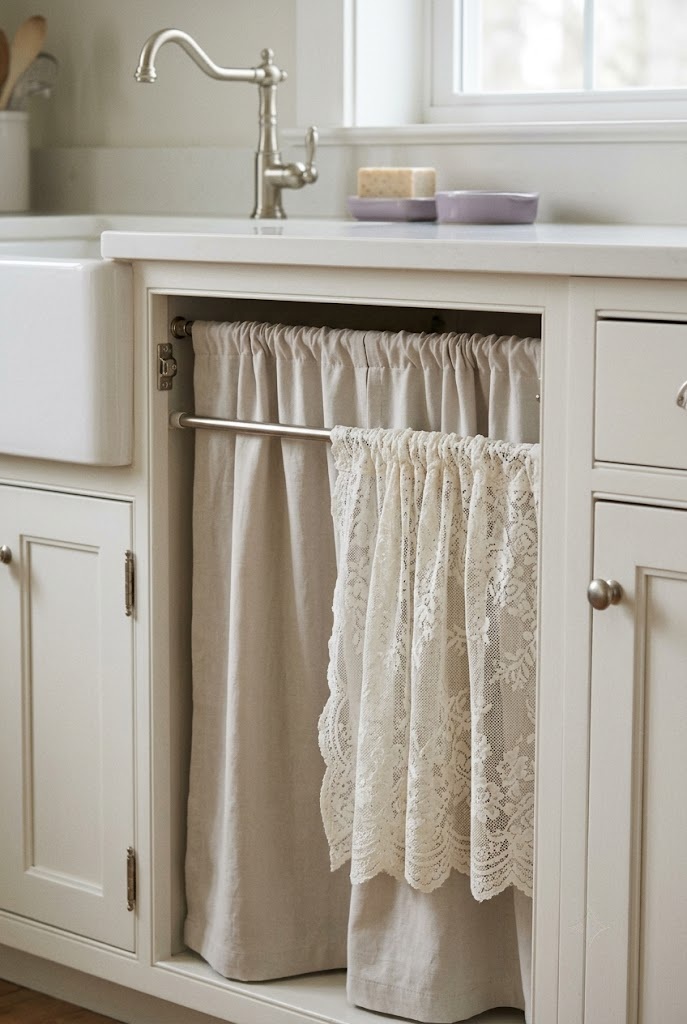
Layering lace over a plain panel solves crochet's transparency problem while keeping the pretty edge, and it is a two-rod job with far less fuss than it sounds. Mount two spring tension rods roughly an inch apart in depth, with solid linen at the back and lace at the front. Clip-on curtain rings on the front rod let you slide the lace aside to reach the cabinet without disturbing the liner behind it. Cotton lace yellows over a sink faster than you would expect, thanks to steam and airborne cooking oil. A cold soak in oxygen bleach every few months keeps it white. Nylon lace resists yellowing but looks obviously synthetic close up.
19. A Pair of Battenburg Lace Tea Towels, Tape-Trimmed
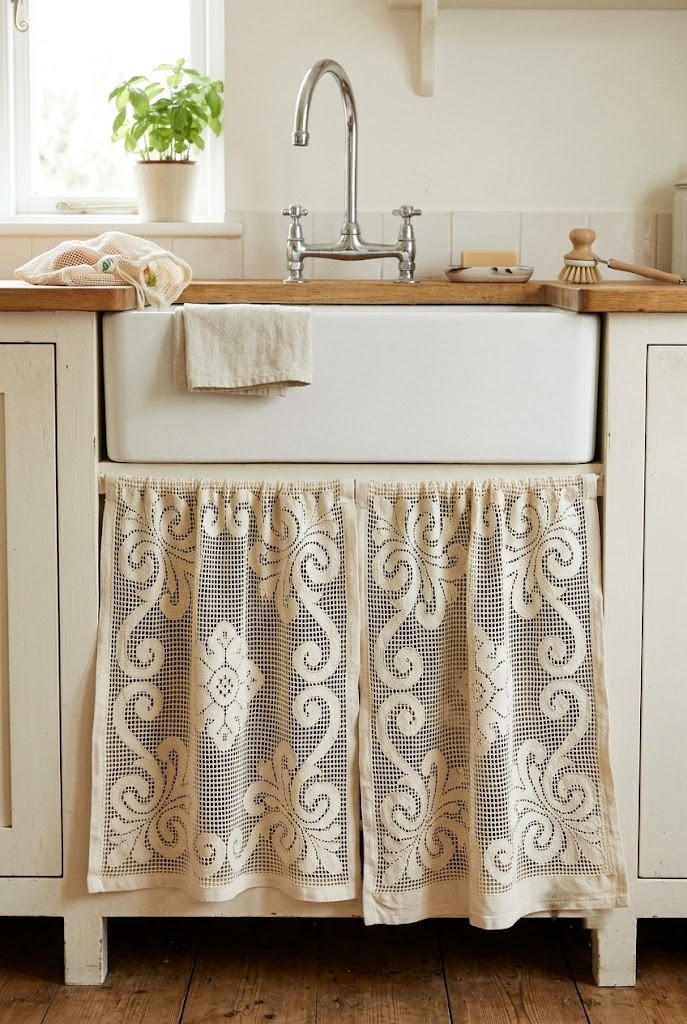
Battenburg lace towels give a heavy tape-and-lace edge that holds its shape far better than fine lace, which matters on a panel brushed by legs and cupboard doors all day long. They arrive pre-hemmed, usually around 18 by 26 inches, so two of them handle a standard opening with a slight overlap at the centre. The dense tape work resists snagging on cabinet hinges. Fine chantilly-style lace does not, and a single snag pulls a run right across the panel. Wash on a gentle cycle inside a mesh bag and skip the dryer entirely, because heat shrinks the cotton tape unevenly and the panel comes out with a rippled edge.
20. Cutwork Eyelet Panel in Plain White
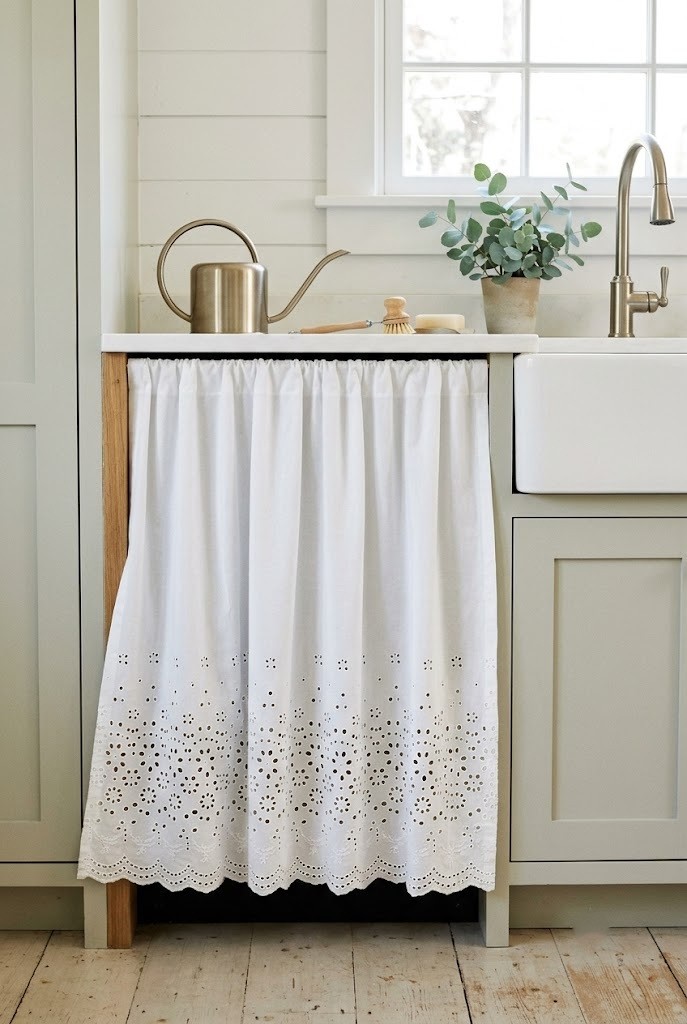
Eyelet reads clean rather than fussy, which makes it the one lace-family option that works in a modern kitchen as easily as a cottage one. The pattern is punched and stitched into solid cotton, so it holds structure and hangs straight without needing a liner behind it. Stick to white or ivory, since coloured eyelet cheapens fast. A useful proportion is a mostly solid panel with the cutwork confined to the bottom third, which keeps the upper half opaque exactly where the plumbing sits. Eyelet holes catch dust along their punched edges, so a monthly pass with a vacuum brush attachment does more good than washing it.
21. A Two-Tier Ruffle Skirt Cut from an Old Bed Skirt
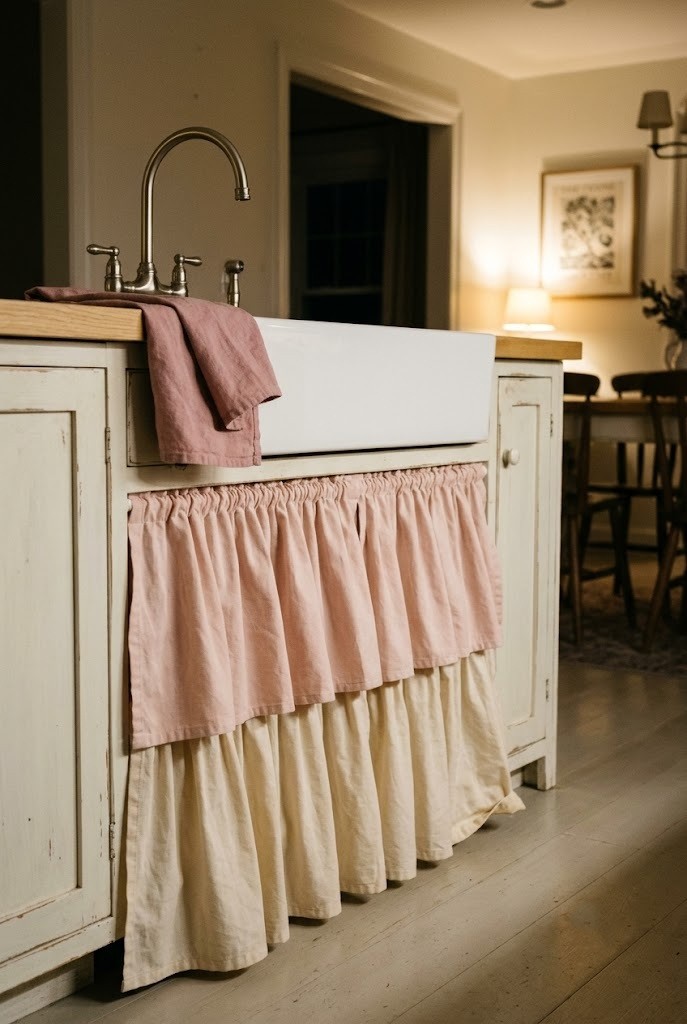
An old bed skirt is already ruffled, already hemmed and already gathered onto a flat panel, making it the single biggest shortcut in this entire list. Cut a section to your cabinet width plus 6 inches, keep the existing gathered header intact, and mount it with sticky-back Velcro exactly the way idea 5 does. Two tiers work better than one at this height, because a single deep ruffle on a 30-inch cabinet looks bottom-heavy and squat. Split the drop roughly 60/40 with the shorter tier on top. Most bed skirts are poly-cotton, which resists wrinkles well and also holds cooking smells longer than pure cotton does.
22. Gathered Ruffle Trimmed with Cotton Pom-Poms
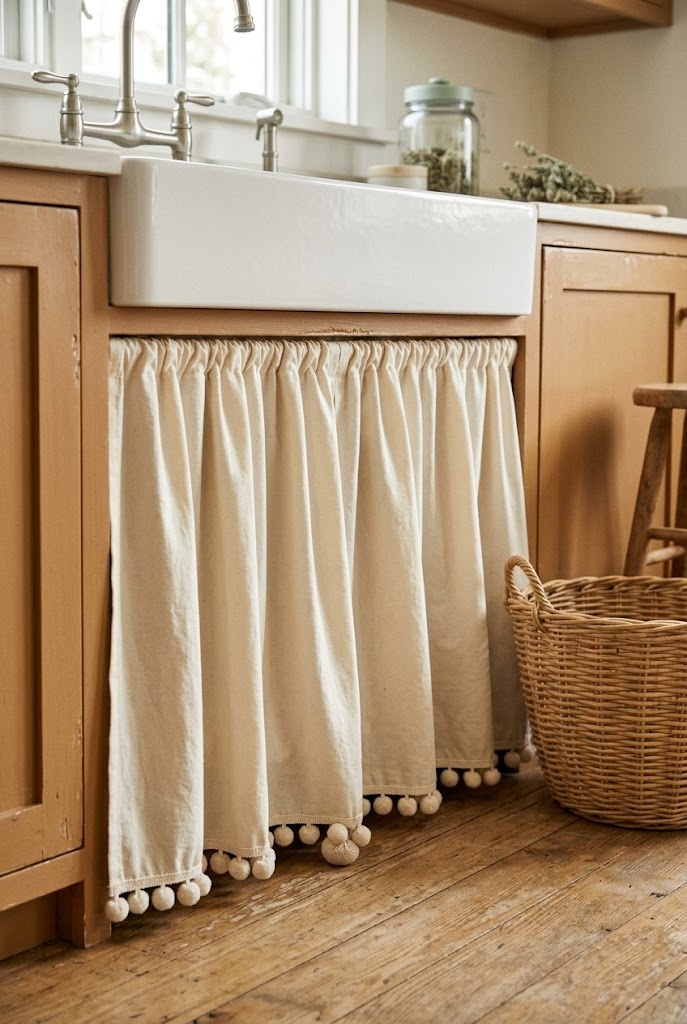
Pom-pom trim along the hem is the cheapest way to make a plain panel look deliberately styled, and at roughly four dollars a metre it stays a low-risk experiment. Fix it with fusible tape along the flat woven header band of the trim, never through the poms themselves. Choose a pom size under half an inch. Larger poms swing, collect dust, and give small children and cats something irresistible to pull at. If you have either in the house, skip this one and use the flat ribbon border approach instead. Cream poms on a cream panel give texture without the trim shouting, while contrast colours date faster than you expect.
23. A Full Box-Pleat Skirt That Replaces a Broken Cabinet Door
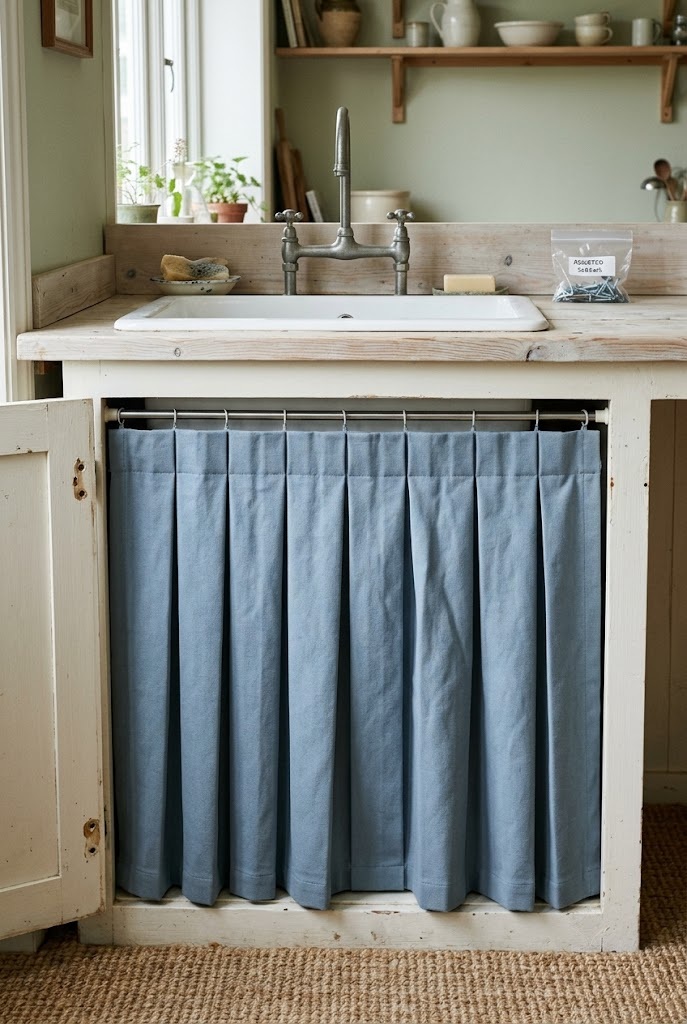
Taking a damaged cabinet door off entirely and replacing it with a box-pleated skirt is often the better call, because a scratched, sagging or split door drags a whole kitchen down in a way a fabric panel never does. Box pleats need three times the opening width in fabric. Fold 4-inch pleats every 4 inches, press hard with a hot iron, and let the creases set overnight under a heavy book before mounting anything. Keep the hinges and screws in a labelled bag for move-out day. The same trick scales to a whole run of lower cabinets with the doors taken off, though a full run needs matching fabric bought in one cut.
Final Thoughts
The fabric decides the mood and the mount decides whether it survives, so choose the mount first if your cabinet has no face frame for a rod to grip. Tension rods for framed openings, Velcro for a flat counter lip, clip rings when you want the hardware to show. Any of these will warm up the kitchen for fall without a drill or a single hole in something you do not own, and all of them come down in five minutes when the lease ends. Save this post to Pinterest so the fabric list and the mount methods stay together.
Frequently Asked Questions
how do you hang a sink skirt without drilling?
Use a spring tension rod inside the cabinet frame, or sticky-back Velcro under the counter lip. The rod works when your cabinet has a solid wood face frame for the rubber ends to press against. Velcro works on flat, non-porous surfaces, but only after you wipe them down with rubbing alcohol to strip off kitchen grease. Both come away with no marks.
what size curtain do I need for a sink skirt?
Buy fabric 1.5 to 2 times your cabinet opening width, and about 2 inches shorter than the height from rod to floor. A standard 30-inch base cabinet with a 24-inch opening needs roughly 40 inches of fabric width for a soft gather, or 72 inches for box pleats. Short is safer than long, since a hem touching the floor mops your kitchen every time you open it.
will a sink skirt get moldy under the sink?
Not usually, unless you already have a leak. Fabric traps humidity only when there is a steady moisture source, so check the trap and the supply lines before you hang anything. Keep the hem clear of the cabinet base, wash the panel every six to eight weeks, and pull the skirt open for an hour after any big washing-up session.
can I use the same fabric for the window above the sink?
Yes, and it usually looks better than trying to match your cabinets. The same iron-on hem tape and clip-ring methods used here work for no-sew window treatments above the sink, so one packet of tape covers both jobs. Keep the window panel a little shorter than a full tier length so the two do not read as one solid wall of fabric.