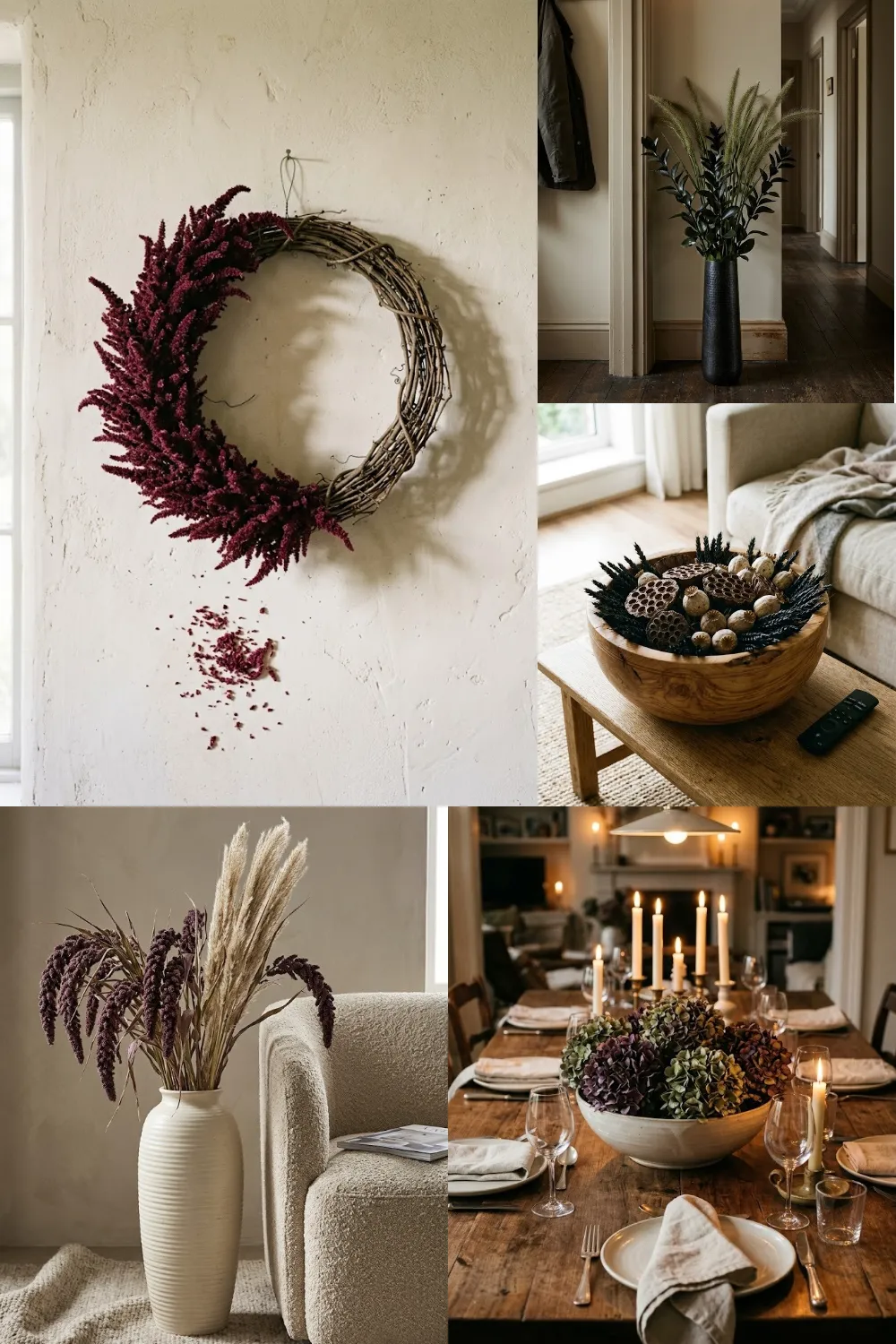
Dried fall flower arrangements with no orange in them come down to swapping three stems: skip the dyed bunny tails, skip the wheat-and-pumpkin pairing, and build on plum, burgundy and chocolate instead. Most dried-flower roundups hand you the same pampas bundle every October, and the ones that do avoid orange tend to go bleached and pale rather than dark. This list goes the other direction. It is organized by vessel rather than by flower, from bud vases up to hanging bunches, with real stem counts, rough costs and honest notes on what sheds. I have run out of patience for a mantel that looks identical to last year's. Save this to Pinterest so you can find it when the stems go on sale.
1. Single Burgundy Amaranth Stem in a Squat Cream Bud Vase
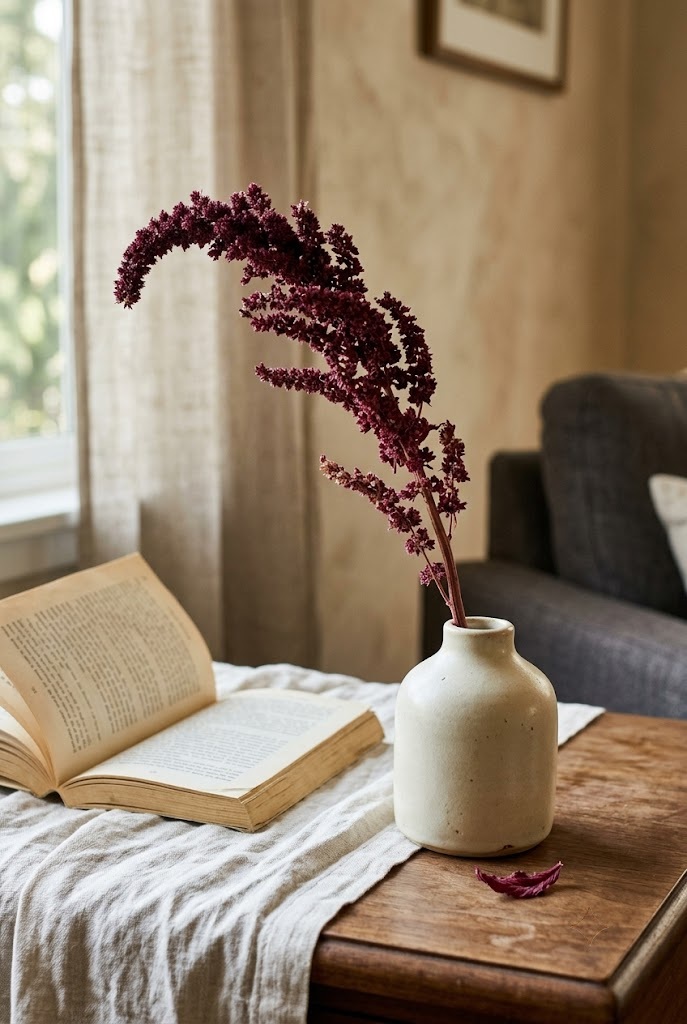
One dark amaranth stem in a squat cream vase reads as deliberate fall color without a single orange note, because the burgundy carries the whole thing and the vase stays quiet. Cut the stem so the flower sits about one and a half times the vase height above the rim, no taller, or the proportion tips forward. Amaranth droops naturally, so let the tail hang over the edge instead of forcing it upright. Buy dried stem bundles rather than single stems; a bundle of ten costs roughly what three loose stems cost at a florist and leaves you spares for idea 2 and idea 24. Cream glaze matters here, because true white goes cold against burgundy.
2. Three-Vase Cluster of Plum Statice, Nigella Pods and Chocolate Ruscus
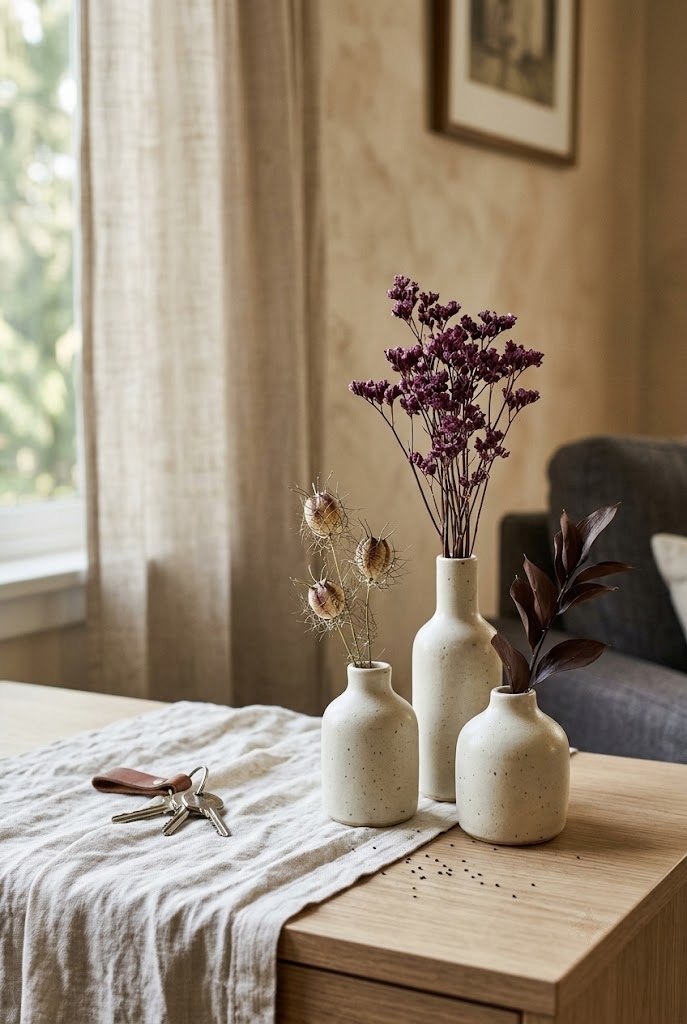
Three small vases holding one stem type each beat one vase holding a mixed bouquet, because the eye reads three clean shapes instead of one muddle. Use odd heights: roughly 4 inches, 6 inches and 9 inches, grouped inside an area no wider than a dinner plate so the cluster stays one object. Ceramic bud vase sets sell in threes for exactly this reason and run cheaper than buying singles. Put the tallest vase back left or back right, never dead center. Statice holds its plum color for years, nigella pods bring the round shape, and dark ruscus supplies leaf so nothing looks like a jar of dry sticks.
3. Black Bearded Wheat in a Narrow Smoked-Glass Bud Vase
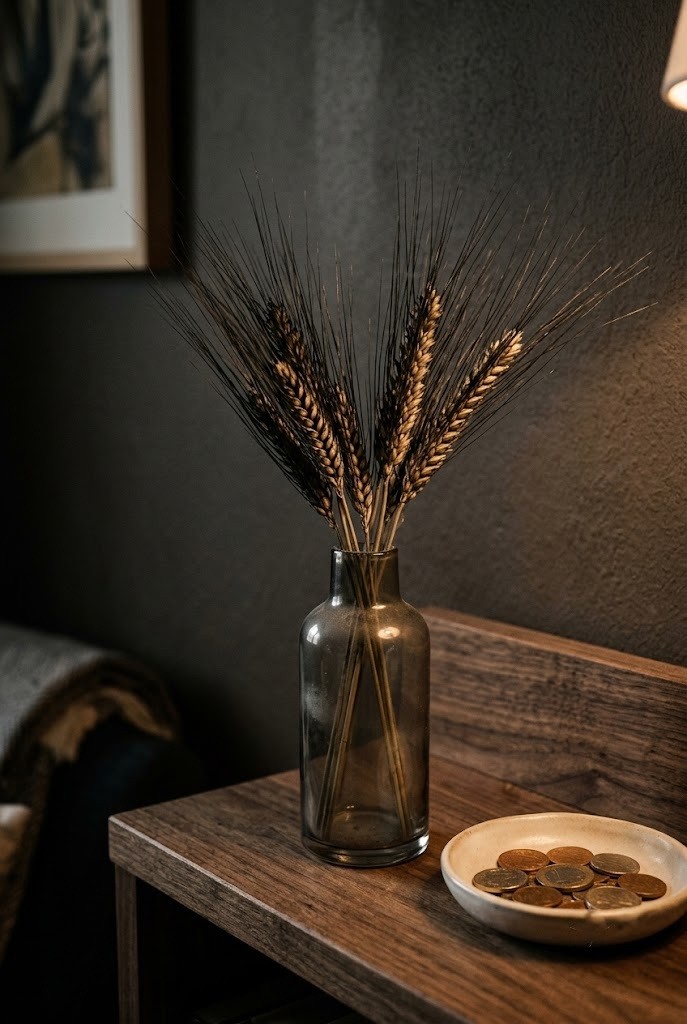
Smoked glass solves the one problem every clear vase has with dried stems, which is that you can see the cut ends and the dust collecting in the bottom. Five to seven wheat stems is the right count for a narrow neck; more and they splay open, fewer and it looks accidental. Black bearded wheat has long awns that catch light, so set it where a lamp rakes across it rather than lighting it head on. Trim each stem to a slightly different length so the heads sit staggered instead of forming a flat line. If clear glass is all you own, drop a handful of dark coffee beans in the base.
4. Dried Hydrangea Head Cut Short in a Speckled Stoneware Bud Vase
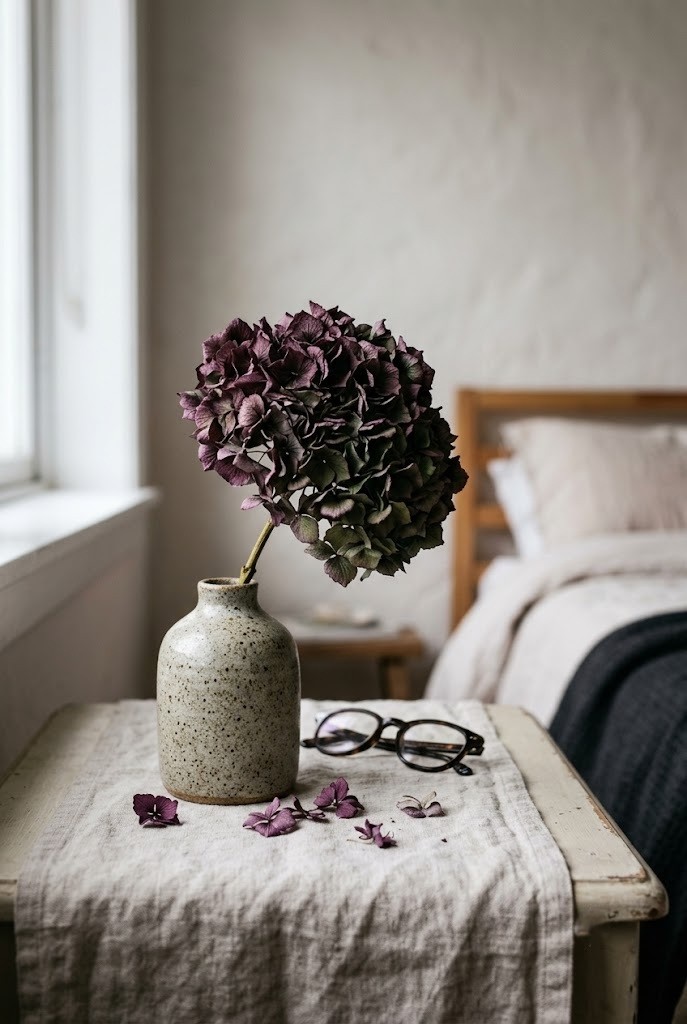
A single hydrangea head cut down to two inches of stem turns a bud vase into something closer to a small sculpture. Hydrangea dries best when you leave it on the plant until the petals go papery, usually late September, then cut it and stand it in an inch of water and let that water evaporate away. Aubergine and antique green are the two colors worth chasing; the pink varieties fade to a dusty beige that fights everything else here. Handle it by the stem only, because the florets crumble under fingers. Speckled stoneware suits it since the flecks echo the uneven petal color, unlike the smooth smoked glass in idea 3.
5. Bathroom Shelf Bud Vase With Preserved Eucalyptus and Deep Plum Larkspur
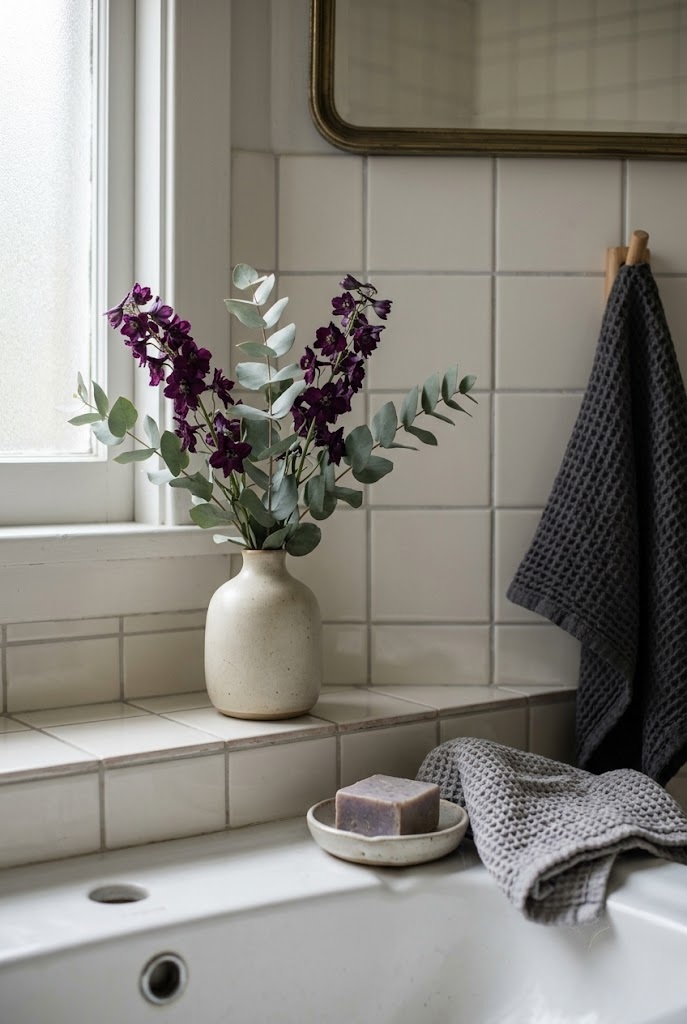
Bathrooms are the one room where preserved stems beat fully dried ones, because glycerine-treated eucalyptus stays supple in steam while brittle dried stems shed straight into the sink. Keep the whole arrangement under 8 inches tall so it clears a shallow shelf and does not get swept off by a towel. Two eucalyptus sprigs and three larkspur spikes is enough, since a bathroom shelf is not the place to chase volume. Deep plum larkspur gives you vertical line without the rust and orange that shows up in almost every fall bathroom styling roundup. Run the exhaust fan during showers regardless, because standing humidity will eventually spot even preserved leaves.
6. Chocolate Palm Spears in a Matte Black Floor Vase, No Pampas
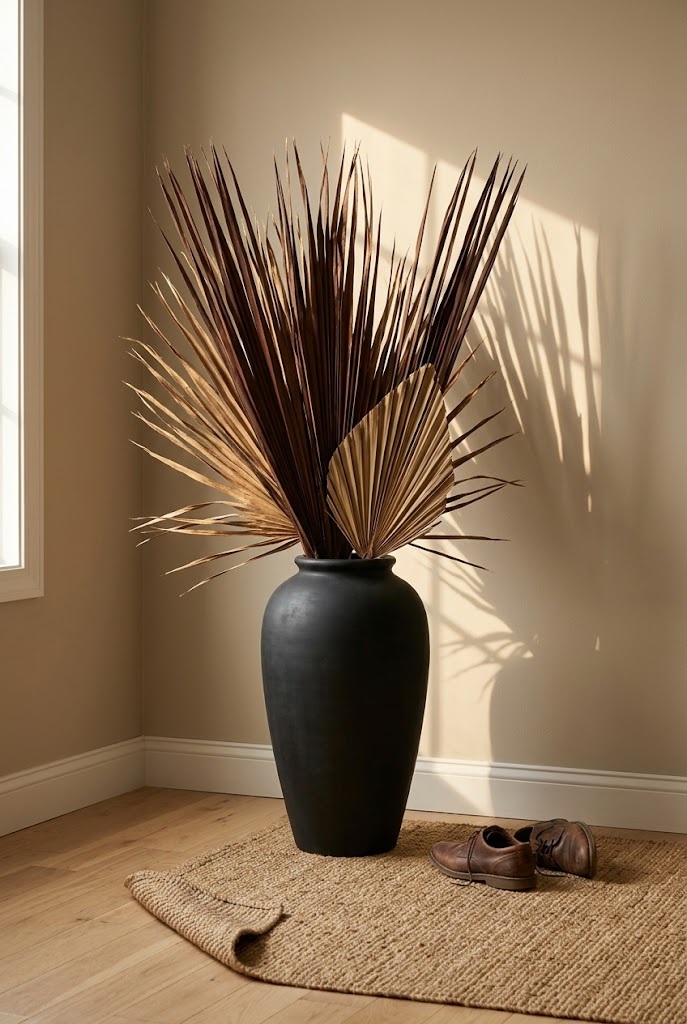
Palm spears do everything pampas does with half the shedding, and a tall floor vase changes the proportion of a whole corner in a way no tabletop piece can manage. Aim for stems reaching roughly one and a half times the vase height above the rim, so a 24 inch vase wants around 36 inches of stem showing. Five to nine spears fills a wide mouth; beyond that it starts to read as topiary. Matte black grounds the chocolate tones and hides the bare cut ends sitting inside. Weight the base with sand or gravel before loading it, because a tall vase full of dried stems is genuinely top heavy.
7. Bare Birch and Burgundy Oak Branches in a Tall Ceramic Floor Vase
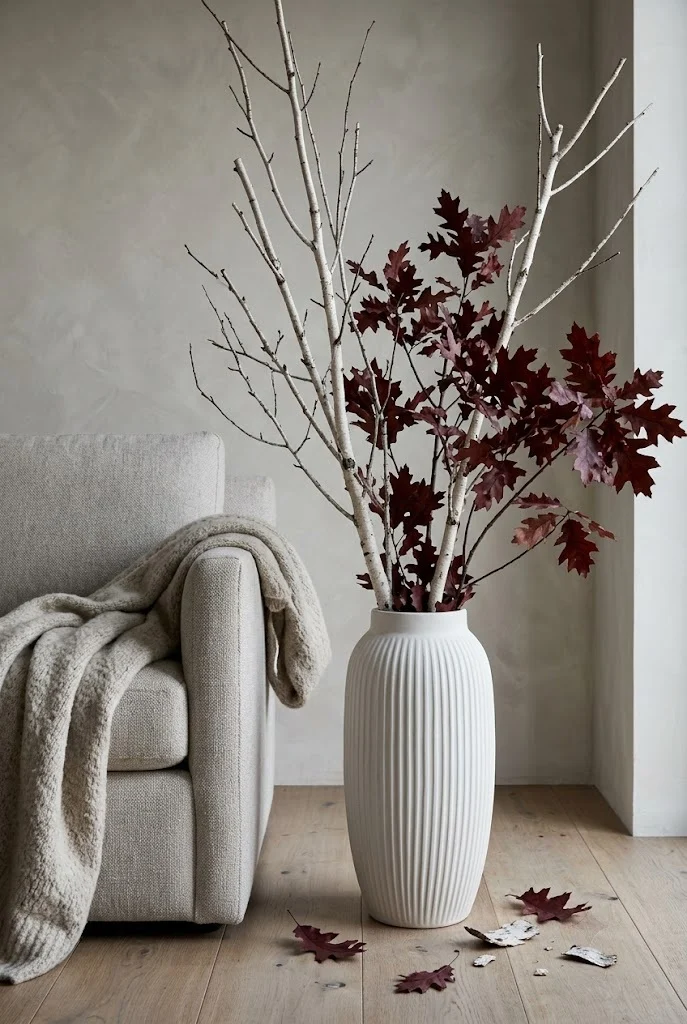
Branches cost nothing and read more expensive than anything you can buy, which is the entire argument for this one. Cut birch or any pale bare branch in threes at different lengths, then add two or three burgundy oak branches with leaves still attached and preserve them by standing the cut ends in a glycerine and water mix for about a week. Leaves treated that way stay flexible instead of shattering by November. Keep the total height under roughly 5 feet indoors or the arrangement starts fighting the ceiling. Strip every leaf that falls below the vase rim, since that is what separates a deliberate branch arrangement from a bucket of yard waste.
8. Dried Wheat Sheaf Bundled Tight in a Wide-Mouth Terracotta Floor Vase
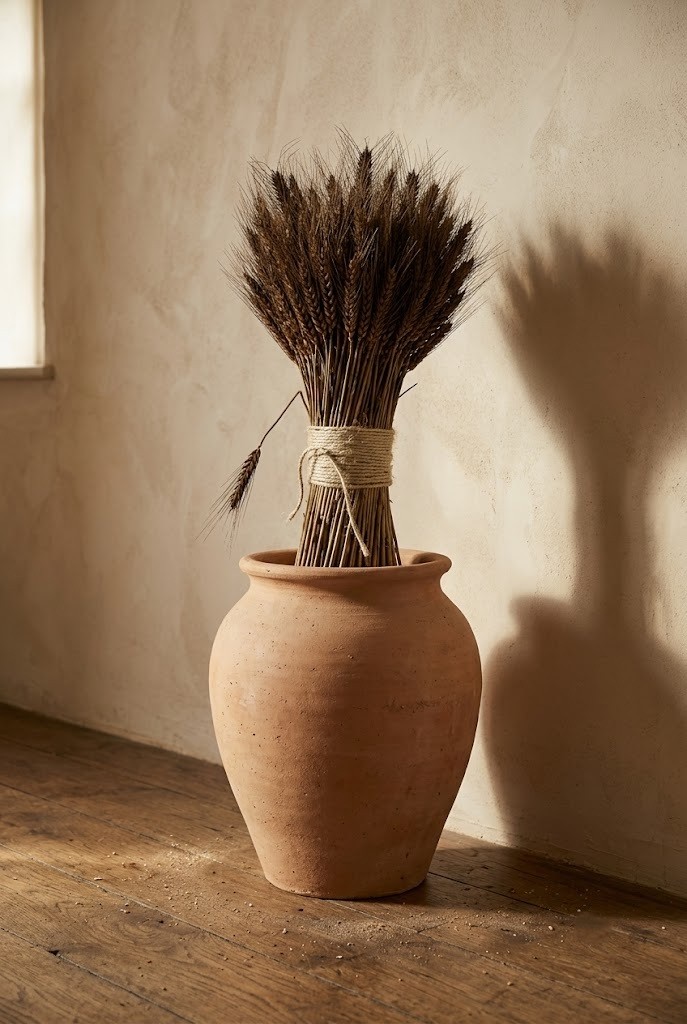
A tight sheaf reads completely differently from a loose spray: bind the wheat with twine about 6 inches below the heads so the bundle stands as one solid column instead of fanning open. Use enough stems that the bundle is at least as thick as your wrist, which usually means two to three dried stem bundles from a craft store. Unglazed terracotta suits it because the matte clay and the straw sit close in tone, so the eye reads one warm mass, warmer and softer than the matte black vessel in idea 6. Black bearded or smoked wheat keeps this out of orange territory, since standard golden wheat drifts straight back into harvest decor.
9. Plum Millet and Setaria in a Ribbed Cream Floor Vase Beside a Sofa
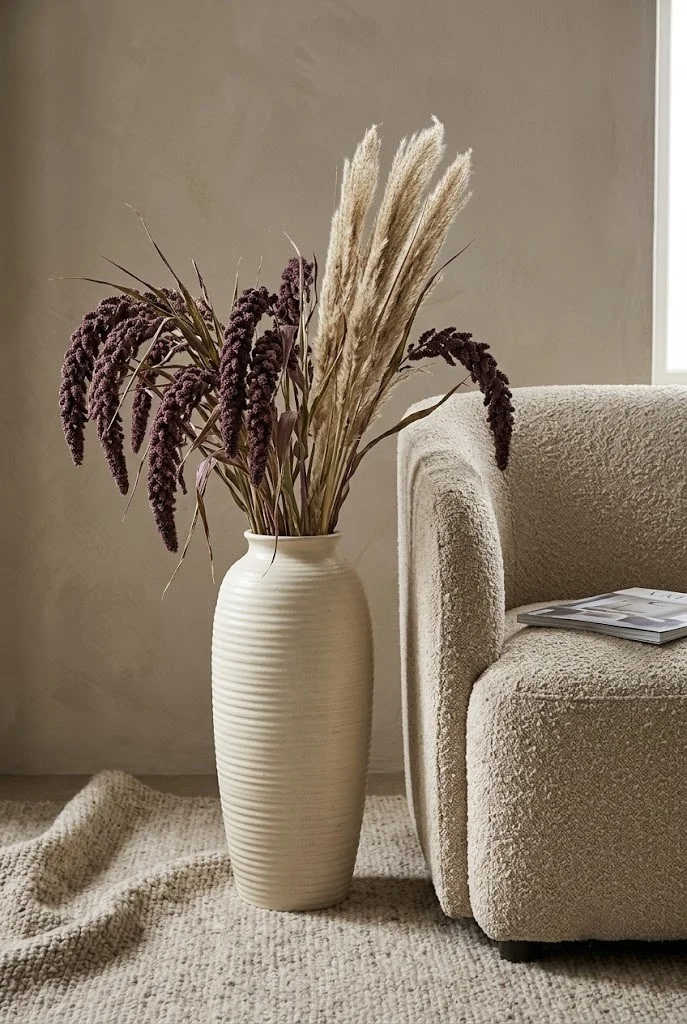
Millet carries a heavy drooping head that fills the top of an arrangement where most grasses go thin, so pairing it with upright setaria gives you mass and line in the same vase. Set the vase 4 to 6 inches out from the sofa arm rather than tight against it, so nobody catches the stems on the way down onto the cushions. Ribbed cream ceramic keeps the vessel quiet while the stems do the work. Plum-dyed millet is widely sold and the dye holds far better than the dye used on bunny tails, which goes blotchy within one season. Nine to twelve stems total suits a 5 inch mouth.
10. Dark Ruscus and Fountain Grass in a Narrow Metal Floor Vase for a Hallway
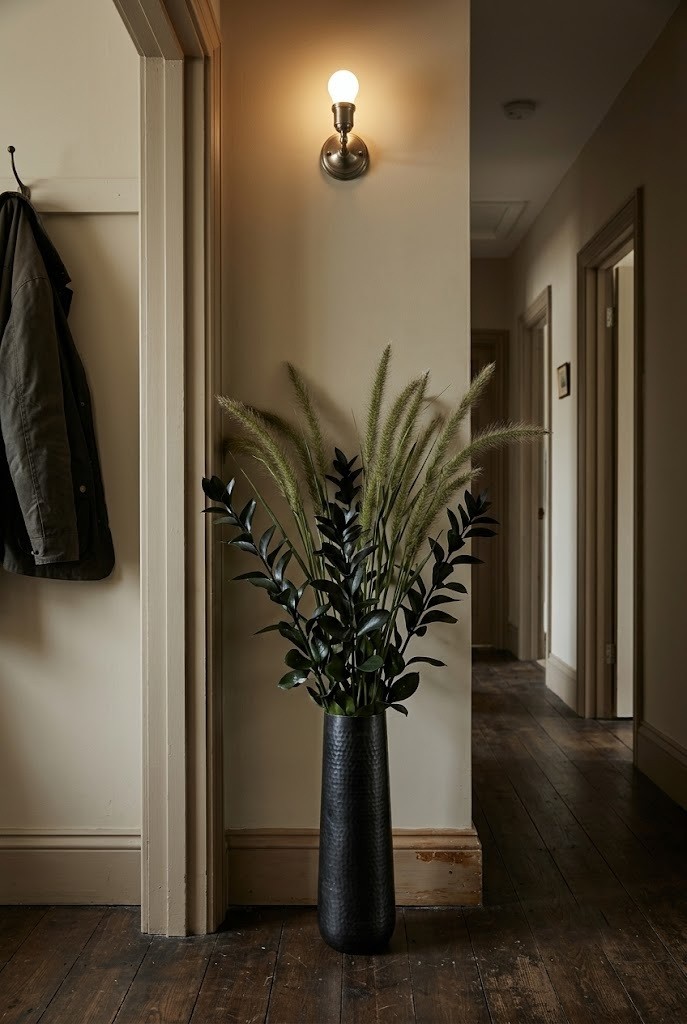
Narrow hallways need a vase with a footprint under about 8 inches, and metal survives the knocks that ceramic does not. Keep the stems tight and vertical rather than spreading, because anything leaning into a walkway gets caught by a coat sleeve within a week. Dark ruscus supplies a deep green-black leaf and fountain grass gives a soft top without much shedding. Fill the vase with dry rice instead of floral foam so the stems stay upright and you can still rearrange them later. If the hallway runs dim, pick stems with some sheen, since fully matte dried grass simply disappears in low light.
11. Flower Frog Bowl of Burgundy Craspedia and Nigella in a Shallow Stone Dish
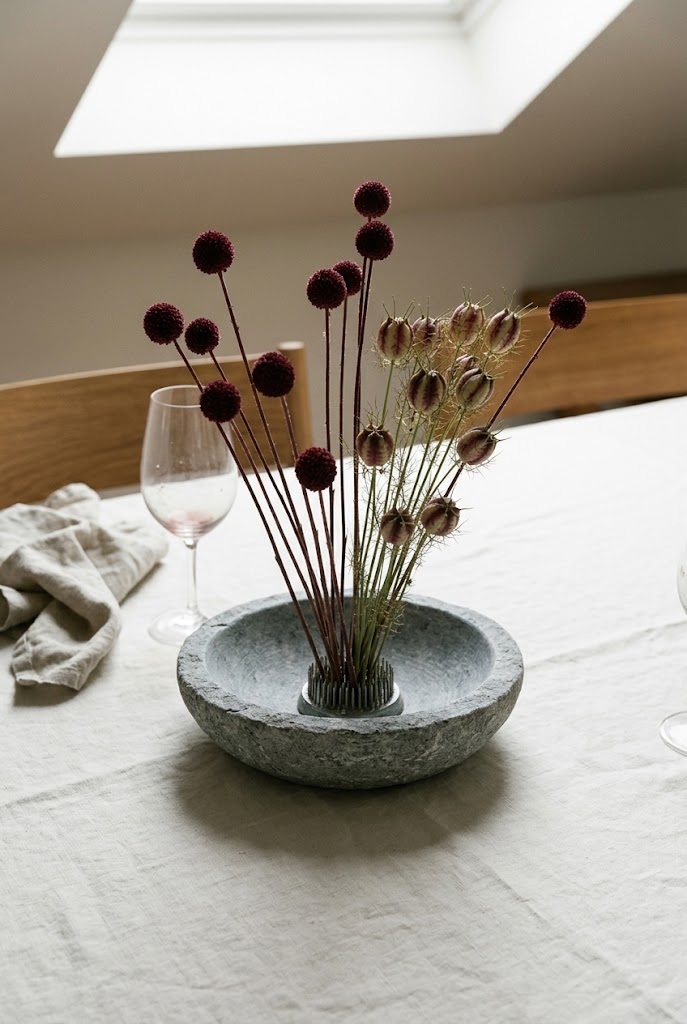
Flower frogs are what make a shallow bowl work at all, because a low dish gives stems nothing to lean against. A pin frog around 2 to 3 inches across holds roughly 15 to 20 dried stems, and you press each stem in at an angle rather than straight down so the finished shape domes slightly. Craspedia dyed burgundy keeps its perfect sphere shape indefinitely and never sheds a thing, which makes it the most forgiving stem in this whole list. Nigella pods add striped detail up close. Set the frog off center in the bowl, then let three or four stems break the rim line so the outline is not a neat circle.
12. Dinner Table Low Bowl of Dried Hydrangea in Aubergine and Antique Green
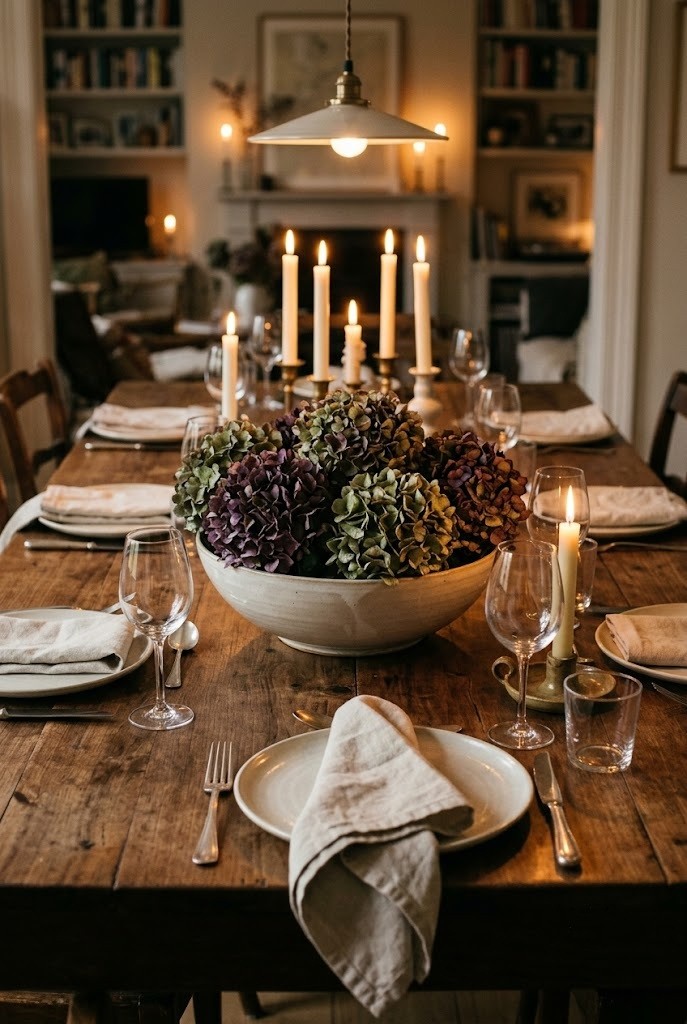
Keep any dinner table arrangement under 12 inches tall so people can actually see each other across it, which rules out most dried grasses and makes hydrangea the obvious pick. Three to five heads packed into a low bowl fills it completely with no mechanics at all, since the heads support one another. Aubergine and antique green together give a depth that a single color cannot reach. Hydrangea crumbles the moment it gets brushed, so build the bowl once and move the whole thing rather than adjusting stems at the table. A light mist of unscented hairspray from about 12 inches away cuts the shedding without changing the color.
13. Chocolate Cosmos and Dried Fern in a Footed Brass Bowl
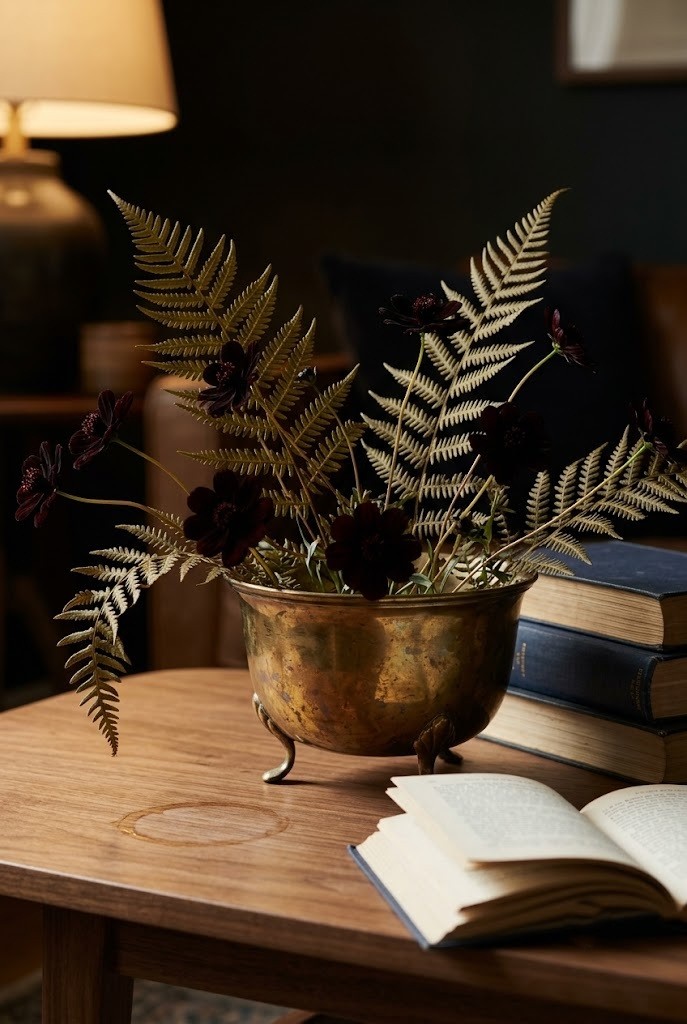
Chocolate cosmos is the darkest flower you can get dried, close to black-red, and a footed brass bowl lifts it just enough that the color stays visible instead of sinking into the table. Real chocolate cosmos is expensive and fragile, so most people substitute dyed dahlia or dried scabiosa sold under the same look, and both survive coffee table life better. Dried fern fronds laid flat across the rim create a horizontal line that stops the bowl reading as a mound. Brass warms the whole thing, which matters more than it sounds: a very dark arrangement in a cool silver or chrome bowl goes gloomy within a day.
14. Coffee Table Bowl of Poppy Pods, Lotus Pods and Black Wheat
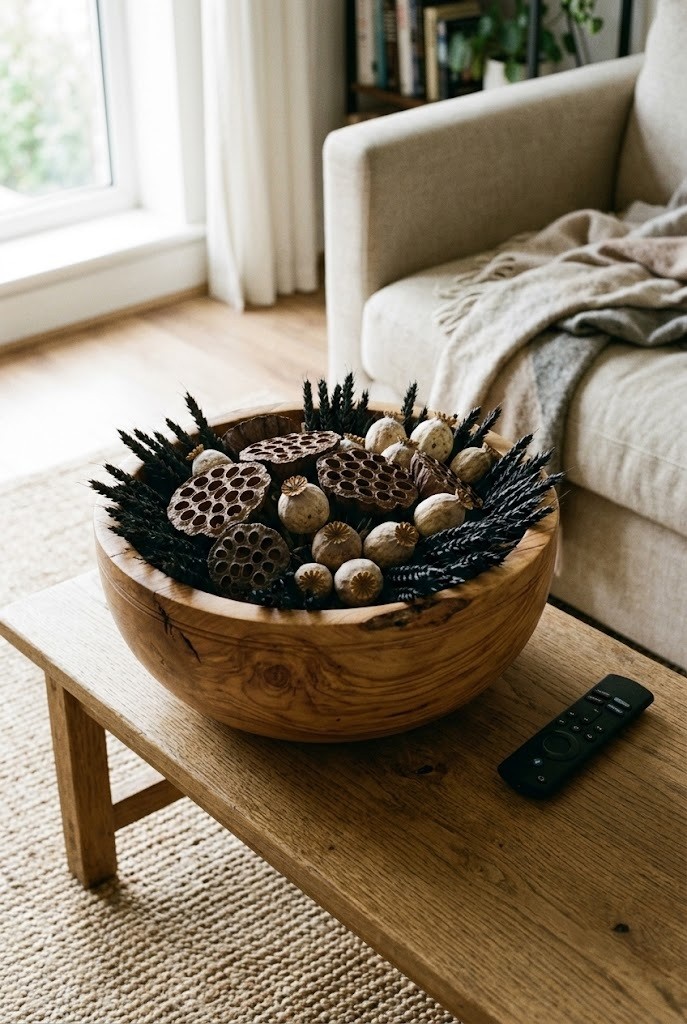
Pods carry an entire arrangement when you want texture without a single petal, and they survive being knocked by remote controls and feet on the table. Mix three sizes: large lotus pods sitting at the base, medium poppy pods filling the middle, and black wheat heads breaking the outline at the top. Cut everything short, roughly 3 to 5 inches, so the bowl stays below coffee table sightline. Pods collect dust in every hollow, so plan on blowing them clear with a hairdryer on the cool setting once a month. This is the most durable arrangement on the list and the one to pick if you have cats.
15. Kitchen Island Low Bowl of Preserved Eucalyptus and Plum Statice
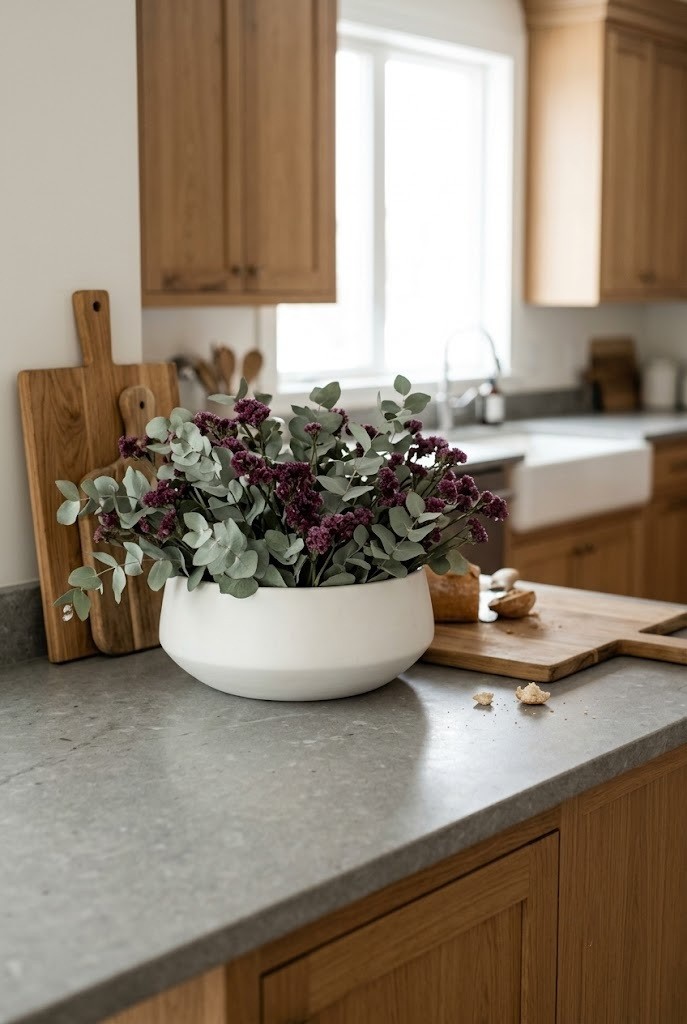
Kitchen arrangements need to survive heat and airborne grease, which makes preserved eucalyptus the safe pick and rules out anything with loose seed heads. Build it wide and low, no more than 6 inches tall, so it never blocks the sightline across an island. The same no-orange logic works on a kitchen counter as it does on a mantel: pull out the dyed orange filler, put plum statice in its place, and the whole surface stops looking like a seasonal display and starts looking like part of the room. Keep the bowl at least 18 inches from the cooktop. Wipe the leaves with a barely damp cloth every few weeks, since kitchen film dulls preserved foliage faster than plain dust ever does.
16. Asymmetric Half Wreath of Burgundy Amaranth on a Bare Grapevine Base
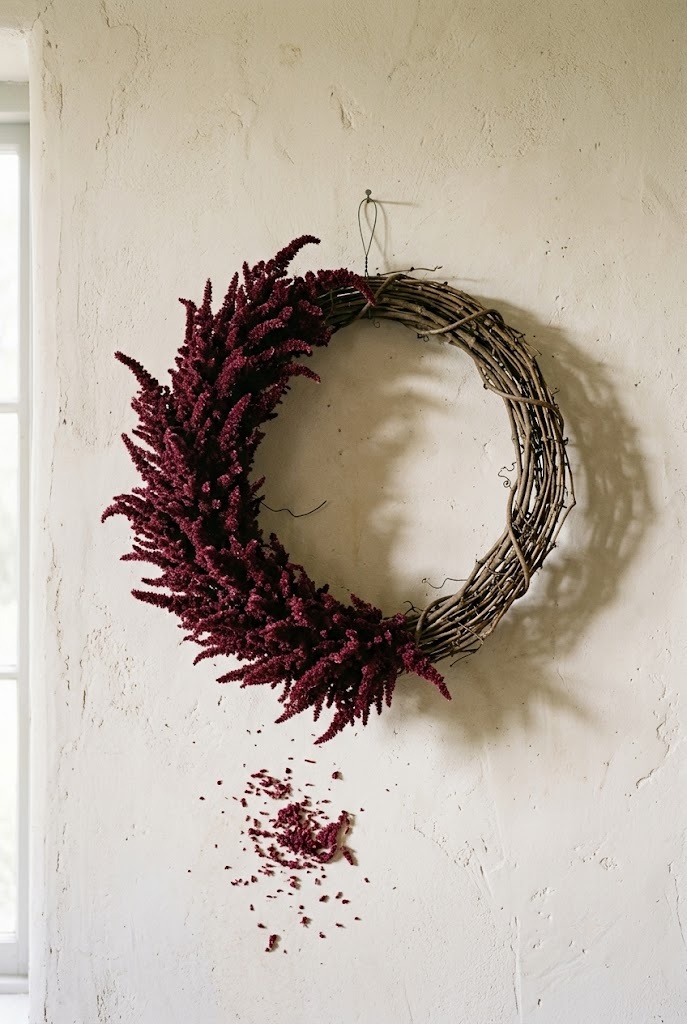
Leaving half the wreath base bare is what makes a dried wreath look designed rather than crafty, and it happens to cut your stem cost roughly in half. Wire the amaranth in overlapping clusters along one third to one half of the ring, all facing the same direction, then stop cleanly instead of tapering off into nothing. Grapevine is the right base for this because the exposed section is genuinely worth looking at on its own. Use paddle wire rather than hot glue so you can strip it and rebuild next year. A 16 inch ring covered halfway takes roughly 20 to 25 amaranth stems.
17. Full Plum Hydrangea Wreath on a Dark Painted Front Door
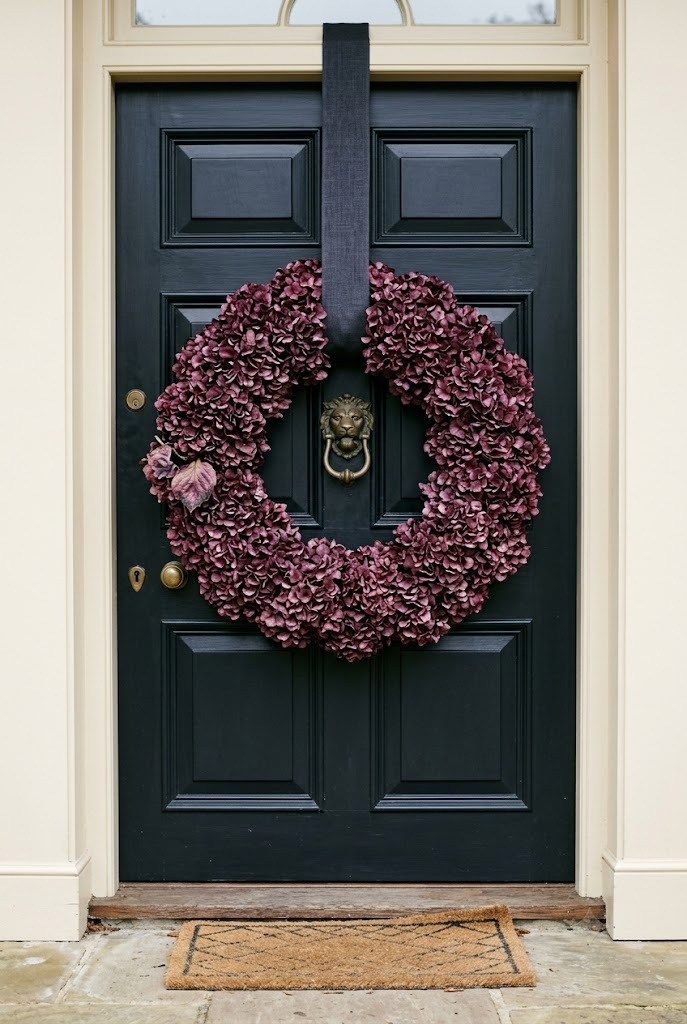
Full coverage is right on a front door where a half wreath reads unfinished from the street, and plum hydrangea gets you that coverage with fewer stems than any other flower, which is the opposite of the bare-base approach in idea 16. Expect real fading outdoors: under a covered porch a hydrangea wreath holds color about one season, and in direct sun about six weeks. Against a dark painted door the plum reads deep rather than pink, which is not true against white. This is the piece that finishes a brown and cream front porch without adding a single pumpkin. Hang it on a wide ribbon rather than a wire hook so it sits off the door and gets airflow behind it.
18. Chocolate Wheat and Black Bearded Barley Ring for an Interior Wall
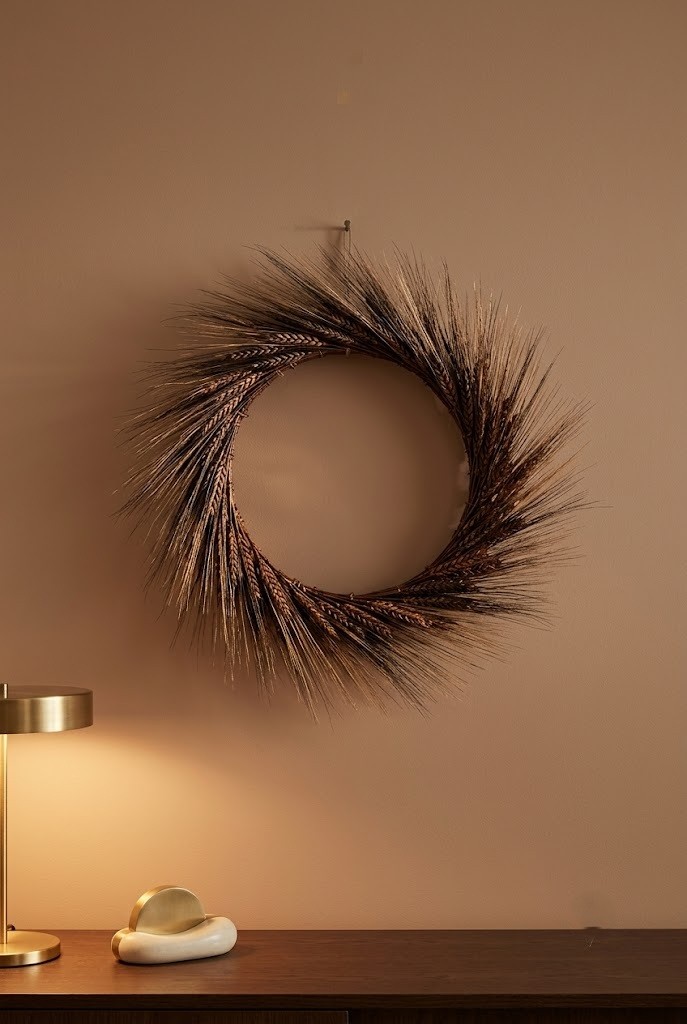
Indoor wreaths can run thinner and far more graphic than door wreaths, so a narrow ring of wheat and barley laid all in one direction reads almost like a drawing on the wall. Keep the outer diameter around 14 to 18 inches for a standard wall gap, because anything larger needs a genuinely big blank wall to sit inside. Lay every stem the same way around the ring so the awns create one continuous sweep instead of a scribble. Smoked or chocolate-dyed wheat avoids the golden harvest look completely. Hang it on a nail set slightly high so the ring tips forward a few degrees and catches light along the awns.
19. Small Preserved Eucalyptus and Nigella Wreath Hung on a Kitchen Cabinet
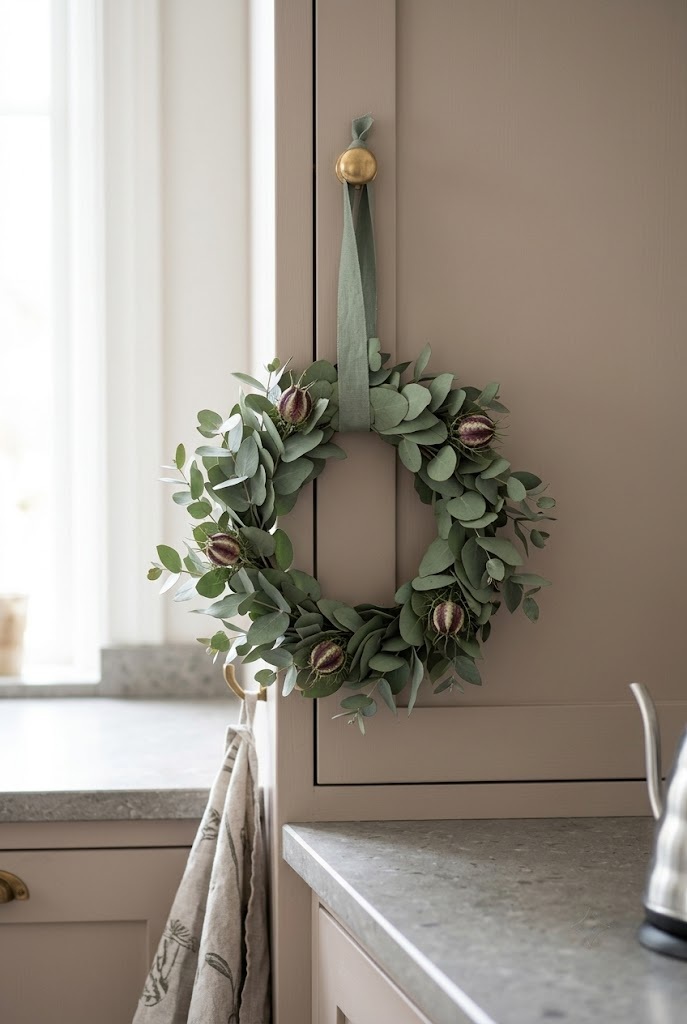
An 8 to 10 inch wreath on a cabinet door hits the right scale for a kitchen, where a full-size wreath just swallows the space and blocks the handle. Hang it with a ribbon looped over the cabinet top and taped inside, or a removable adhesive hook rated above 1 pound, so renters leave nothing behind. Preserved eucalyptus stays flexible enough to survive the door swinging open twenty times a day. Add nigella pods sparingly, maybe seven or eight, positioned in a loose arc rather than scattered evenly around the ring. Check the wreath clears the countertop when the door opens, which is the detail most people discover only after hanging it.
20. Loose Dried Eucalyptus Garland With Burgundy Amaranth Falling at One End
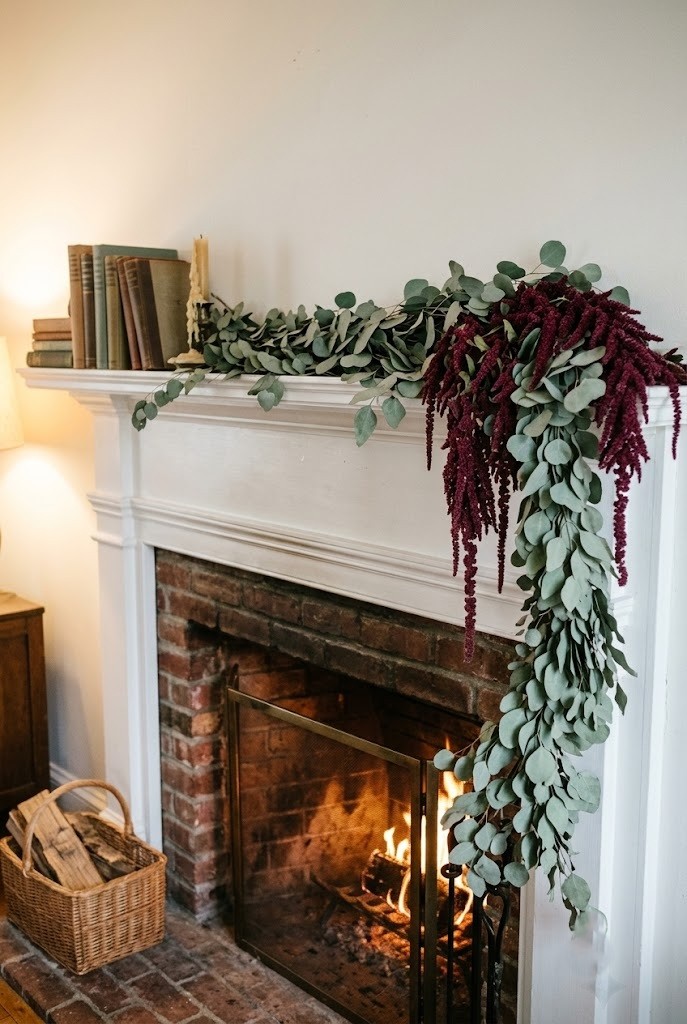
Weighting a garland to one end fixes the symmetrical mantel look that nobody actually wants, and it costs nothing to do. Run preserved eucalyptus along the full mantel, then concentrate the burgundy amaranth in the final third and let a few stems drop 10 to 14 inches over the edge. Anchor the garland with two heavy objects at the ends, a candlestick at one side and a stack of books at the other, rather than taping it to the shelf. Preserved eucalyptus stays pliable for years and is worth the extra cost over dried for anything that has to bend around a corner. Keep the drop at least a foot clear of a working firebox.
21. Wheat and Ruscus Mantel Garland Kept Under Fifteen Inches Deep
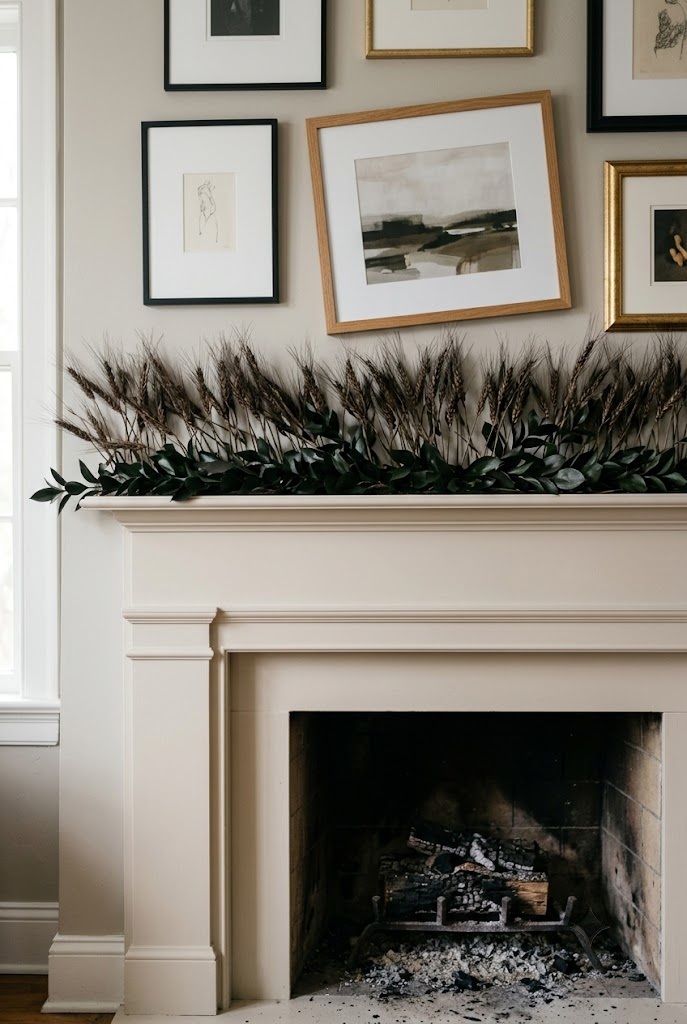
Depth is the measurement that ruins mantel garlands, not length: anything projecting more than about 15 inches out from the wall gets bumped constantly and blocks whatever art hangs above. Build on a thin wire spine, lay the ruscus flat against the mantel first, then angle the wheat slightly outward for texture. Trim back any stem pointing straight into the room. Fifteen inches sounds generous until you add a candle in front of it and realize the flame sits inside the greenery. This is a tighter, more disciplined version of the loose garland in idea 20, and the better choice for a narrow room or a fireplace you actually use.
22. Plum Statice and Dark Fern Garland Woven Along a Shelf Ledge
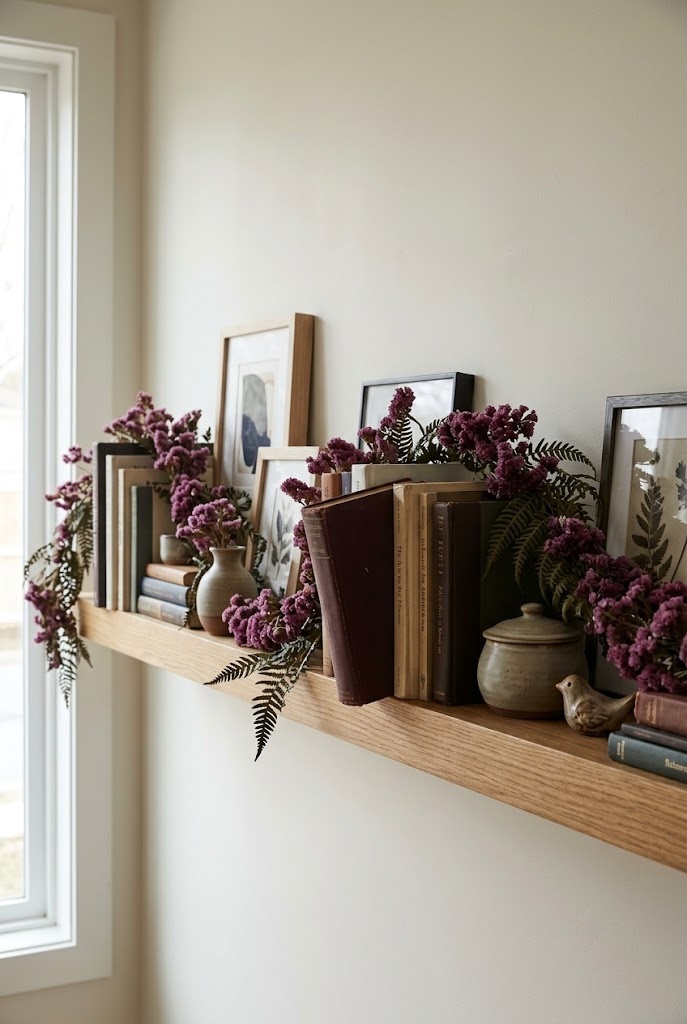
Shelf ledges take a garland better than mantels in most apartments, since not everyone has a fireplace and a floating shelf delivers the same horizontal line for free. Weave the statice and fern through the objects already on the shelf rather than laying the garland in front of them, so books and frames sit inside the greenery instead of behind a hedge. Statice is nearly indestructible and holds plum color for years without fading, which matters a lot on a shelf that catches daylight. Leave at least a third of the shelf completely empty. Two feet of garland usually covers a four foot shelf once the gaps are accounted for.
23. Bookcase Ledge Garland of Bleached Ruscus Dyed Deep Wine
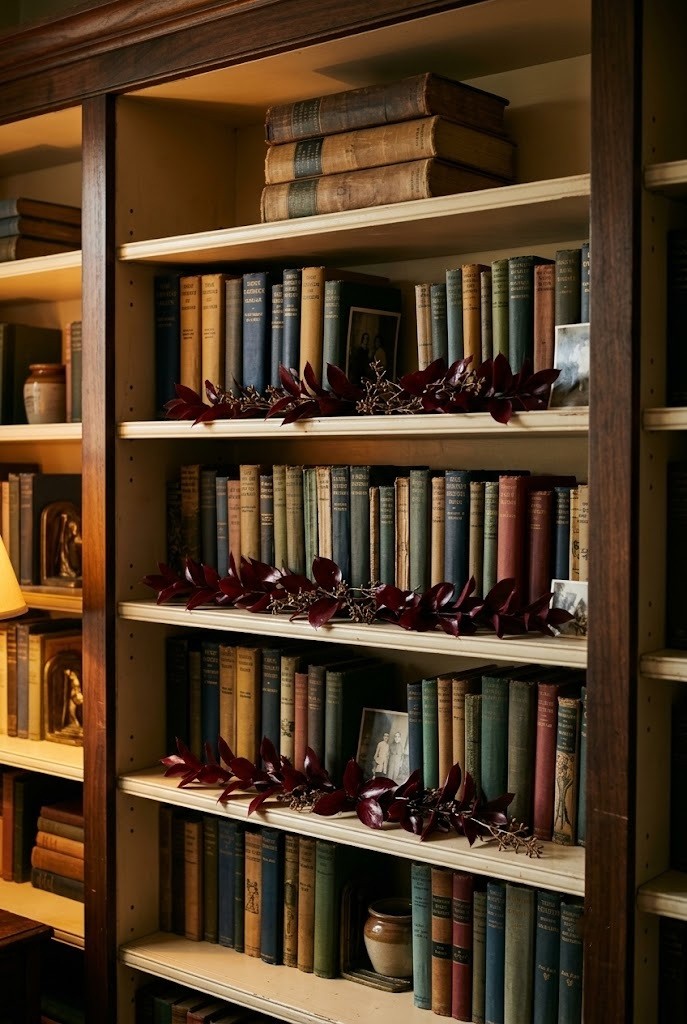
Wine-dyed ruscus gives you leaf shape in a color that does not exist in nature, and that is exactly why it works against books, where a true green would read like somebody forgot to water a houseplant. Run short 12 to 18 inch sections across two or three shelves rather than one long continuous piece, so the eye moves up the bookcase instead of stopping at one line. Dyed ruscus can transfer color onto light surfaces when humidity climbs, so slip a strip of clear plastic underneath it on painted or unfinished wood. Buy it by the bunch, since a single bunch usually covers two shelf sections.
24. Upside-Down Drying Bunch of Burgundy Amaranth Hung From a Kitchen Beam
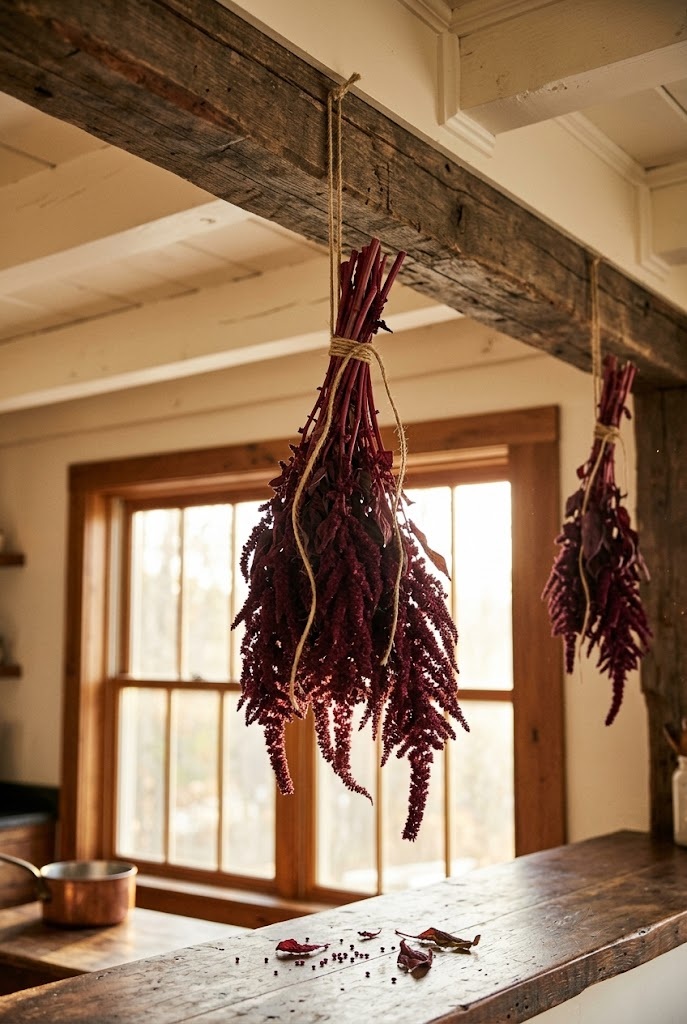
Hanging a bunch upside down to dry is both the method and the display here, so you get several weeks of the fresh color slowly settling into its final burgundy while it earns its place on the wall. Tie 8 to 12 stems with twine, leaving the loop long enough to slip over a hook, and hang it somewhere dark and dry if you want maximum color retention or out in the open if you accept some fading in exchange for looking at it. Amaranth takes roughly two to three weeks to dry through. Leave 6 inches of clearance below head height. Never hang it above a stove, because steam and grease turn drying stems into a mess.
25. Wall-Hung Dried Wheat and Larkspur Bundle Tied With Chocolate Ribbon
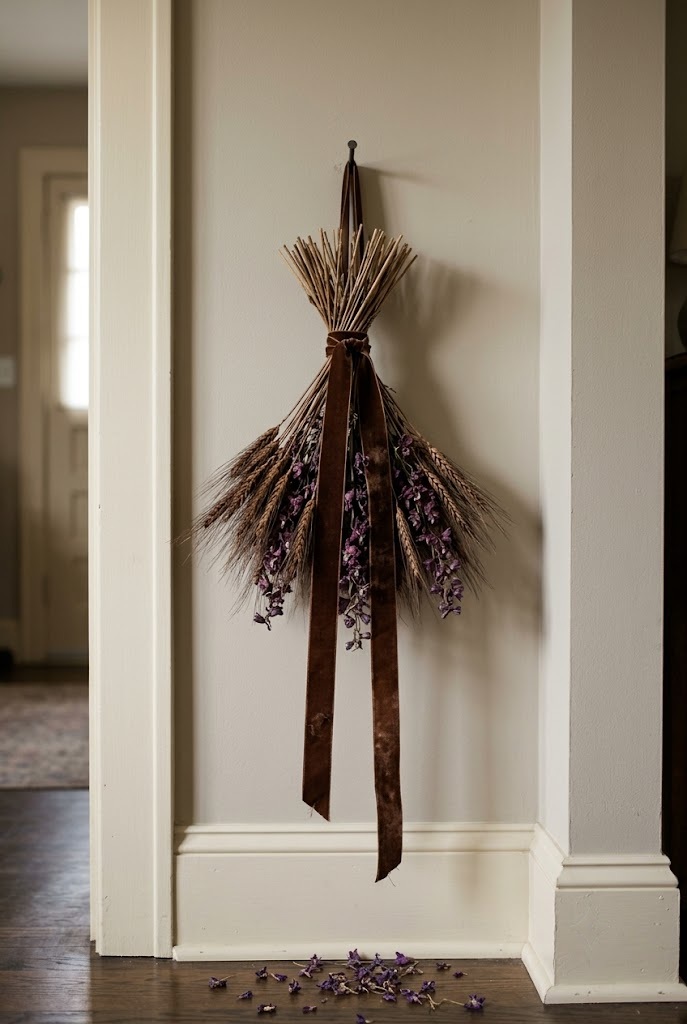
A flat wall bundle is the cheapest thing on this list and the right answer for that narrow strip of wall between a door frame and a corner. Lay the stems out on a table in a fan, wheat at the back and larkspur in front, tie once tightly about a third of the way down, then hang the whole thing from a single small nail. Keep the overall length between 18 and 24 inches so it stays a wall object rather than a decoration jutting into the room. Chocolate ribbon in grosgrain or velvet reads considerably richer than the raw jute everyone reaches for. Dust it by tipping it forward and blowing across the stems.
26. Hanging Hoop of Plum Millet and Preserved Eucalyptus Over a Console
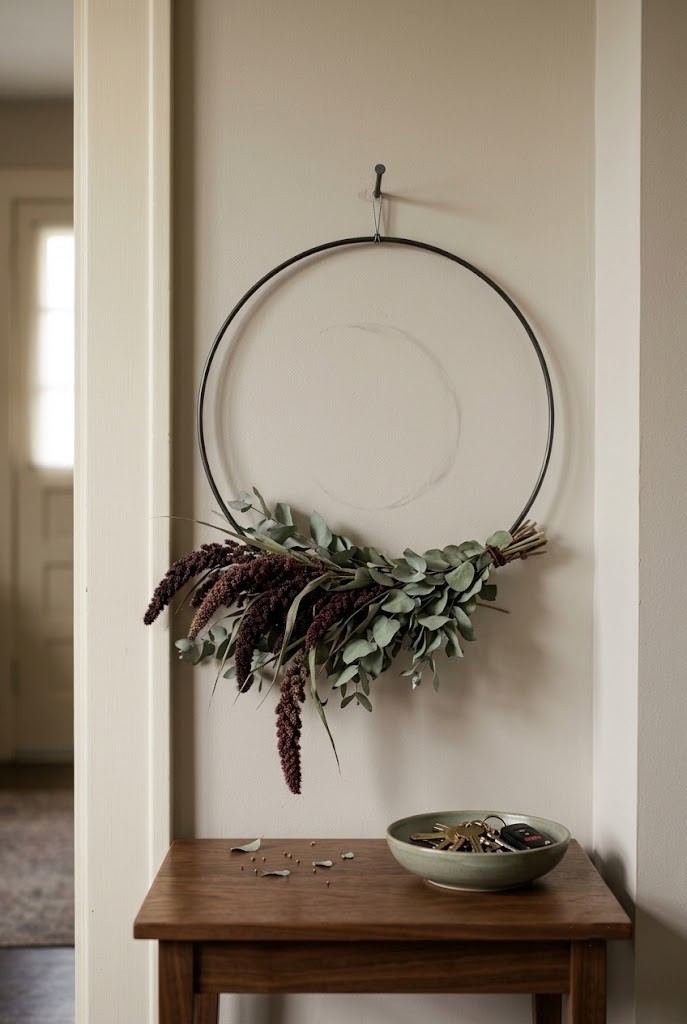
A metal hoop hung 18 to 24 inches above a console gives you height on a bare wall without committing to art, and it costs a fraction of anything framed. Attach stems to one side of the hoop only, roughly the lower left or lower right quarter, and leave the rest of the ring completely empty so the circle stays legible. Millet droops naturally, so let it hang below the hoop rather than forcing it to follow the curve. Use a 14 to 18 inch hoop above a standard console, because anything smaller simply vanishes on the wall. Balance the visual weight by keeping whatever sits on the console low, the same principle behind the low bowl in idea 12.
Final Thoughts
The whole no-orange thing comes down to three purchases: one bundle of burgundy stems, one bundle of dark grass or wheat, and something green and preserved to fill the gaps between them. Every idea above is a recombination of those three plus a different vessel, so the shopping list stays short. Start with the low bowl or the bud vase cluster if you have never worked with dried stems, because both are forgiving and neither needs a flower frog. Save this post to Pinterest so it is there when you are standing in the craft aisle in September.
Frequently Asked Questions
What dried flowers are fall colors but not orange?
Burgundy amaranth, plum statice, chocolate cosmos, black bearded wheat, dried hydrangea in aubergine and nigella pods all read as fall without touching orange. Skip anything labeled harvest mix, which is almost always dyed orange bunny tails plus golden wheat. Preserved eucalyptus and deep red oak leaves fill in around the darker stems.
Do dried flowers or faux stems look more real?
Dried wins for anything with a seed head, pod or grass; faux wins for anything with a soft petal. Real dried wheat, hydrangea and eucalyptus keep a texture no manufacturer replicates, while faux versions of the same read plastic close up. For soft-petaled flowers, faux stems that pass at arm's length are usually easier to find than a decent dried version.
How long do dried flower arrangements last?
Two to three years indoors out of direct sun, and roughly six months on a covered porch. Sunlight is what turns burgundy to dull brown fastest, so keep the dark stems away from a south-facing window. Dust with a hairdryer on the cool setting and never mist them with water, which spots the petals permanently.
Are dried flowers still in style for 2026?
Yes, but the colors moved. Bleached pampas and dyed bunny tails peaked a few years back; what is showing up now is darker and tighter, built on wine, plum and chocolate stems in smaller vessels. Oversized pale pampas in a corner floor vase now reads dated rather than current, which is worth knowing before you buy.