Moody small bathroom ideas usually fall apart the moment you factor in a builder-grade tub shower combo, that glossy white acrylic box fighting every dark wall around it. Every ranking guide photographs freestanding soaker tubs in big windowed rooms, which is useless when you have 40 square feet and an alcove tub bolted to the wall. This post solves that exact problem: how to make the white combo read as intentional instead of a mistake, sorted from a single accent wall up to a full ceiling drench. First, the part nobody warns you about: dark walls in a windowless room need three real light sources, not vibes. Save this to Pinterest so you can plan the lighting before you buy the paint.
1. Charcoal accent wall behind a white alcove tub
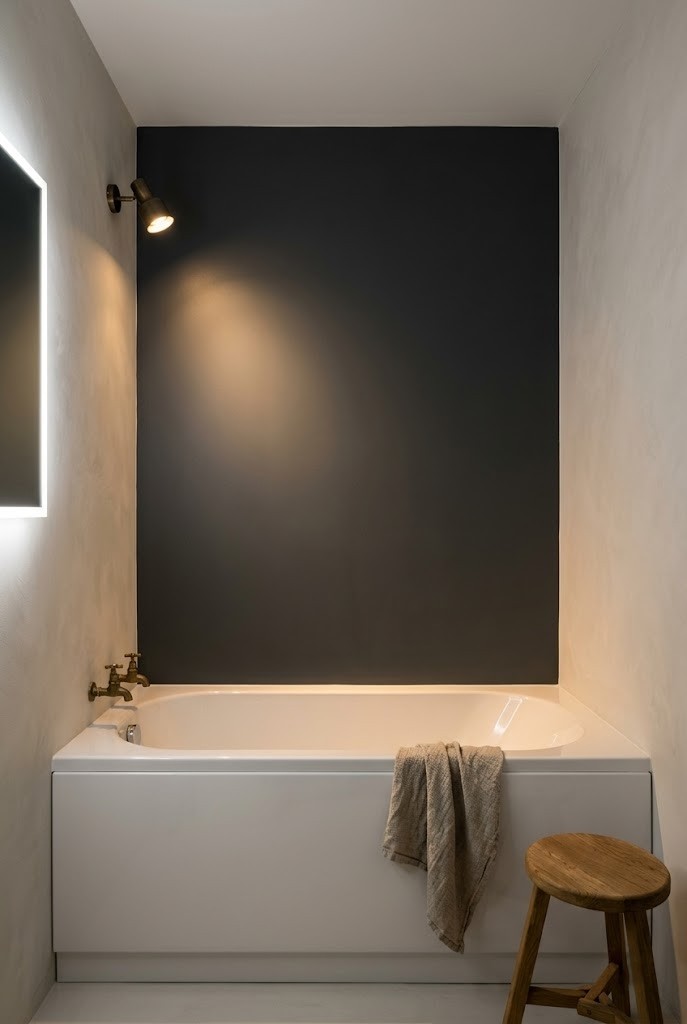
Paint only the wall the tub sits against in a deep charcoal, and the white acrylic suddenly reads as a deliberate bright object instead of an eyesore. This is the lowest-commitment moody move: one plane goes dark, the other three stay pale, and the contrast frames the tub like it was planned. Keep the charcoal in an eggshell or satin finish so steam wipes off without leaving streaks. The trick only works if that dark wall is well lit from the front; a dark wall with a single ceiling bulb above it turns muddy and flat by evening. Position your brightest light source to wash down the charcoal, not the opposite wall.
2. Forest green painted alcove surround, white tub
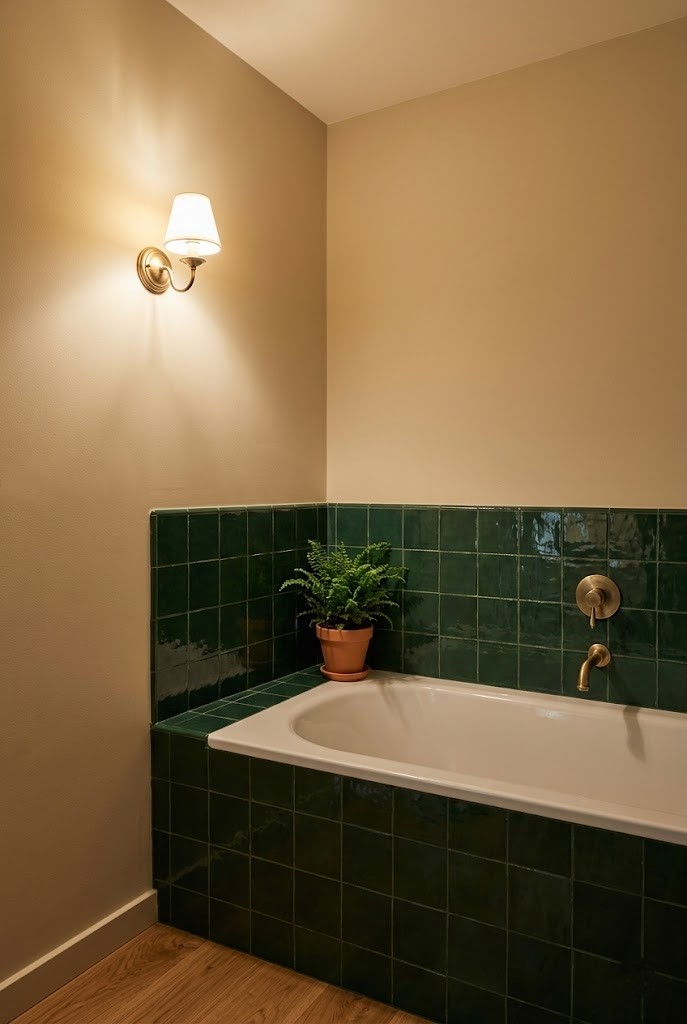
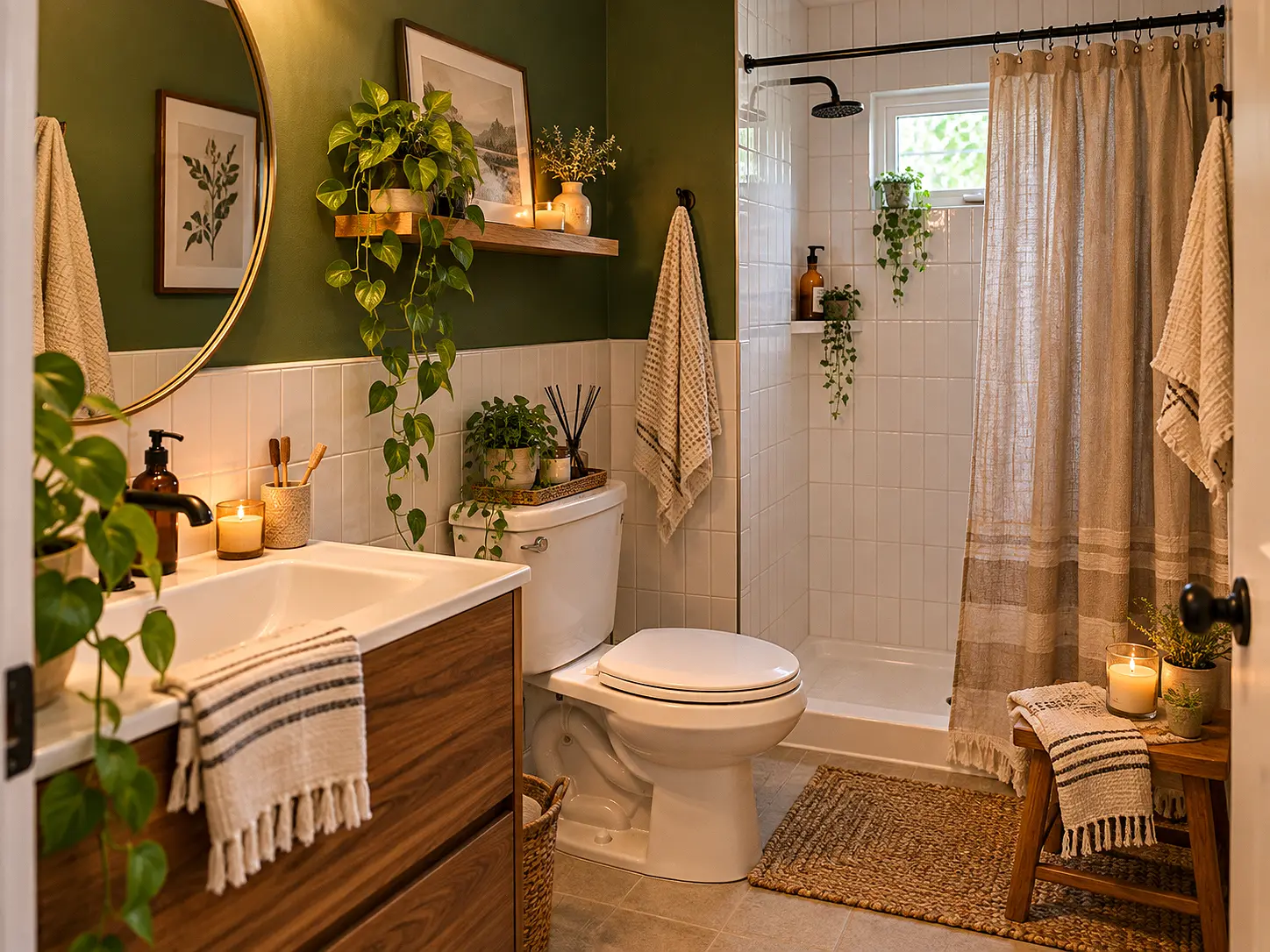
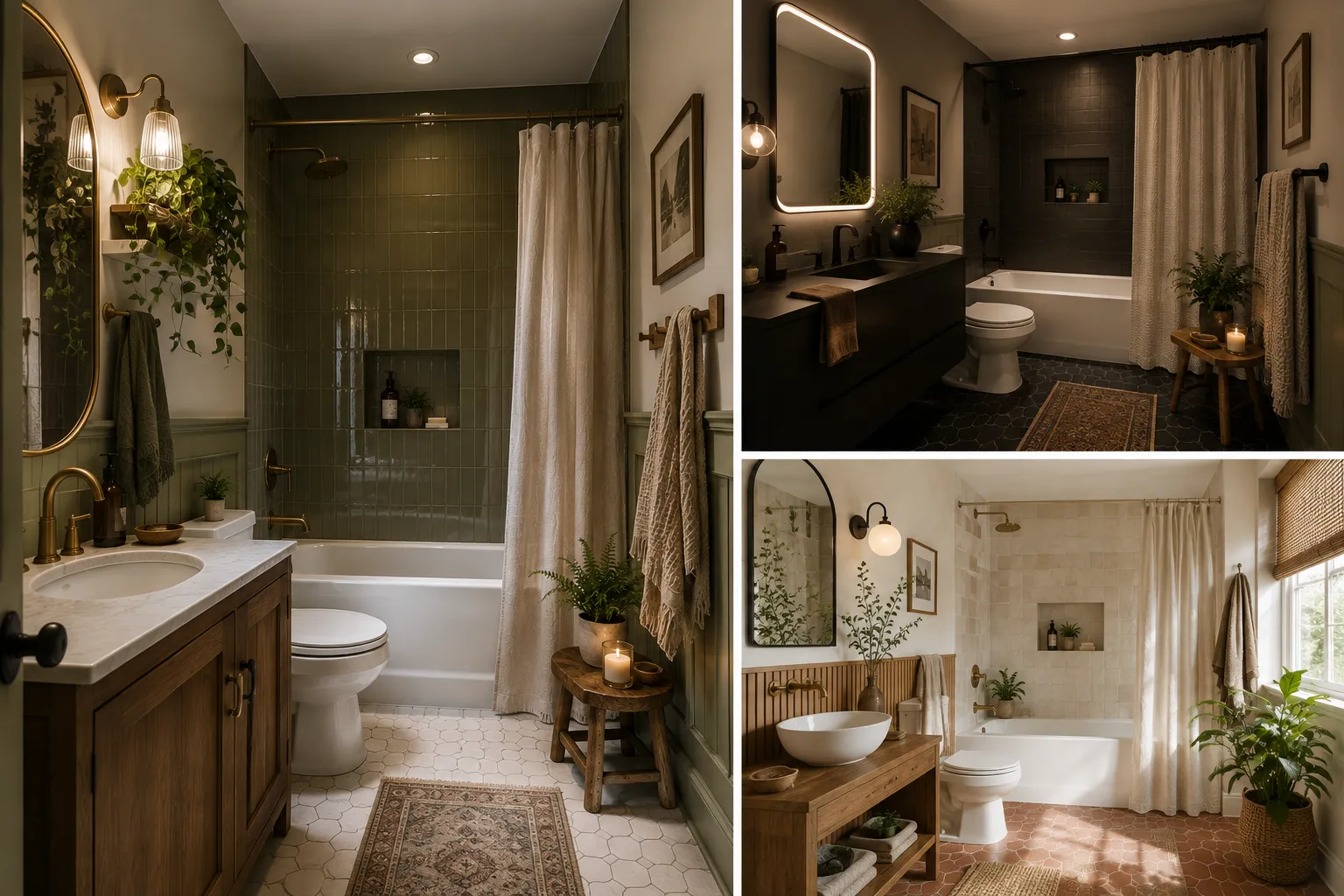
Painting just the tiled alcove around the tub a deep forest green, and nothing else, gives you a moody wet zone without committing the whole room. The green wraps the three tile walls the shower spray hits, the tub stays white, and the rest of the bathroom reads light and normal. Use a bathroom-rated enamel or tile paint made for wet areas, or you will be repainting in six months. This works best when the surround tile is already a plain matte you can prime over. Green in particular flatters warm skin tones under lamp light, which matters more in a windowless room than in a bright one.
3. Dark large-scale wallpaper on the sink wall
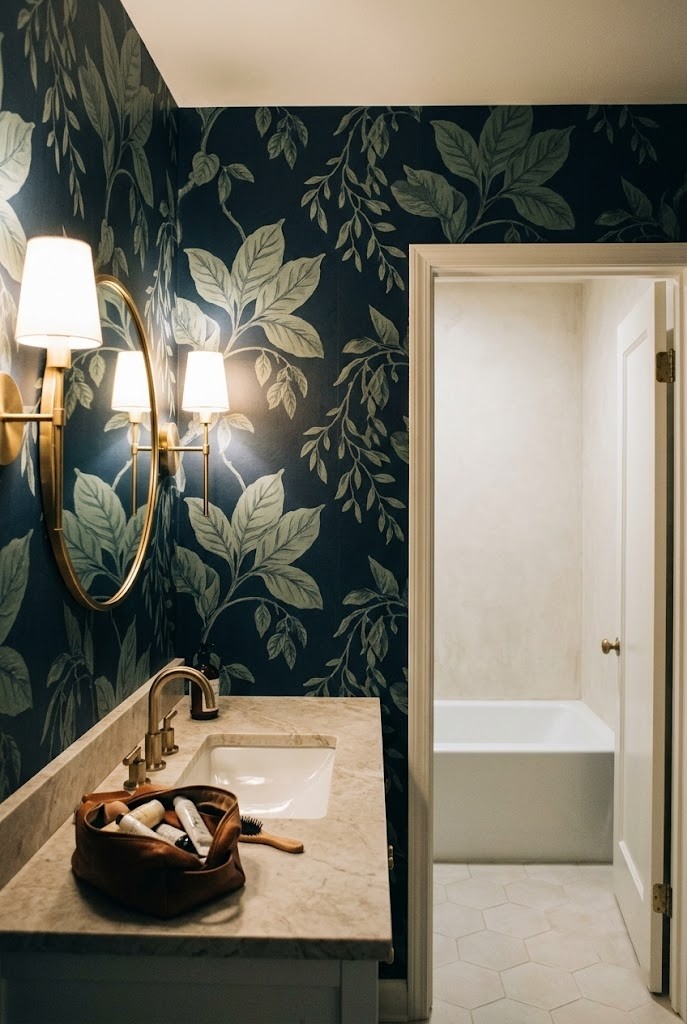
Hang a dark large-scale wallpaper on the sink wall only, and keep the tub wall pale, so the moody weight lives away from the wet zone entirely. This sidesteps the biggest small-bathroom wallpaper worry: steam and splashes peeling the seams. The sink wall stays relatively dry, the pattern gives you depth and drama, and the white tub reads as a clean counterpoint across the room rather than something you tried to hide. Choose a paste-the-wall vinyl or a peel-and-stick rated for humidity. In 40 square feet, a large motif actually works better than a tiny one; small repeats read as busy and shrink the room.
4. Matte black tile frame around the tub surround
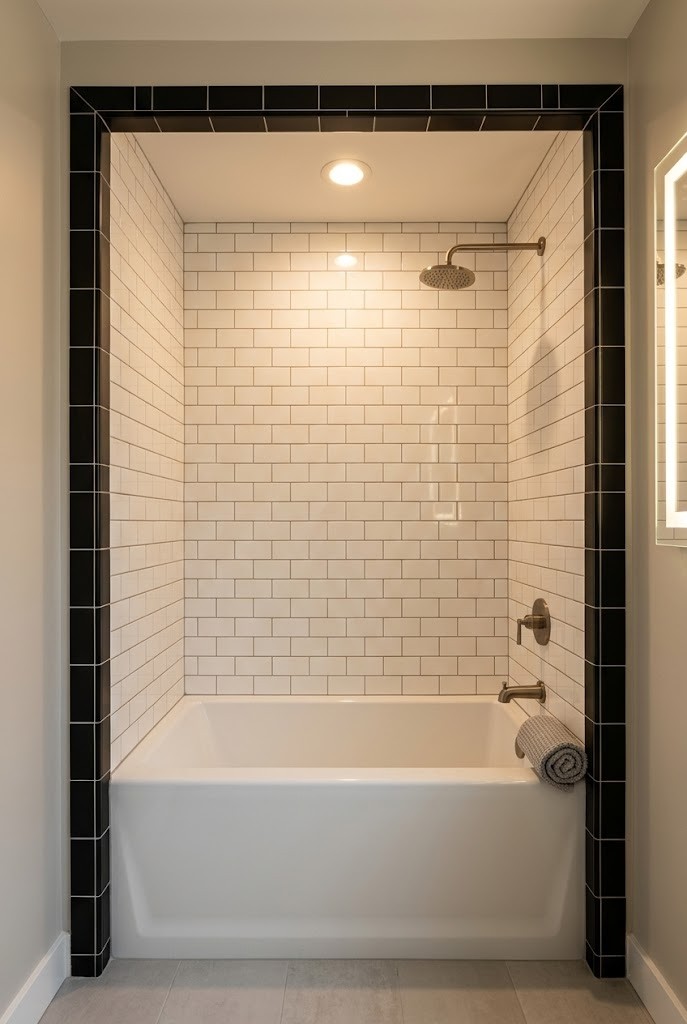
Tile a dark border around the existing white surround, a two-tile-wide frame of matte black or deep green around the alcove opening, and the white tub stops looking like a random box and starts looking mounted, like art in a frame. You keep the waterproof white tile where the water actually hits and add darkness only at the edges. This is a weekend job with a wet saw rental and pre-mixed thinset. The dark frame also hides the grout line where the surround meets the wall, which is usually the first place a builder-grade combo looks cheap.
5. Deep plum wall with plug-in sconces by the mirror
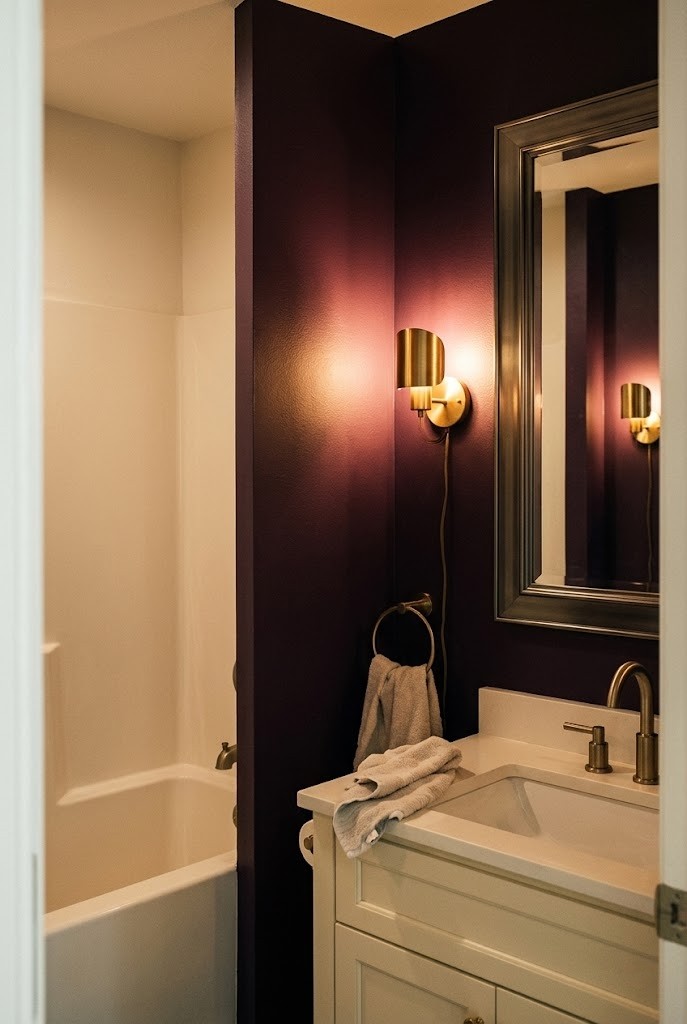
Mount a pair of plug-in wall sconces on a deep plum accent wall beside the mirror, and you solve the color and the lighting problem in one move. Plum reads brown-toned and cocooning under warm bulbs, and the sconces at face height give you the side lighting a windowless room desperately needs; overhead-only light throws shadows down your face and makes any dark wall look grim. Plug-in sconces matter here because most builder bathrooms have no junction box beside the mirror, and you are not rewiring a rental. Run the cords down into a channel or behind a slim molding so the look stays clean.
6. Vertical black shiplap accent wall behind the tub
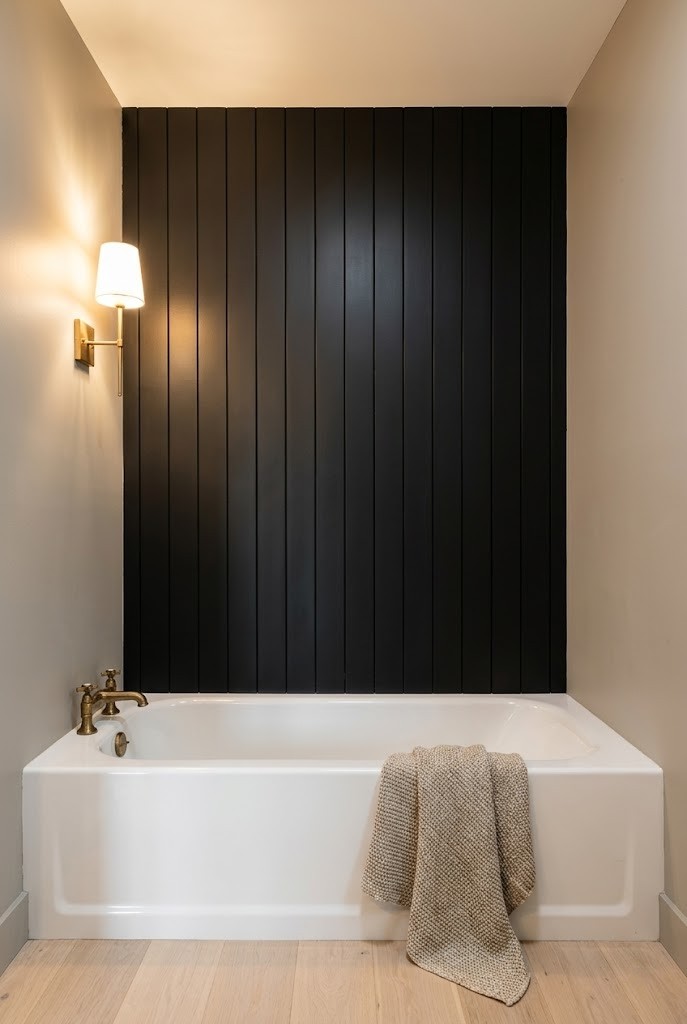
Run vertical black shiplap or MDF panel strips up the tub wall for a moody accent with texture the flat charcoal in idea 1 can't give you. The vertical lines also pull the eye upward, which makes a cramped 5x7 feel taller than it is. Prime and paint the panel in a satin or semi-gloss so it survives humidity and wipes clean. Keep the panelling out of the direct spray zone; behind and beside the tub is fine, inside the wet surround is not, because water works into the seams. The ridged shadow lines read as expensive even when the material underneath is budget MDF.
7. Charcoal dark grout on white tub tile
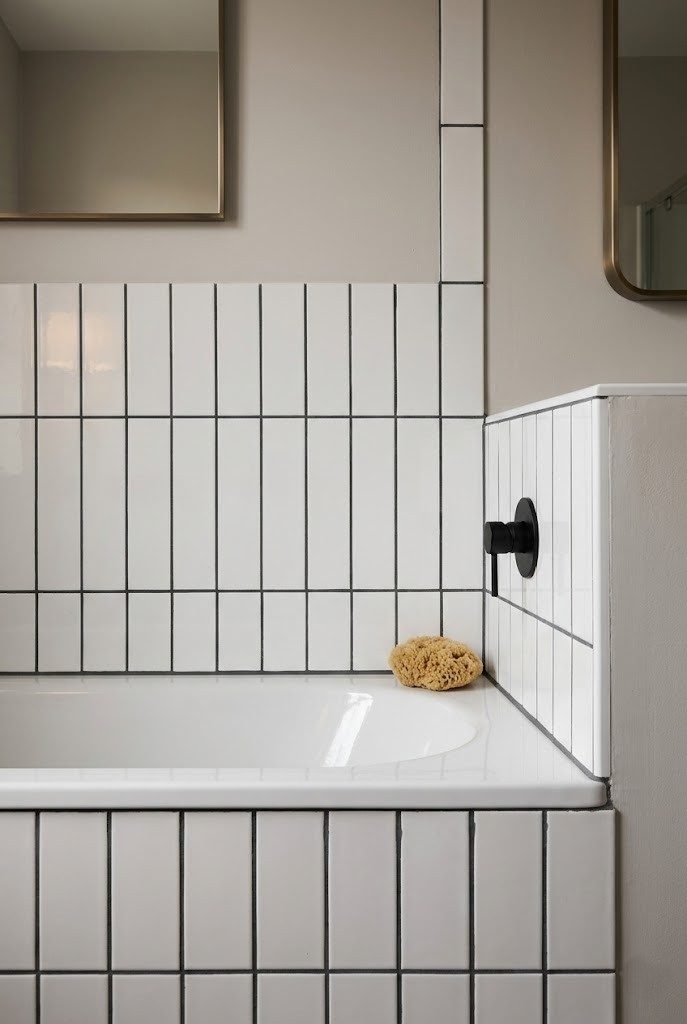
Regrouting existing white tile in charcoal or black instantly makes a plain builder surround look moody and intentional without touching the tile itself. The dark grid reads graphic and deliberate, and it hides the discoloration that white grout picks up around a tub. This is the cheapest structural moody move there is, and it is reversible enough for renters who can't retile: grout stain and grout refresh coatings sit on top of the existing lines. Test a hidden corner first, because very old grout sometimes won't take stain evenly. Done right, the whole surround shifts moody for the price of a coffee and an afternoon of taping.
8. Near-black painted ceiling over pale walls
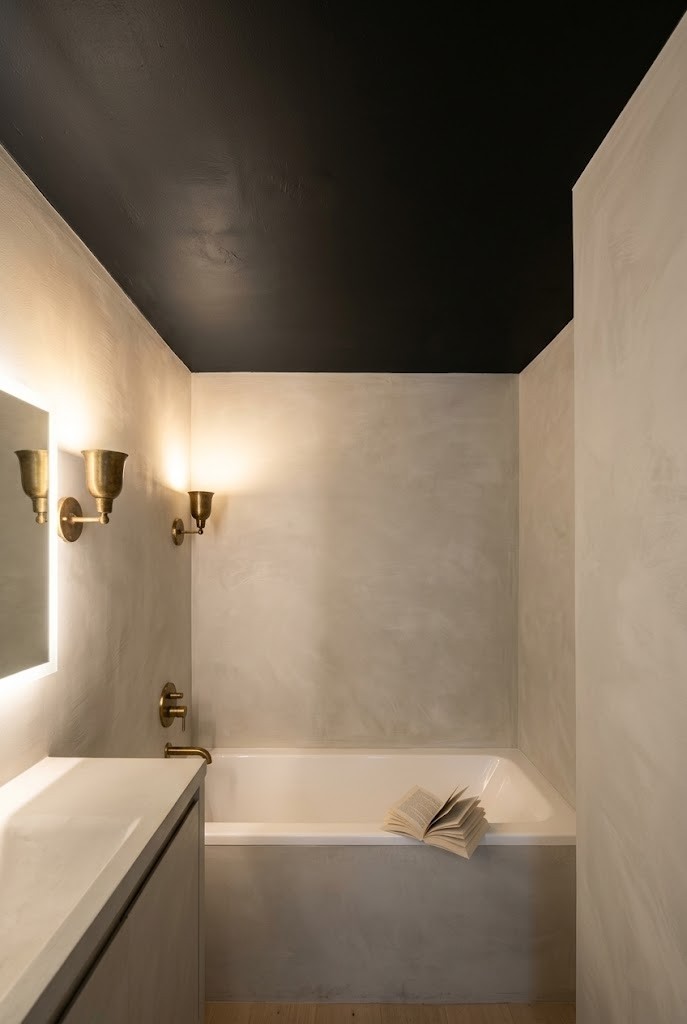
Painting only the ceiling a deep near-black, while walls stay pale, lowers the room visually and wraps it in a moody cap without darkening the surfaces you touch daily. It sounds backwards in a small bathroom, but a dark ceiling over light walls reads intimate rather than cramped, and it keeps the white tub firmly in the light zone where it belongs. Use a moisture-resistant matte so steam doesn't spot it. The catch is lighting: a dark ceiling eats the bounce light you'd normally get off a white one, so you must add wall-level and mirror-level sources to compensate, or the room goes gloomy fast.
9. Dark walnut vanity anchoring a light bathroom
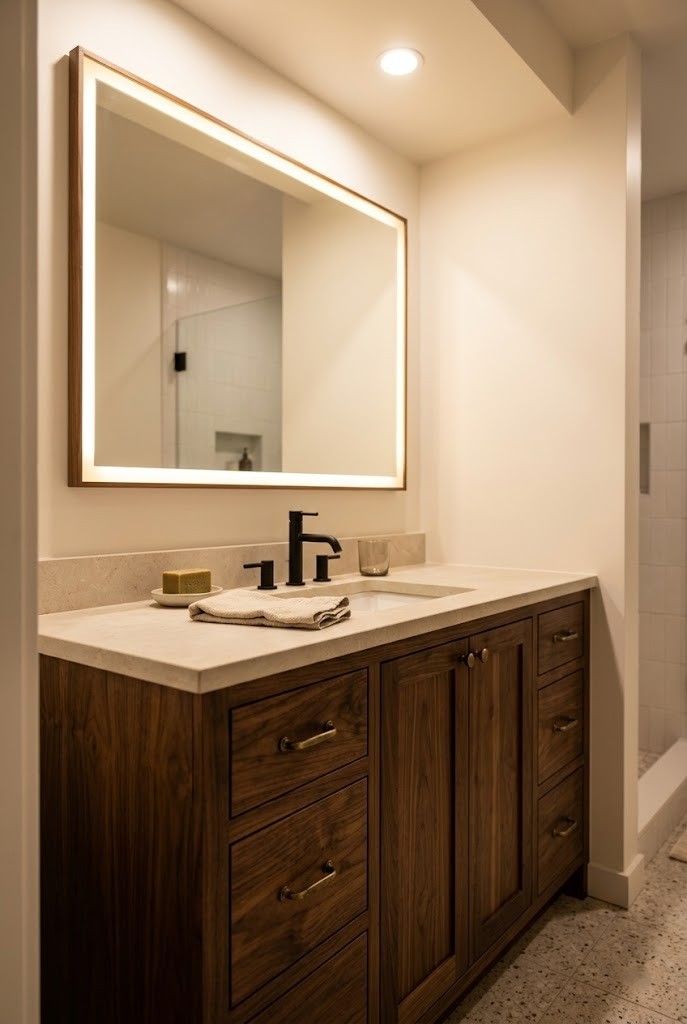
Swapping or refacing the vanity in a dark walnut or black finish anchors the whole room in one moody object while walls and tub stay light. The vanity is the one large piece your eye lands on at sink height, so darkening it does more visual work per dollar than any wall. In a rental, a peel-on wood-look or matte-black wrap gives you the same anchor without painting, and it peels off at move-out. Keep the countertop pale to bounce light back up into your face at the mirror. A dark vanity with a pale top is the proportion most builder bathrooms are missing.
10. Dark half-height wainscot under pale upper walls
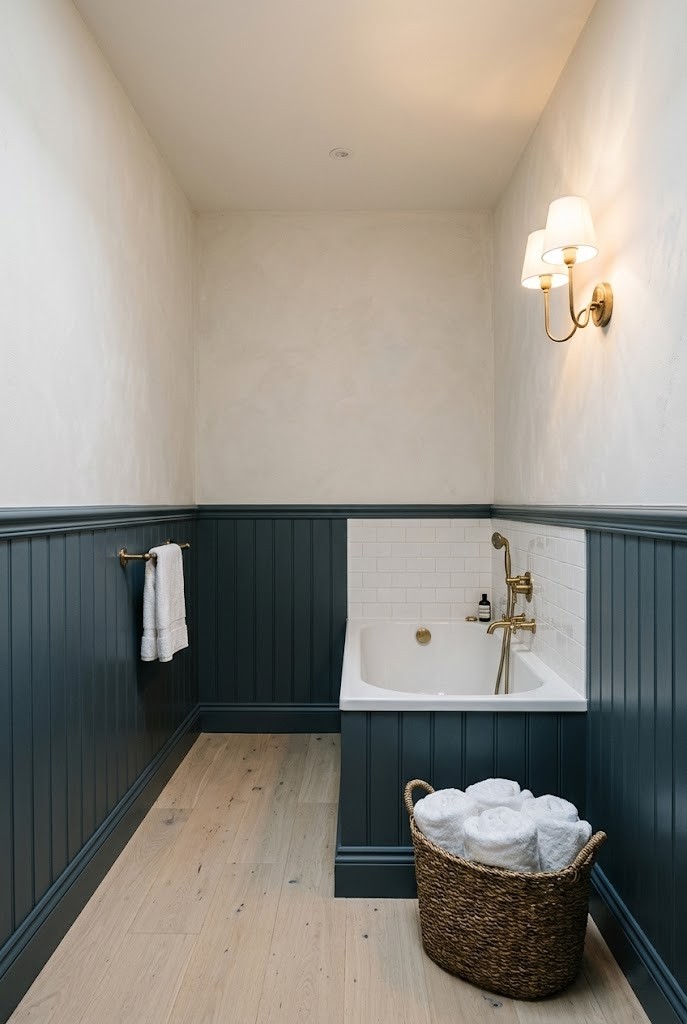
Taking a dark color up to chair-rail height and leaving the top half pale is the safest moody move for a room this small, because it grounds the space without closing it in. The dark lower band visually anchors the white tub at its own level, so the tub reads as part of a two-tone scheme rather than a lone bright box. Cap it with a slim rail around three feet up. Below the rail can be beadboard, panel moulding, or just flat paint in a durable satin that takes scuffs near the floor. Keeping the upper half light preserves the light bounce a windowless room can't spare.
11. Dark tile below, matching dark paint above the tub
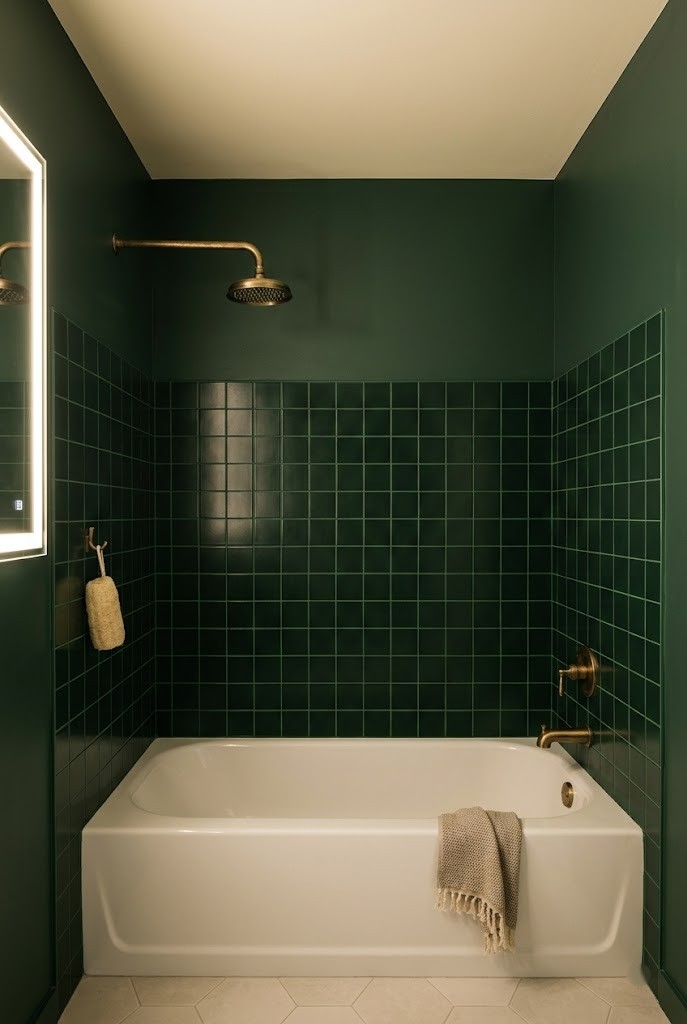
Running dark tile across the lower wet zone and continuing the same dark tone in paint above the tub line ties the surround into the room instead of leaving it stranded. Unlike the dry sink wall in idea 3, this is the wall that gets wet, so tile does the waterproofing low and paint carries the color up high where splashes don't reach. Match the paint as closely to the tile as you can; a near-match reads as one continuous dark surface, while a bad match looks like two failed attempts. The white tub sitting in front of a unified dark wall finally looks chosen rather than tolerated.
12. Tadelakt-look microcement dark half wall
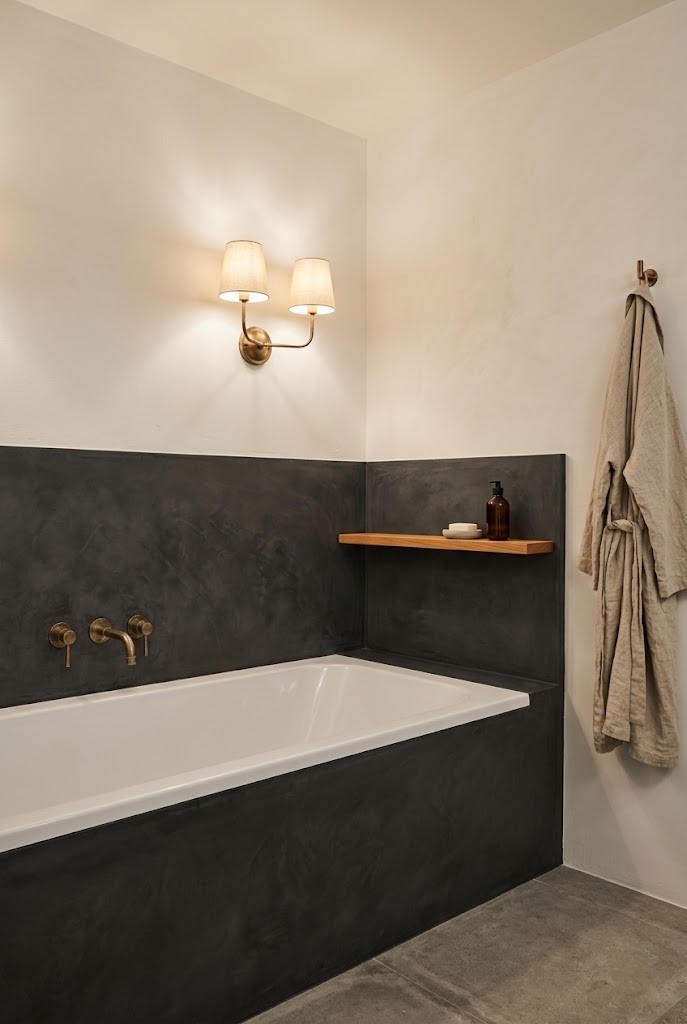
A tadelakt-style microcement finish on the lower half gives you a seamless, grout-free dark surface that feels far more expensive than tile. The continuous matte plane wraps the wet zone with no lines to discolor, and its slight variation in tone catches lamp light in a way flat paint can't. Roll-on microcement kits let you fake the look over existing tile or drywall without a plasterer. Seal it properly for wet areas or it will stain. In a windowless room the subtle texture matters: a dead-flat dark wall reads as a void, while a surface with faint movement reads as depth, which is what you actually want.
13. Floor-to-ceiling dark textured shower curtain
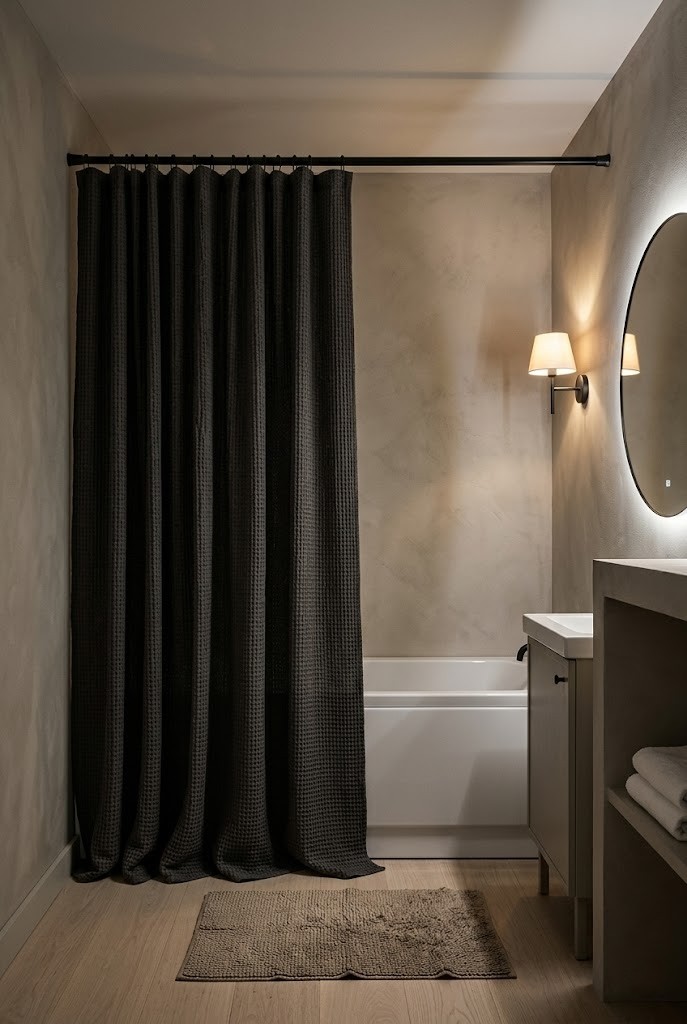
A floor-to-ceiling dark textural shower curtain, hung high and wide, is the single fastest way to make an alcove combo read moody, because it turns the busiest visual zone dark on demand. Mount the rod at ceiling height rather than at the tub, and let the curtain run the full wall width; the extra length draws the eye up and hides the transition where the white surround meets the wall. A waffle-weave or heavy linen-look curtain in charcoal or deep green adds the texture flat vinyl never will. When it's open, the white tub shows; when it's closed, the wet zone disappears into the dark scheme.
14. White tub as the seam between two dark tones
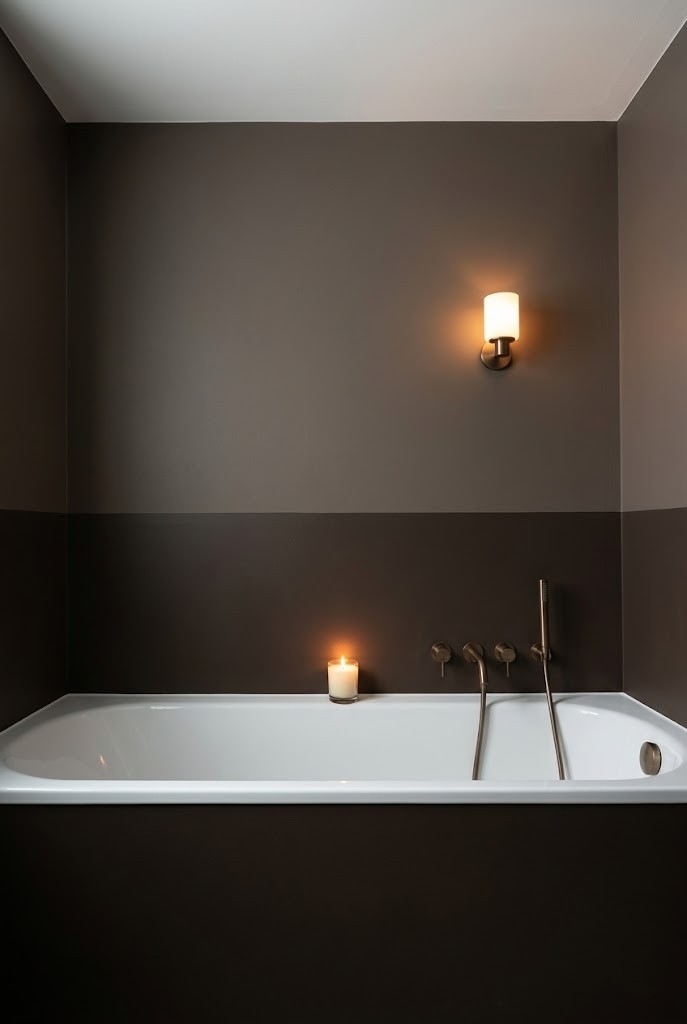
Letting the white tub itself act as the dividing line between a dark lower zone and a deep-toned upper wall turns the combo's biggest liability into the design's organizing seam. Where idea 10 uses a chair rail as the break, here the top edge of the tub surround is the break, so the white rim reads as intentional trim between two planes of color. Paint or tile below the tub line in the darkest tone, then bring a slightly lifted version of the same color above. The eye accepts the white band because it's doing a job: separating two deliberate zones instead of floating alone.
15. Dark board-and-batten to mid-height by the tub
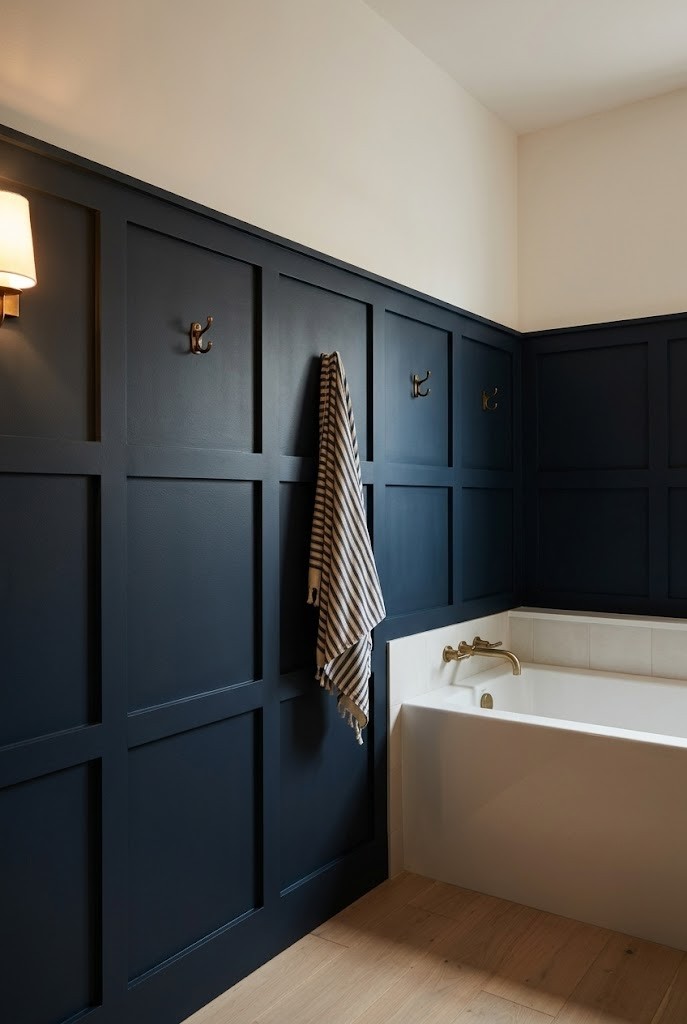
Board-and-batten taken to mid-height and painted a deep matte gives the lower wall architectural texture that flat dark paint lacks, and the vertical battens make a low ceiling feel taller. The raised grid catches side light and throws soft shadow lines, so the wall reads as crafted rather than merely dark. Build it from primed MDF strips glued and nailed over existing drywall, then caulk every seam before painting or the joints telegraph. Keep it out of the direct spray zone. The framed squares also give a small room rhythm, which stops a single dark expanse from feeling like a flat backdrop behind the tub.
16. Dark tile wainscot ringing the whole bathroom
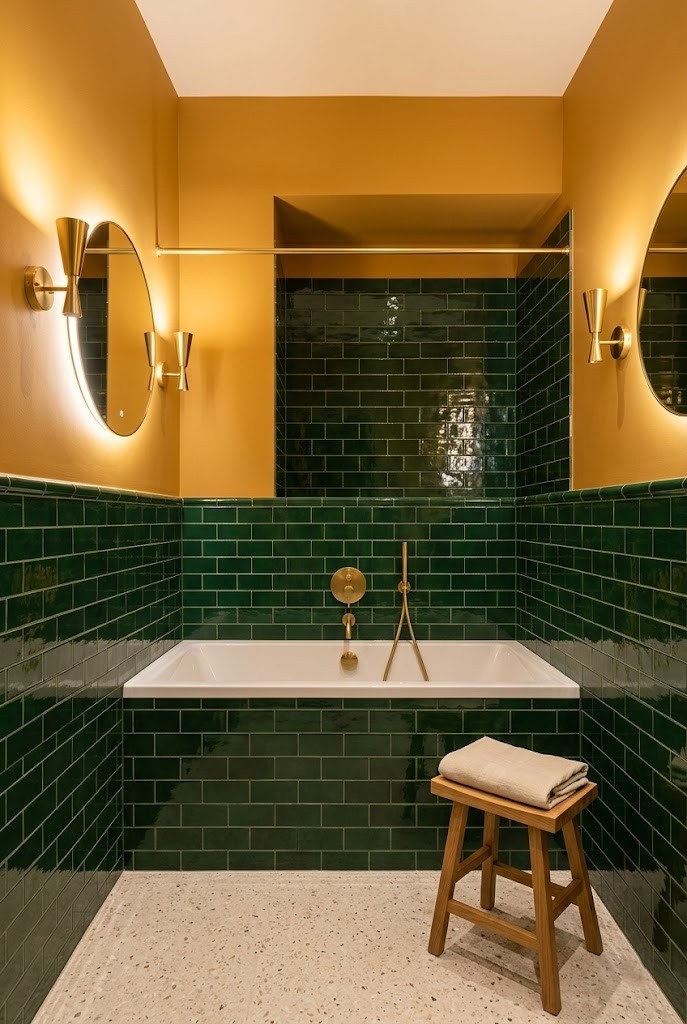
Extending dark tile as a wainscot band around the whole room, not just the wet surround, wraps the lower third in waterproof darkness and makes the tub's tile read as part of a deliberate ring. The band ties the combo surround to the rest of the walls so it stops looking like an isolated patch. Above the tile, a warm mid-tone keeps the room from going cave-dark. Keep the tile line level all the way around, even where the tub interrupts it, so the eye reads one continuous datum. A wandering tile line is the detail that makes a small bathroom feel unresolved.
17. Brass rail capping a dark moody half wall
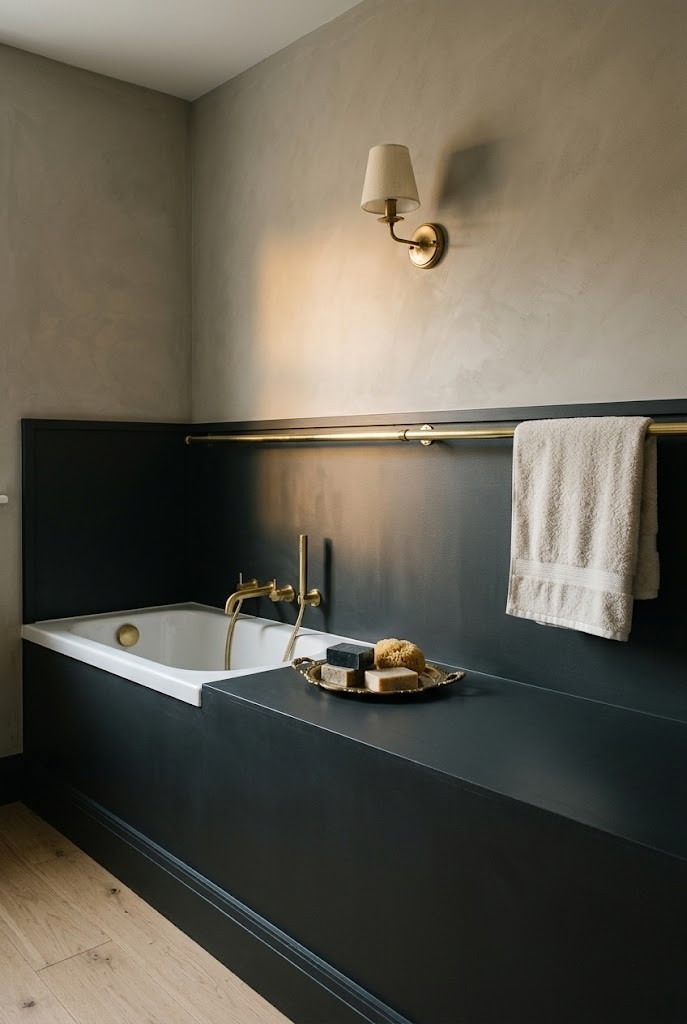
A slim brass or aged-bronze rail capping a dark half-wall gives the two-tone break a warm metallic line that pulls the whole scheme together. The metal picks up the warm lamp light, echoing the sconce hardware from idea 5, so the room reads coordinated rather than assembled from parts. Below the rail, a deep tone; above, something softer. The rail itself can be a picture-rail moulding wrapped in brass tape or a genuine metal profile. In a windowless room, warm metal is doing real work: it catches and returns the little light you have, adding sparkle a flat matte scheme goes without.
18. Dark floor and dark base grounding the white tub
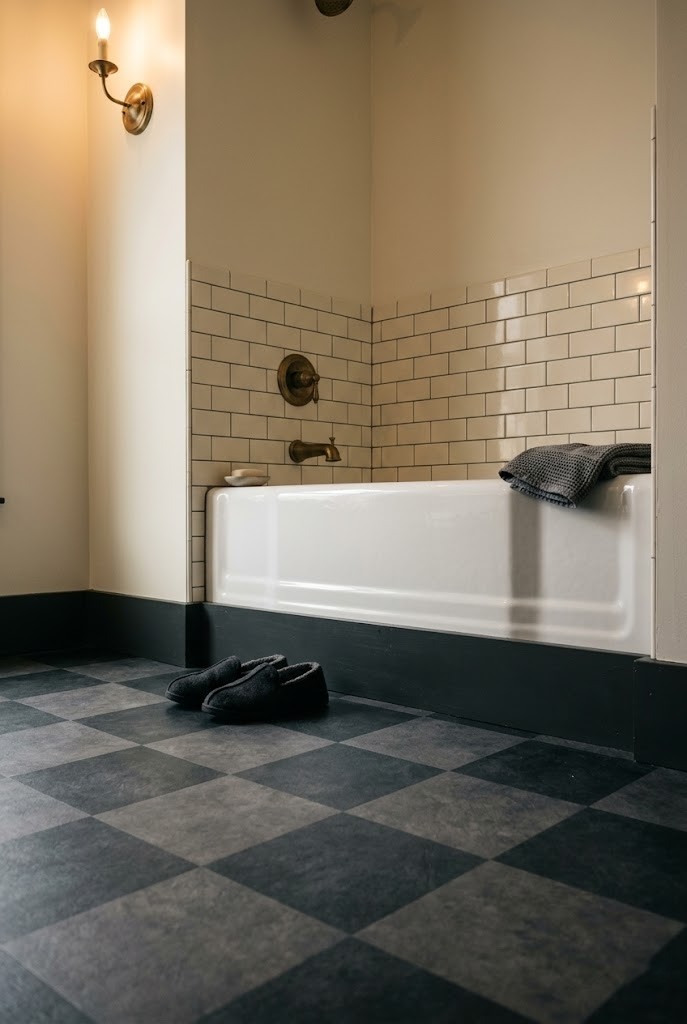
Grounding the room with a dark floor and carrying a dark tone up the lower third makes the white tub feel planted rather than perched. When the floor is pale and the tub is white, the tub floats and reads flimsy; a dark floor gives it visual weight underneath. Peel-and-stick vinyl tile in a dark slate or checker pattern is the rental-friendly route and survives bathroom moisture better than people expect. Continue a dark base up the wall to the same low line all around. The tub now sits in a dark base zone, so its whiteness reads as a chosen highlight above the grounding, not a mistake.
19. Full charcoal drench with a white alcove tub
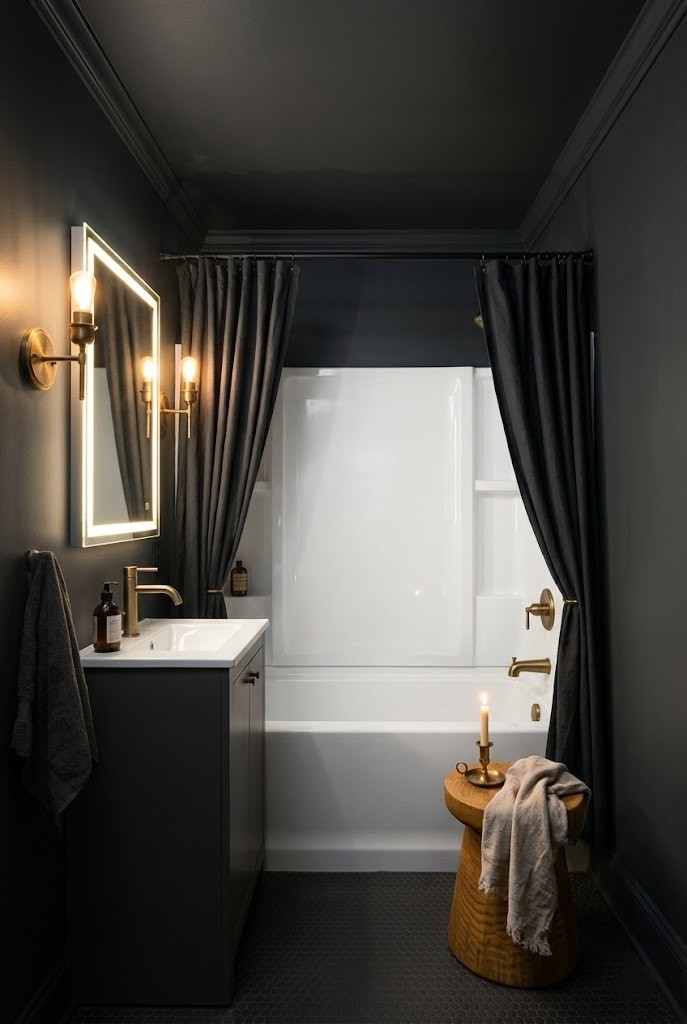
Drenching every wall and the ceiling in one deep charcoal, trim included, turns the white tub into the single deliberate highlight in an otherwise enveloping room. Where idea 1 darkened one wall, this commits fully: same color on walls, ceiling, trim, and door, so there are no edges for the eye to catch and the small room reads as one continuous cocoon. The white acrylic combo now has a clear job, being the one bright thing, so it stops looking accidental. Use a matte or eggshell on walls and a moisture-resistant version on the ceiling. This is the highest-impact move and the one most dependent on getting the lighting right.
20. Deep forest green drenched small bathroom
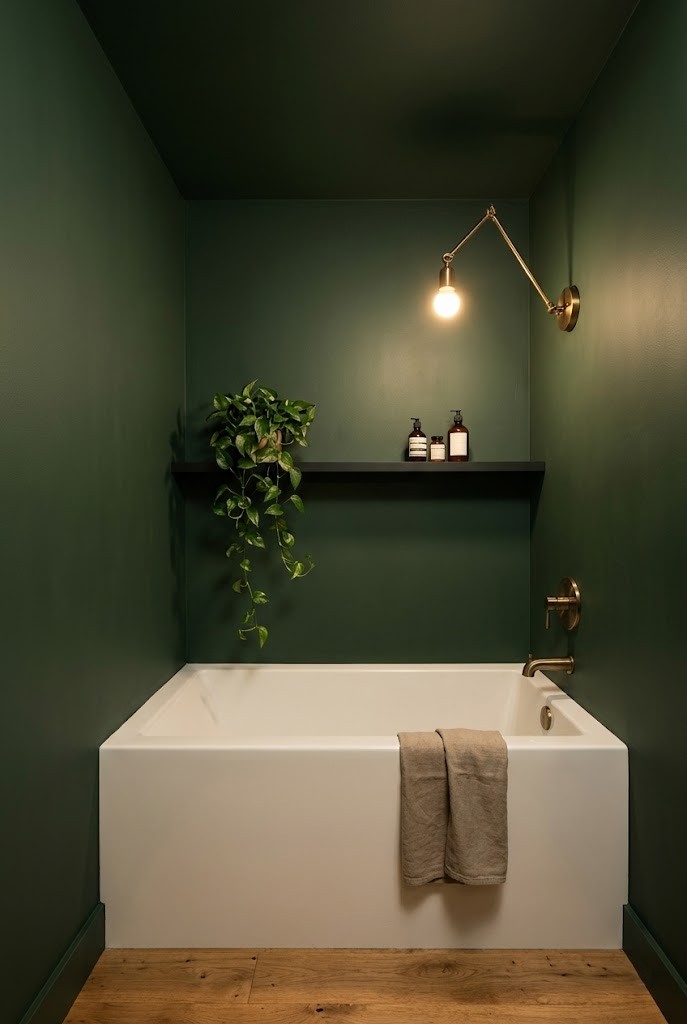
A full forest-green drench reads warmer and more organic than charcoal while still cocooning the room completely, which suits people who find true dark grey cold. Green holds up especially well under warm bulbs, going soft and mossy rather than flat, so it flatters a windowless room where all your light is artificial anyway. Take it over walls and ceiling for the enveloping effect. The white tub against deep green reads crisp and almost botanical, like porcelain in a conservatory. Keep at least one warm metal finish in the room, because green plus black plus white alone can tip cold; brass or bronze warms it back up.
21. Oxblood drenched bathroom with a white tub
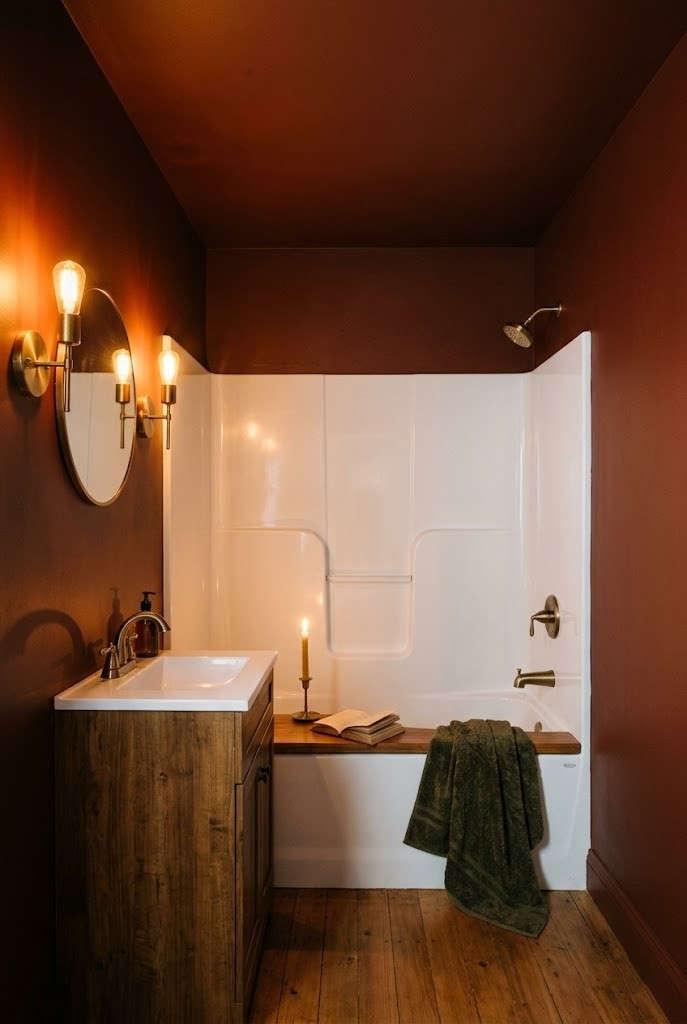
An oxblood or dark terracotta drench gives you a moody room that feels warm and earthy instead of moody-cold, which is rare and worth considering in a windowless space. The red-brown wraps the room and makes the white tub read like a bright fixture in a dim, candlelit space. This color is the most sensitive to light temperature of any in this post: under cool bulbs oxblood turns muddy and brownish, but under warm 2700K light it glows. Get the bulbs right before you judge the paint. Pair it with warm wood and aged brass rather than black, which can make the red look heavy and bruised.
22. Near-black room with matte black fixtures, white tub
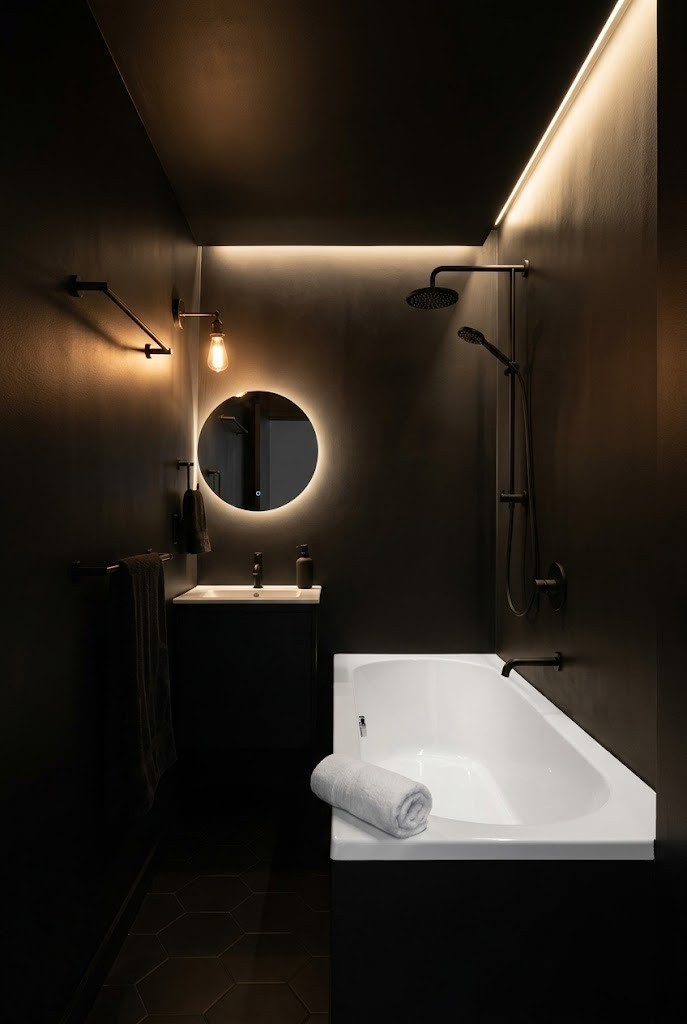
Going near-black on every surface and matching the fixtures in matte black leaves the white tub as the only light element in the entire room, which is the most graphic version of this whole approach. Swapping the builder chrome shower head, tap, and towel bars for matte black hardware removes the last shiny silver distractions, so nothing competes with the tub's white. The result is nearly monochrome: black room, white tub, and the fittings receding into the walls. This is not a look for the faint-hearted in 40 square feet, so it leans entirely on layered light to keep it from feeling like a closet. Three sources, minimum.
23. Dark drench with a matching dark shower curtain
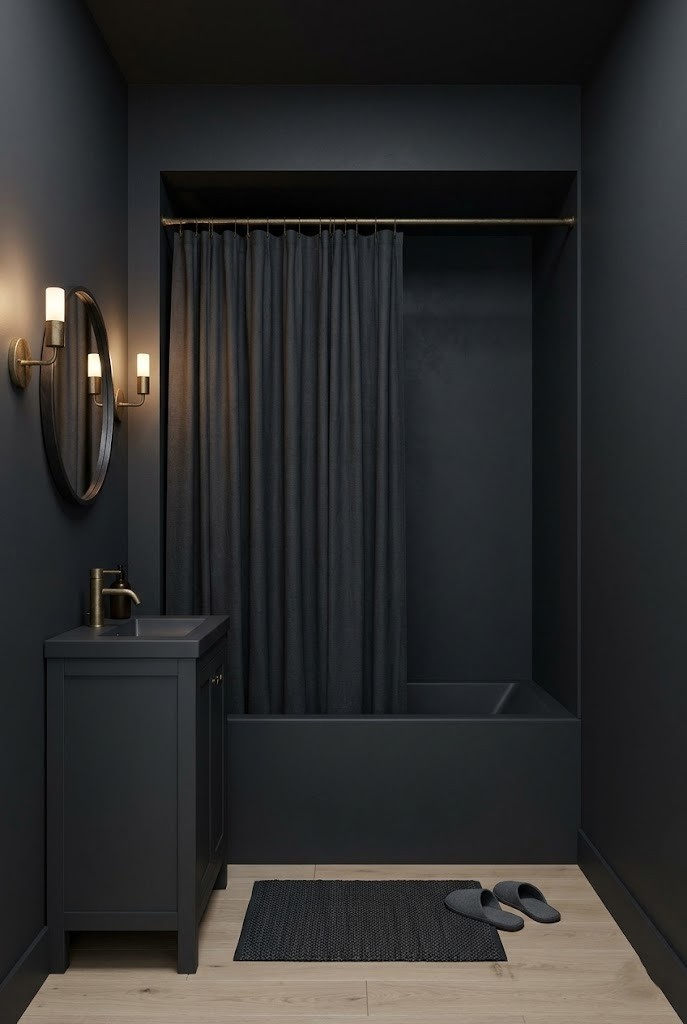
Pairing a full dark drench with a matching dark shower curtain lets the white tub vanish entirely when the curtain is closed, so the room reads as a seamless dark box on demand. This takes the curtain trick from idea 13 to its conclusion: instead of the curtain being a dark accent against light walls, it merges into an already-dark room, and the alcove simply disappears. Choose a curtain within a shade or two of the wall color. When you want the tub visible, open it; when you want a pure moody room, close it and the combo is gone. It's the most flexible way to live with a tub you can't remove.
24. Dark-painted tub apron blending into the drench
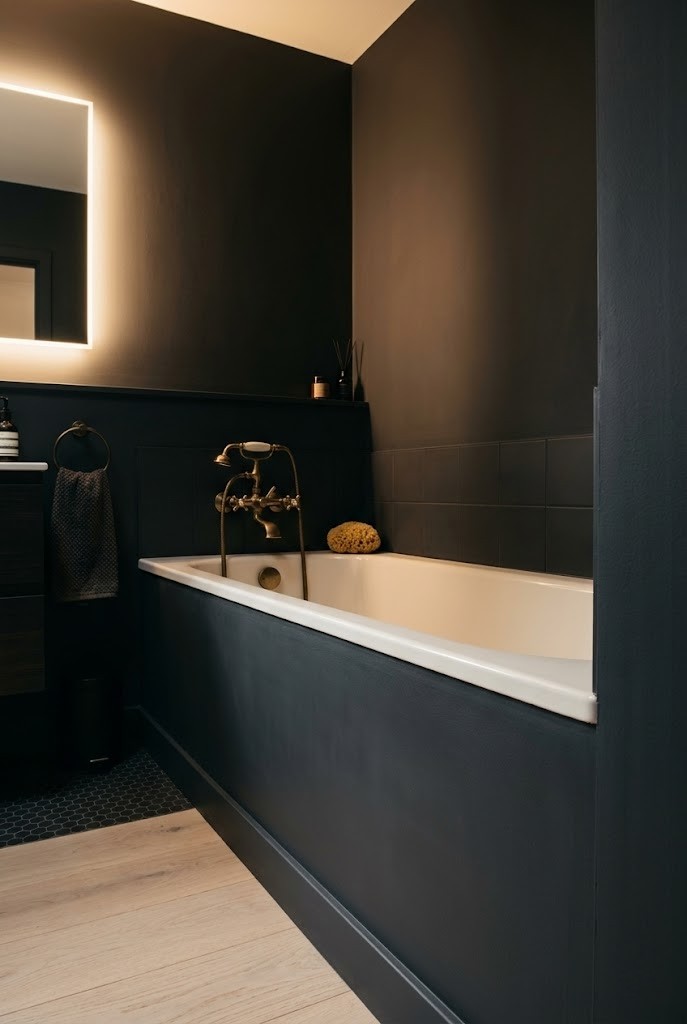
Painting or cladding the tub's exterior apron in the room's dark color removes the white box's biggest offending surface: the front skirt facing the room. Specialized tub-and-tile epoxy paint bonds to acrylic and can carry the drench right onto the apron, so only the inner basin stays white. Suddenly the tub isn't a white box at all; it's a dark surround with a white bowl set into it, which reads intentional and built-in. Prep is everything here, since epoxy peels on a poorly sanded surface. This is the move for people who want the combo to genuinely disappear into the scheme rather than just be lit around.
25. Drenched bathroom lit by three warm sources
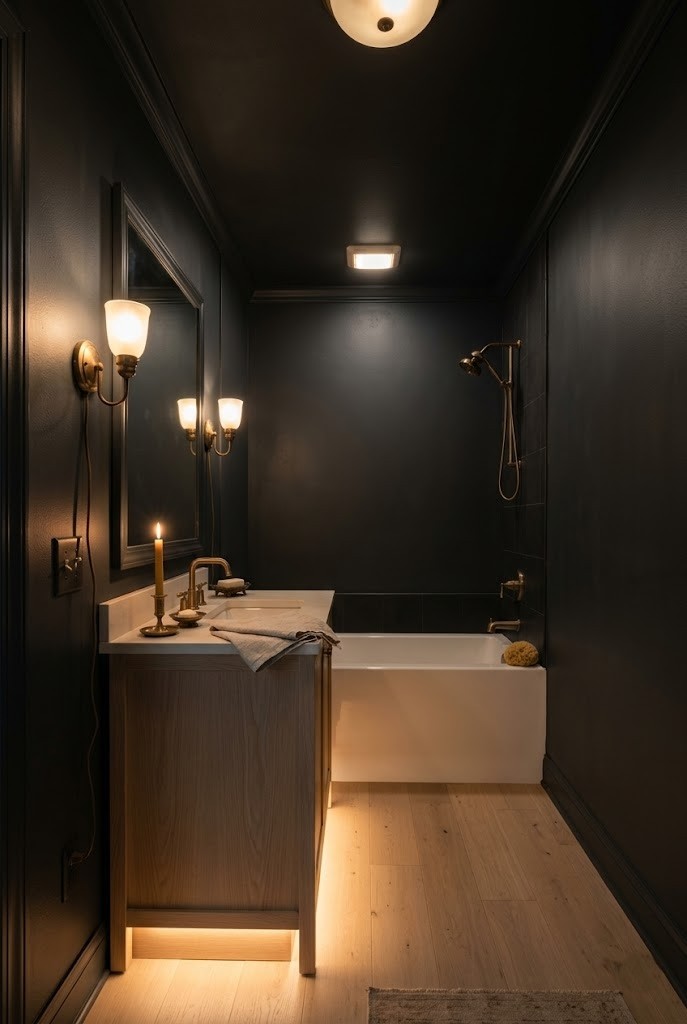
Building the drench around three separate warm light sources is what makes a dark small bathroom feel cocooning instead of cave-like, and it's the step every moody-bathroom photo quietly relies on. The three are: a mirror-level source for your face, a plug-in sconce pair or backlit mirror; a low ambient source like an LED strip under the vanity toe-kick; and a warm overhead on a dimmer. Overhead alone in a dark room throws every shadow downward and makes skin look grey. All three on warm 2700K bulbs give you a room that's dark by design but flattering to stand in. Get this right and any color above works; get it wrong and none do.
26. Large mirror bouncing light in a dark small bath
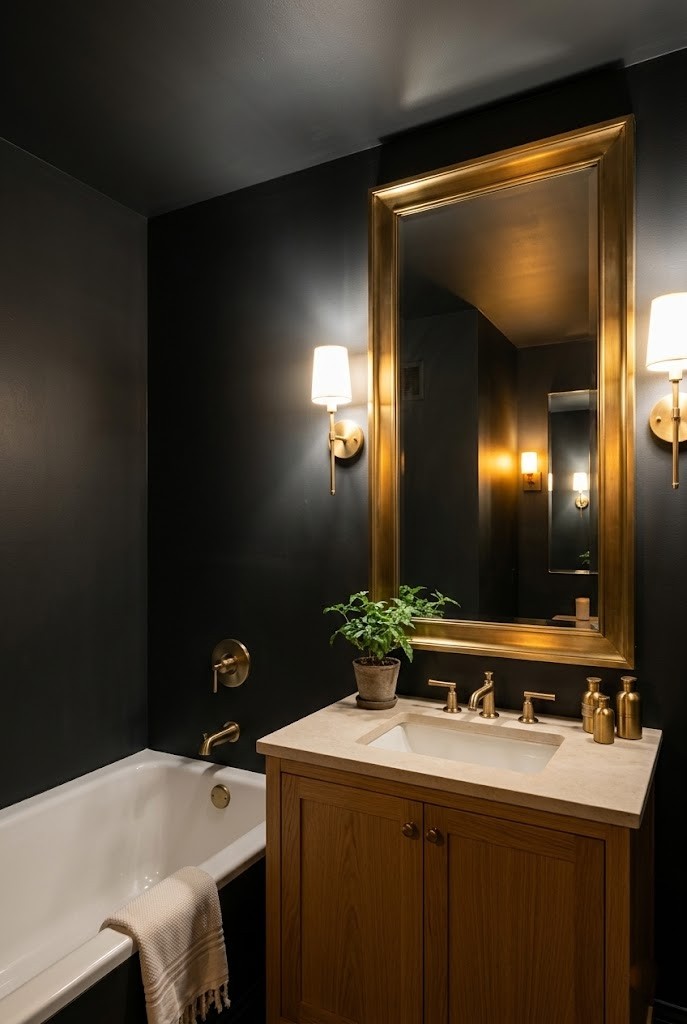
Hanging the largest mirror the wall will take, and lighting it well, is the final move that lets a fully drenched 40-square-foot bathroom stay dark without feeling like a cave. A big mirror doubles the perceived depth and bounces the layered light from idea 25 back into the room, so the darkness reads as intentional atmosphere rather than a cramped box. Frame it in warm metal to catch the light. Position it opposite or adjacent to your brightest source so it reflects light, not a dark wall. In a small drenched room the mirror is not decor, it's a working tool that buys back the openness the dark paint spends.
Final Thoughts
The white tub shower combo is not the problem people think it is. Once you sort the lighting, three warm sources in a windowless room, the color choice opens up, from a single charcoal accent wall to a full oxblood drench with the tub as the one bright note. Start with the least commitment your nerve allows and go darker from there. Even a windowless half bath can carry this if the light is right. Save this to Pinterest so the lighting plan is ready before you open a paint can.
Frequently Asked Questions
Can a moody bathroom work with a white tub shower combo?
Yes, a white alcove combo works in a dark scheme as long as you give it a job. Frame it with dark walls, ground it with a dark floor, or paint the tub apron so only the basin stays white. The white then reads as a deliberate highlight rather than a builder-grade leftover you forgot to fix.
How do you light a small windowless bathroom painted a dark color?
Use three separate warm light sources, not one overhead. Put a source at mirror height for your face, a low ambient source like an under-vanity LED strip, and a dimmable overhead, all on 2700K bulbs. Overhead-only light in a dark room throws harsh downward shadows and makes both your skin and the walls look grey.
What paint finish should I use in a small bathroom with a shower?
Eggshell or satin on the walls and a moisture-resistant matte on the ceiling. Satin wipes clean and resists steam better than flat, which matters most near the tub. Save true semi-gloss for trim and any panelling in the splash zone. Avoid flat matte on walls you'll touch daily; it marks and won't wash.
Will dark paint make my small bathroom look even smaller?
Not if you light it well. Dark color actually blurs the edges of a small room, which can make boundaries feel less defined rather than more cramped. The thing that makes a dark small bathroom feel tight is poor lighting, not the color. Add a large mirror and layered warm light and the darkness reads as depth.