You can update a beige tile bathroom without replacing tile, because the tile is rarely the problem, the beige-on-beige is. Most guides on how to update a beige tile bathroom without replacing tile hand you a paint chip and a shrug, or tell you to hire a color consultant to read your undertone. This post skips both. First you diagnose your own tile as pink-beige or yellow-beige with a sheet of white paper, then work outward by surface: walls, textiles, metals, lighting, and floor, each choice tuned to the undertone you found. Twenty-one specific, copyable looks, no demo and no chisel required. Save this to Pinterest so the undertone test is in your pocket at the paint counter.
1. Diagnose the undertone first, then paint the walls to match it
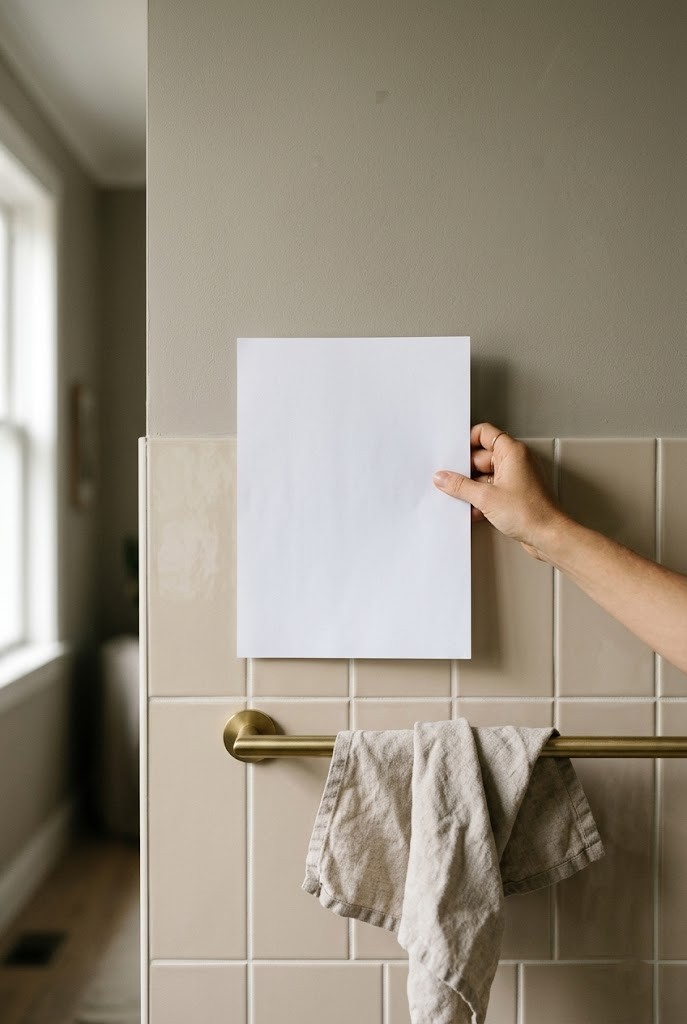
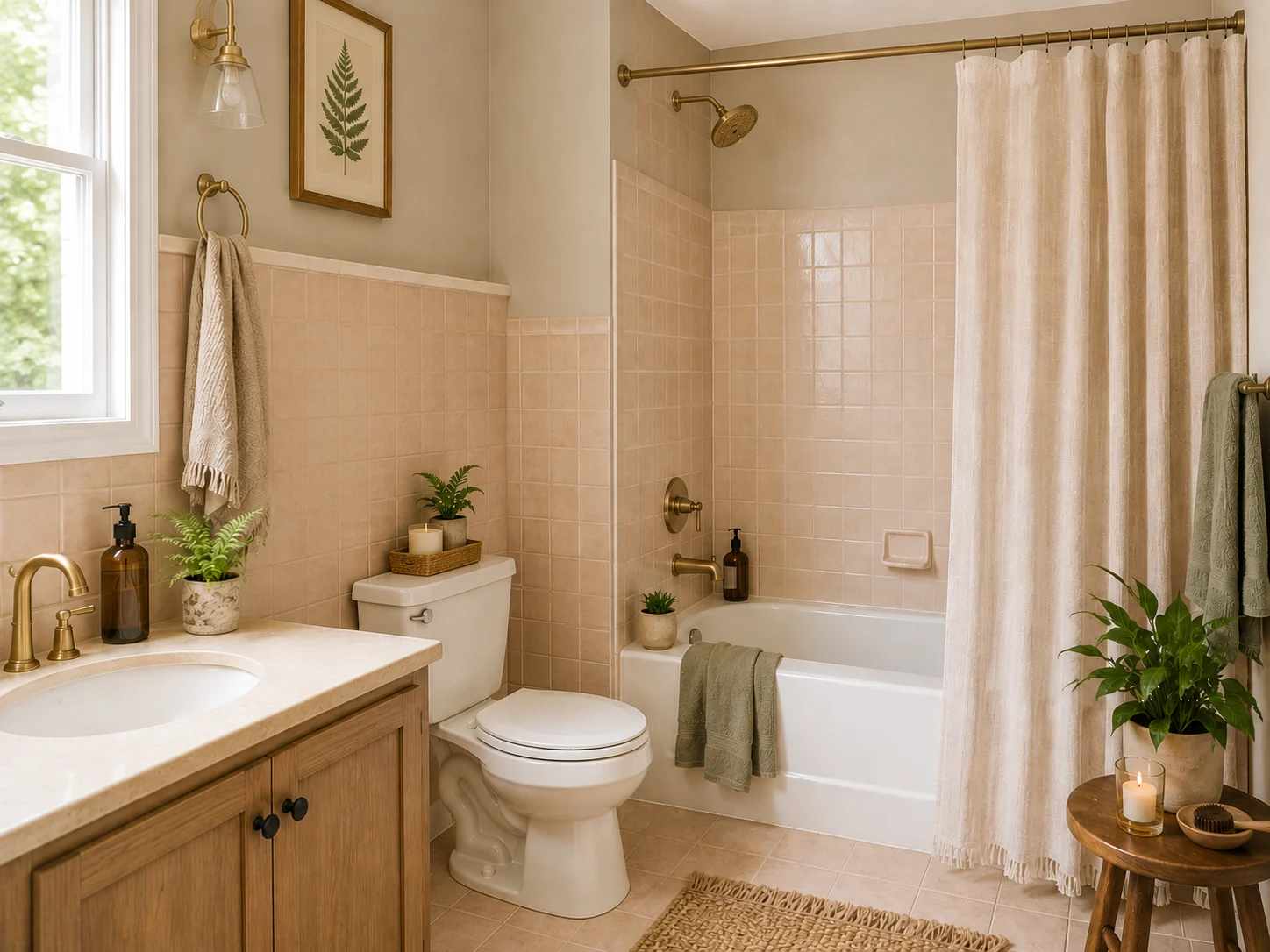
The single highest-leverage move is matching wall paint to the tile's undertone, and that starts with naming the undertone bluntly: pink-beige, where the tile looks mauve or rosy, or yellow-beige and almond, where it looks gold or faintly green. Hold a sheet of plain printer paper flat against a dry tile in daylight, and whatever the tile does next to pure white is your answer. Pink-beige tile wants a warm greige with a whisper of gray to calm the rose. Yellow-beige wants a soft warm white or a muted clay, never a cool gray that turns almond green. Buy undertone-matched paint samples and test a 12-inch swatch beside the tub before you commit to a gallon.
2. Warm greige walls that quiet pink-beige tile
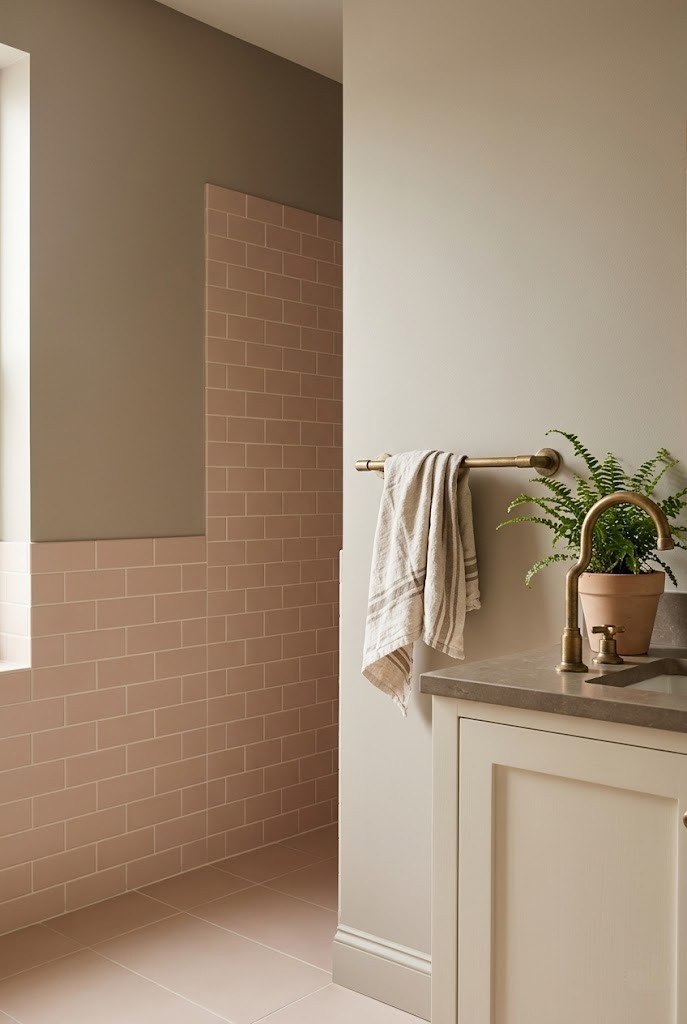
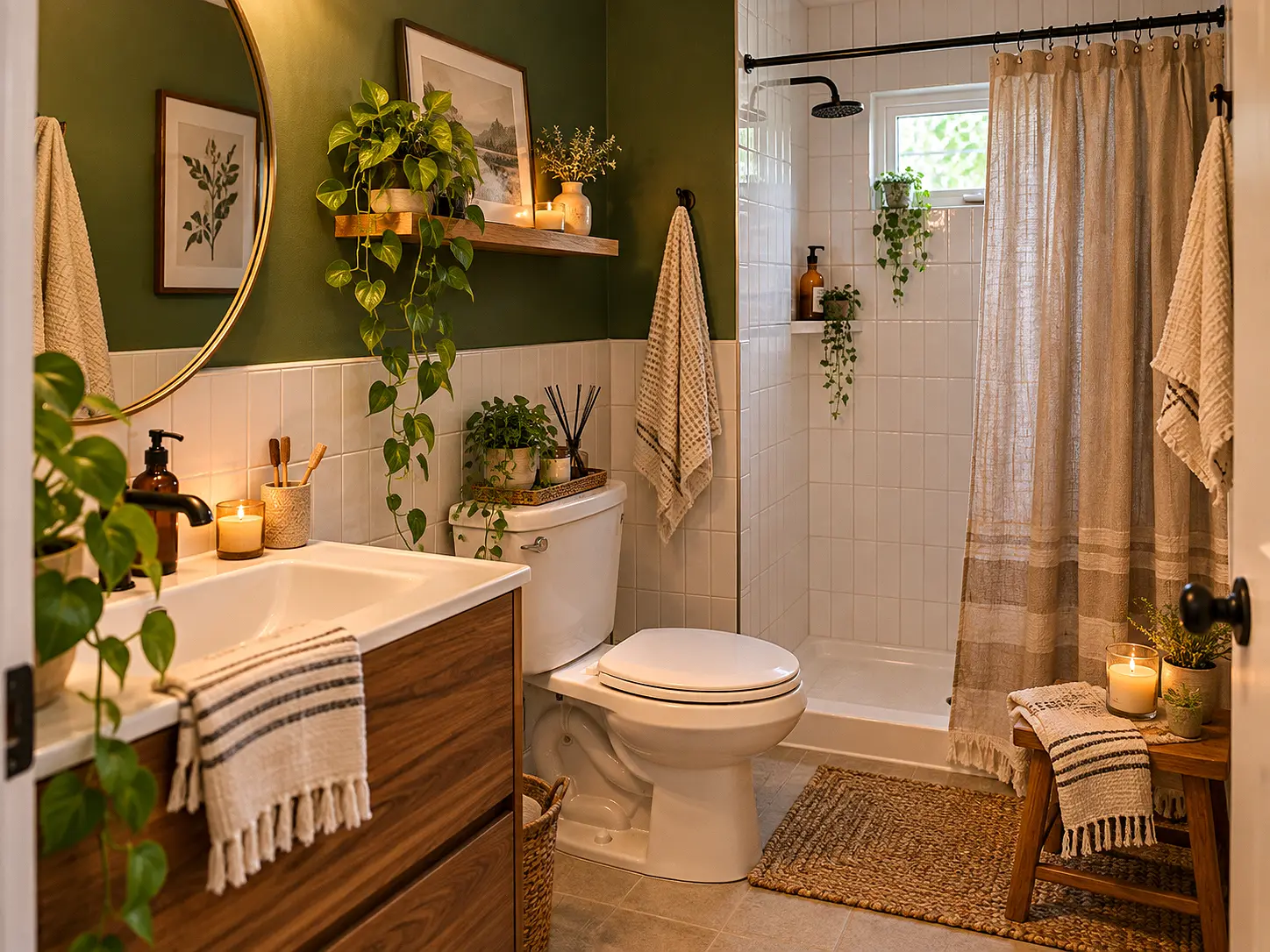
Pink-beige tile calls for a warm greige with just enough gray to mute the rose, not a clean gray that fights it. If your white-paper check in idea 1 came back rosy, look at greiges that lean warm, think mushroom or a soft taupe-gray rather than anything with blue underneath. The goal is a wall that reads as a quiet, slightly deeper neutral so the tile stops being the loudest beige in the room. Test undertone-matched paint samples on the wall that gets the most light and the wall closest to the tub, because light shifts greige more than any other neutral, and a chip that looks perfect in the store can go pink on the wall.
3. Warm white or clay walls for yellow-beige almond tile
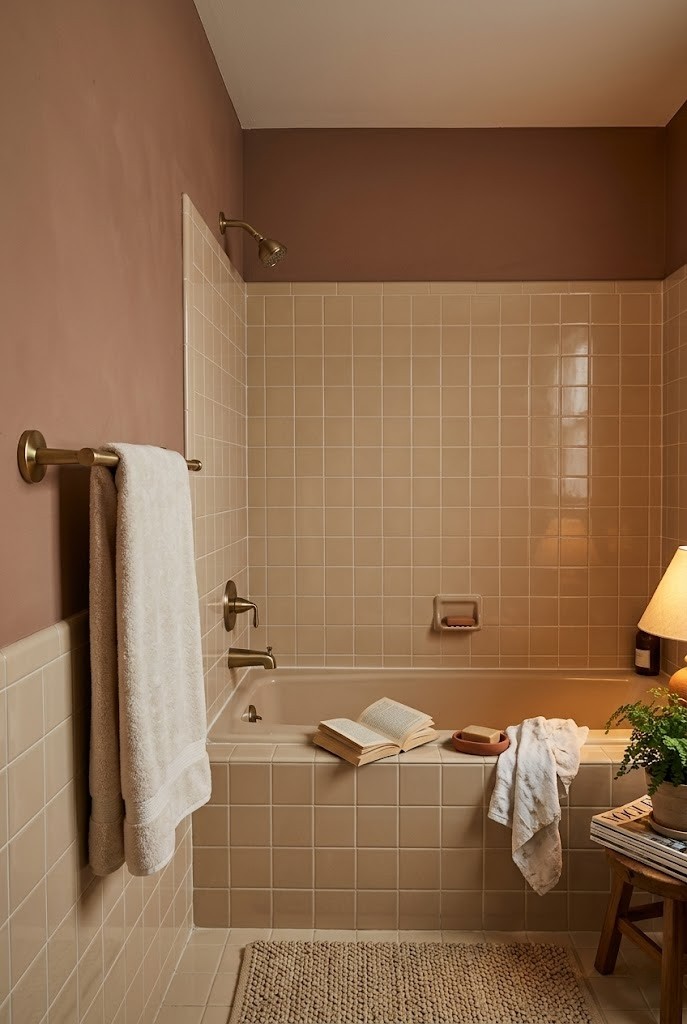
Yellow-beige and almond tile want a warm white or a muted clay above them, and almost never a cool gray. If your undertone test came back gold or a faint green, a soft warm white keeps things light while a muted clay or warm putty adds enough color that the almond looks chosen rather than leftover. Clay is the braver pick, and it flatters gold undertones the way cool grays never manage to. Order undertone-matched paint samples in both a warm white and a clay, then judge them in the evening under your real bulbs, since almond shifts hard under artificial light and a daytime-perfect white can go dingy after dark.
4. A charcoal or olive accent wall that makes beige look intentional
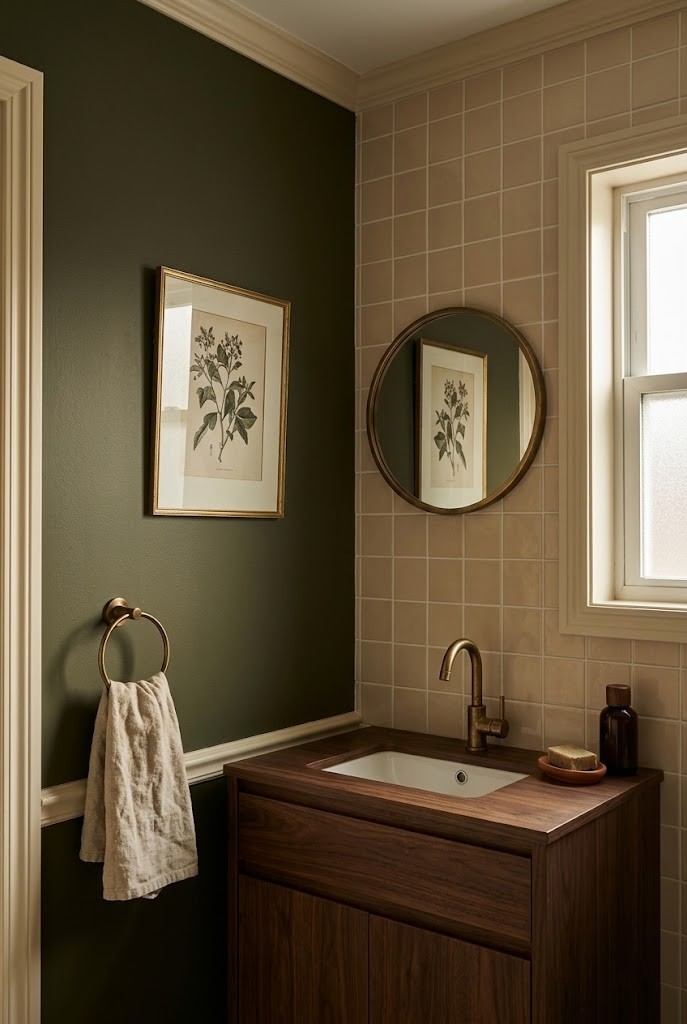
A deep wall color such as charcoal, olive, or dark clay turns beige tile into a deliberate two-tone scheme instead of an apology. Paint the one wall the tile does not touch, often behind the toilet or by the door, in something saturated, and the eye reads contrast-by-design rather than mismatched-beige. This works best in bathrooms with at least one full non-tiled wall plus a window or decent light, since dark colors eat a windowless room alive. Keep the trim and ceiling in a warm white so the beige tile has a visual bridge back to the dark wall, otherwise the two zones feel unrelated instead of paired.
5. Peel-and-stick wallpaper on the wall behind the vanity
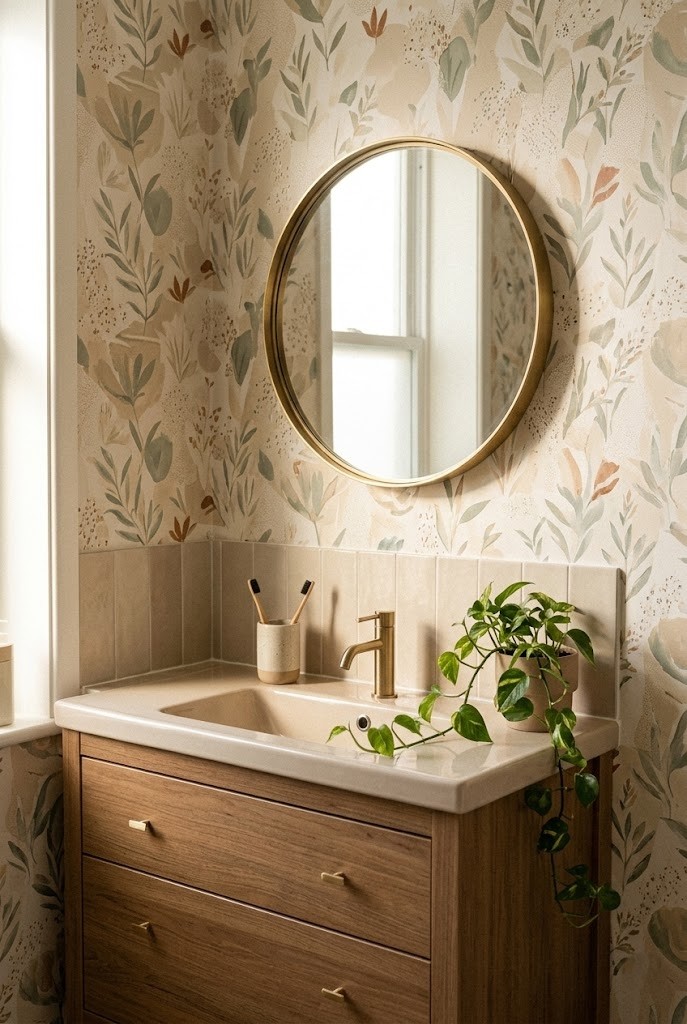
Peel-and-stick wallpaper on one dry wall adds pattern and pulls the beige into an intentional palette without a drop of paint. Choose a print that already contains a beige or almond note so the tile looks like part of the pattern's family, plus one contrast color to give the eye somewhere else to land. Put it on the wall behind the vanity or toilet, well away from direct shower splash, and smooth each panel from the center outward to chase out bubbles. For renters this buys real pattern with a full reversal at move-out, which is the entire appeal of going the stick-on route instead of committing to paint.
6. A paintable beadboard half-wall that hides the lower beige tile
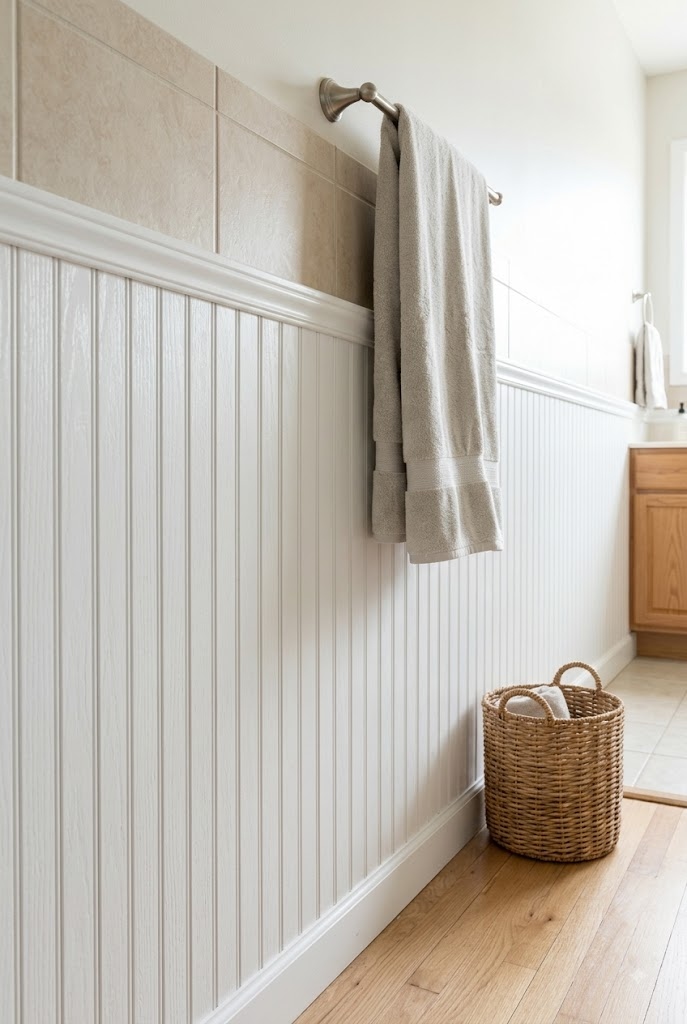
A paintable beadboard or board-and-batten half-wall covers the lower run of beige tile entirely and hands the room the architecture it never had. Run it to roughly 36 to 42 inches high, cap it with a simple ledge, and paint the whole thing in your undertone-matched wall color so the covered tile simply disappears. Lightweight PVC beadboard panels shrug off bathroom humidity far better than raw MDF and cut cleanly with a utility knife. This is the move when the lower tile is the single ugliest surface in the room, because you are not removing anything, only hiding it behind something you actually chose.
7. A bold shower curtain that anchors the almond tub-shower combo
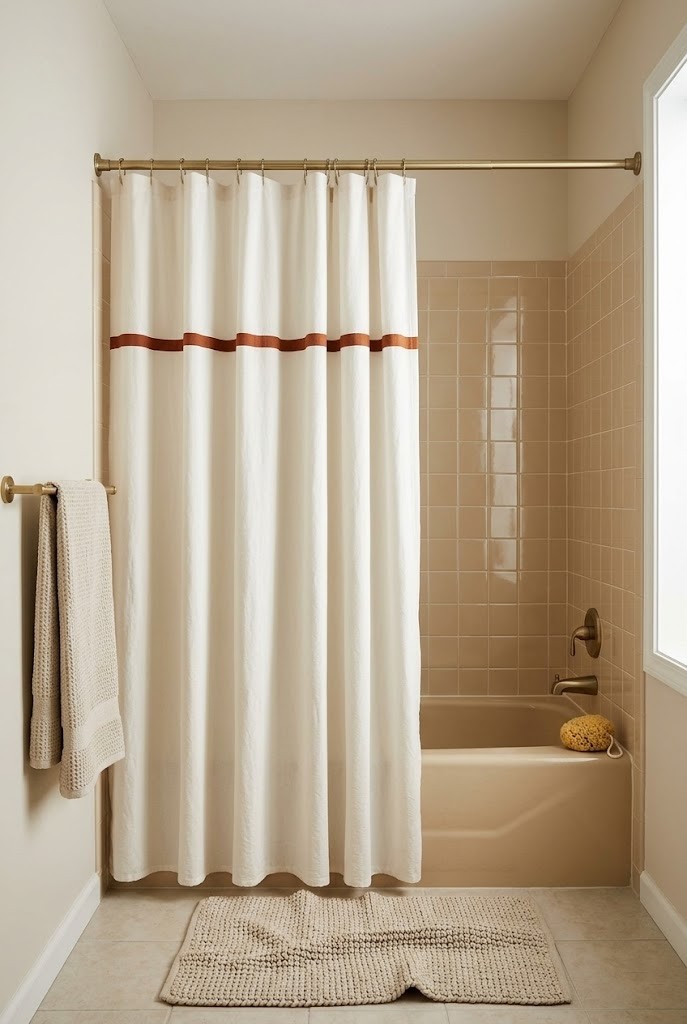
Your shower curtain is the largest single piece of fabric in the room, so it sets the color story for the entire almond tub-shower combo. Pick a curtain that introduces your intended palette, a warm white with a clay stripe, an olive, a deep rust, rather than another beige that vanishes against the tub. Hanging a floor-grazing curtain high near the ceiling also drags the eye up and past the almond surround, which makes the combo feel less like the room's centerpiece. This is the cheapest high-impact change available and the fastest thing to undo if you change your mind about the whole direction later.
8. Layered bath mats that break up the beige floor
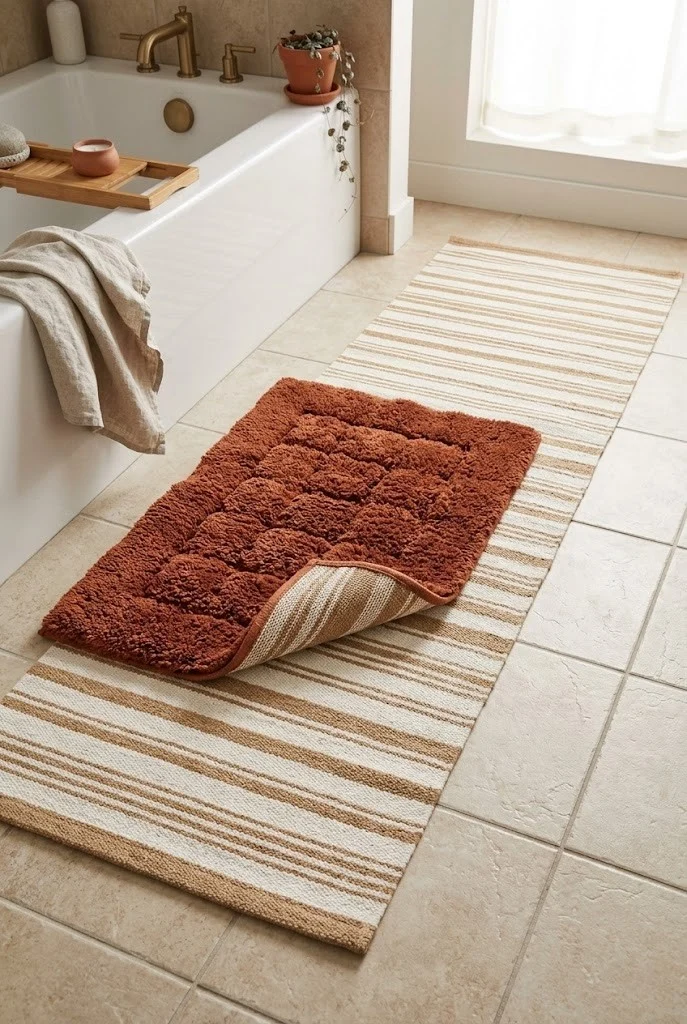
Layering a low-pile runner under a plush bath mat adds color and softness at floor level, exactly where beige tile usually dominates. Lay a washable cotton runner down the main walkway and a thicker mat at the tub, both carrying the accent color you chose for the curtain in idea 7, so the floor stops reading as one unbroken beige field. Natural fibers such as cotton and jute dry faster and mildew less than shag in a humid room. This layering also buys time on the floor tile itself if you are not ready for the peel-and-stick route in idea 21 yet.
9. Towels in a warm white plus one accent for the third color
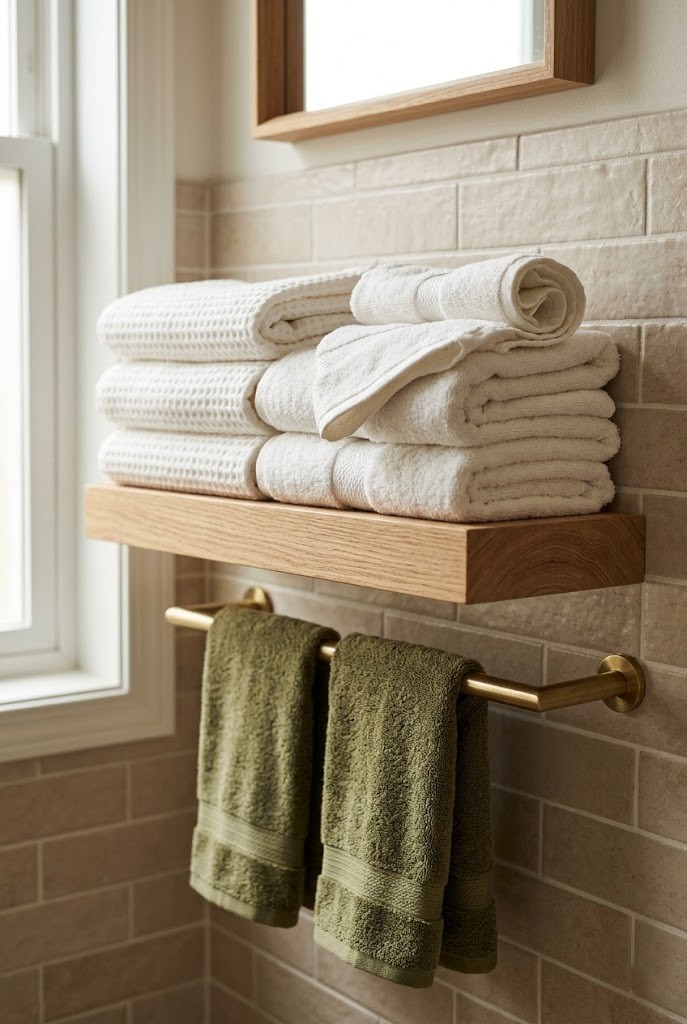
Towels are the easiest place to run the third color that makes beige look deliberate. Keep the bulk of your towels in a warm white or your accent shade, then add one or two hand towels in a bolder version of that accent for a hit of punch. Fold the good ones on an open shelf or ladder where they read as decor rather than laundry waiting to happen. Warm-white cotton reads clean against almond far better than bright white, which only makes the tile look dingy by comparison. Buy the whites in a single dye lot so they actually match each other on the rail.
10. A Roman shade or cafe curtain at the window for color up high
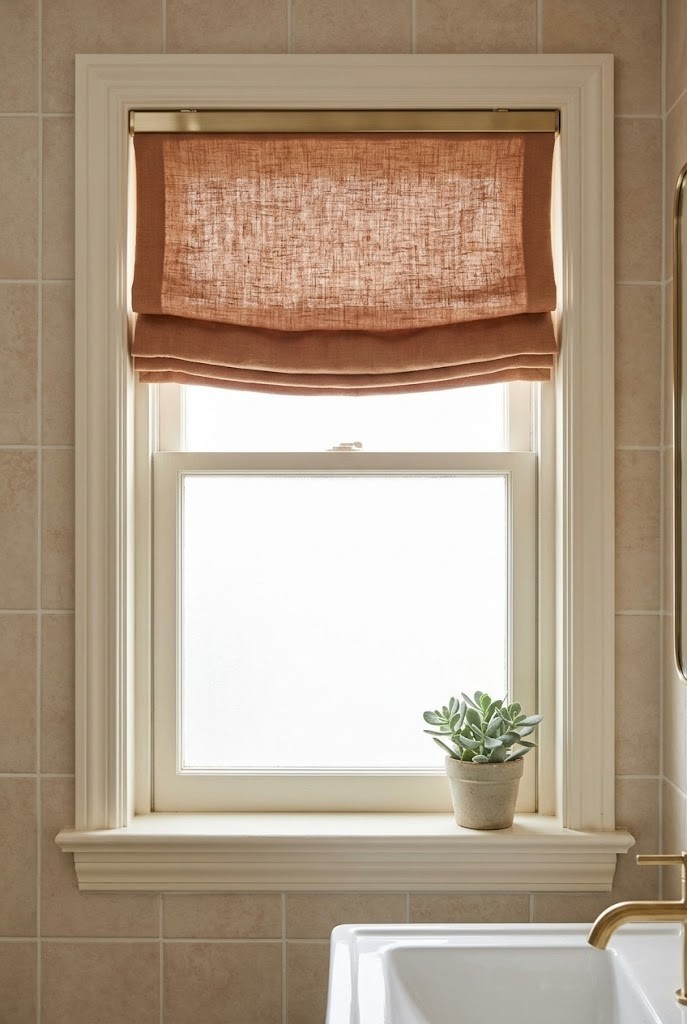
A fabric Roman shade or cafe curtain at the bathroom window brings a second hit of your palette up high, balancing the color you added at floor level. Choose a moisture-tolerant fabric or a faux-linen in your accent color, and mount the shade above the frame to make the window feel taller than it is. In a bathroom saddled with a boring vinyl window, this is the fastest way to soften the whole wall it sits on. If privacy and light both matter, pair a light-filtering shade with the existing frosted glass rather than fighting the glass you already have.
11. Tonal textures that give beige depth without a fighting color
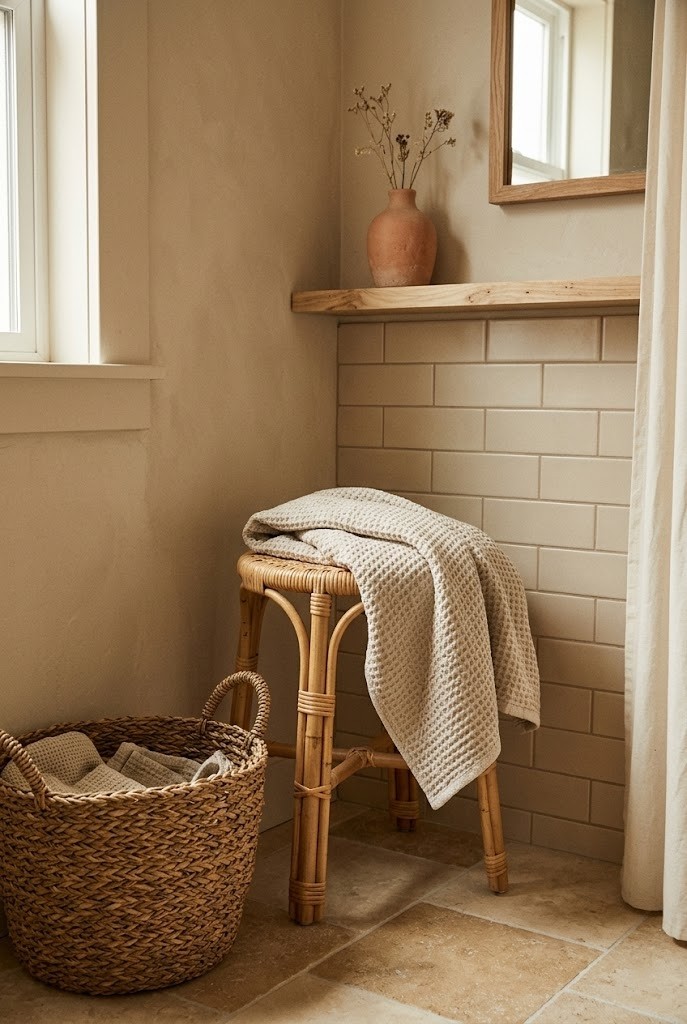
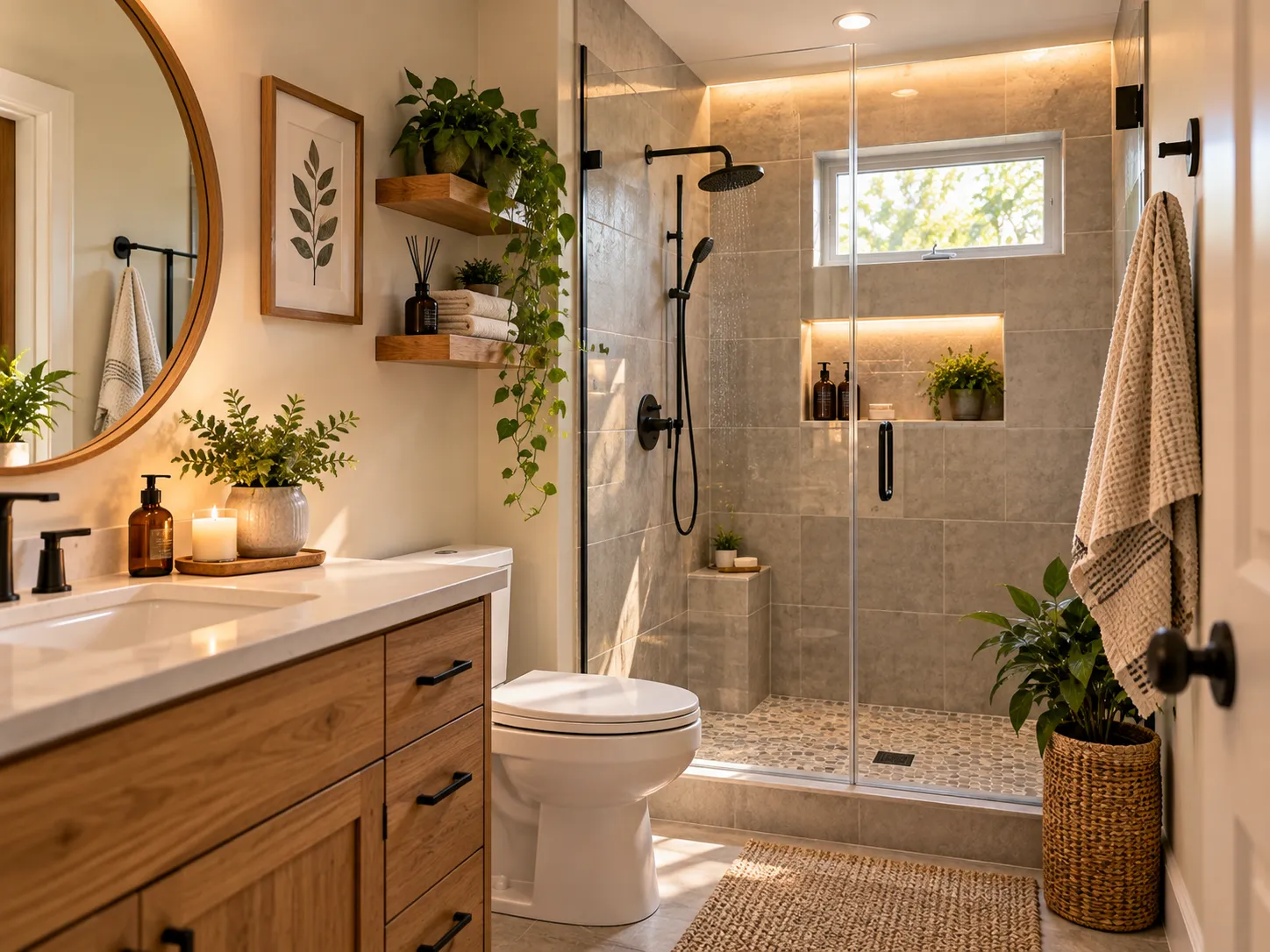
Adding texture within a single tonal family gives beige real depth without introducing a color that competes. Stack a waffle-weave towel, a nubby bath mat, a woven basket, and a rattan stool, all in warm neutrals, and the room reads layered and rich rather than flat and dated. The trick here is tonal variety, not color variety, since five different textures in the same warm-neutral range beats five different colors every time. This is the quiet move for people who genuinely like their beige and only want it to look current and intentional instead of accidental and stuck in place.
12. Swap the faucet and shower trim to brushed brass or matte black
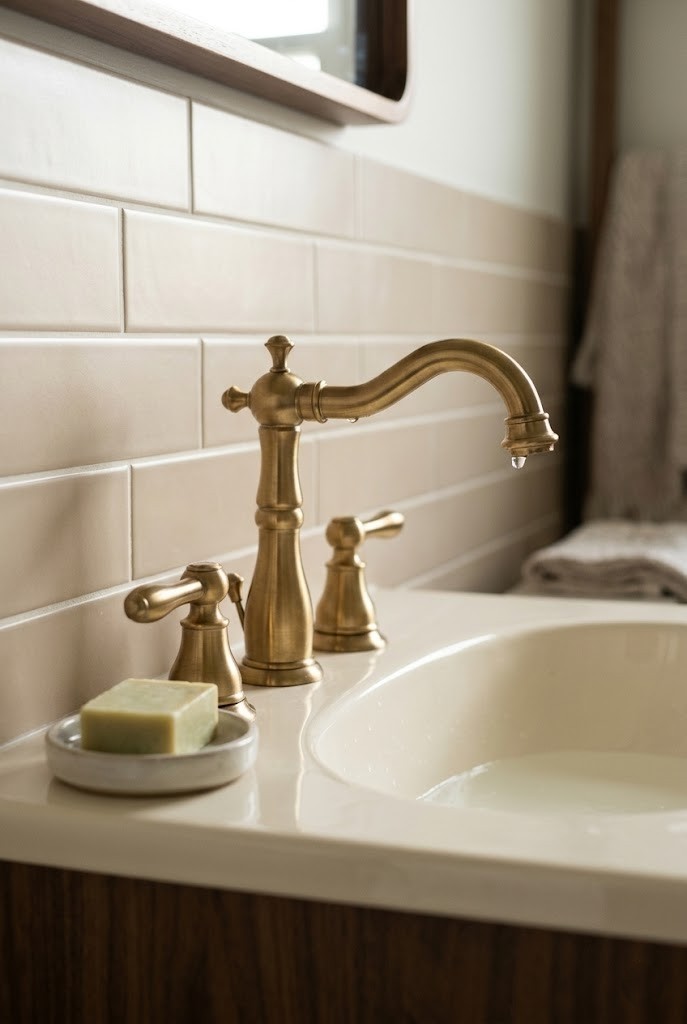
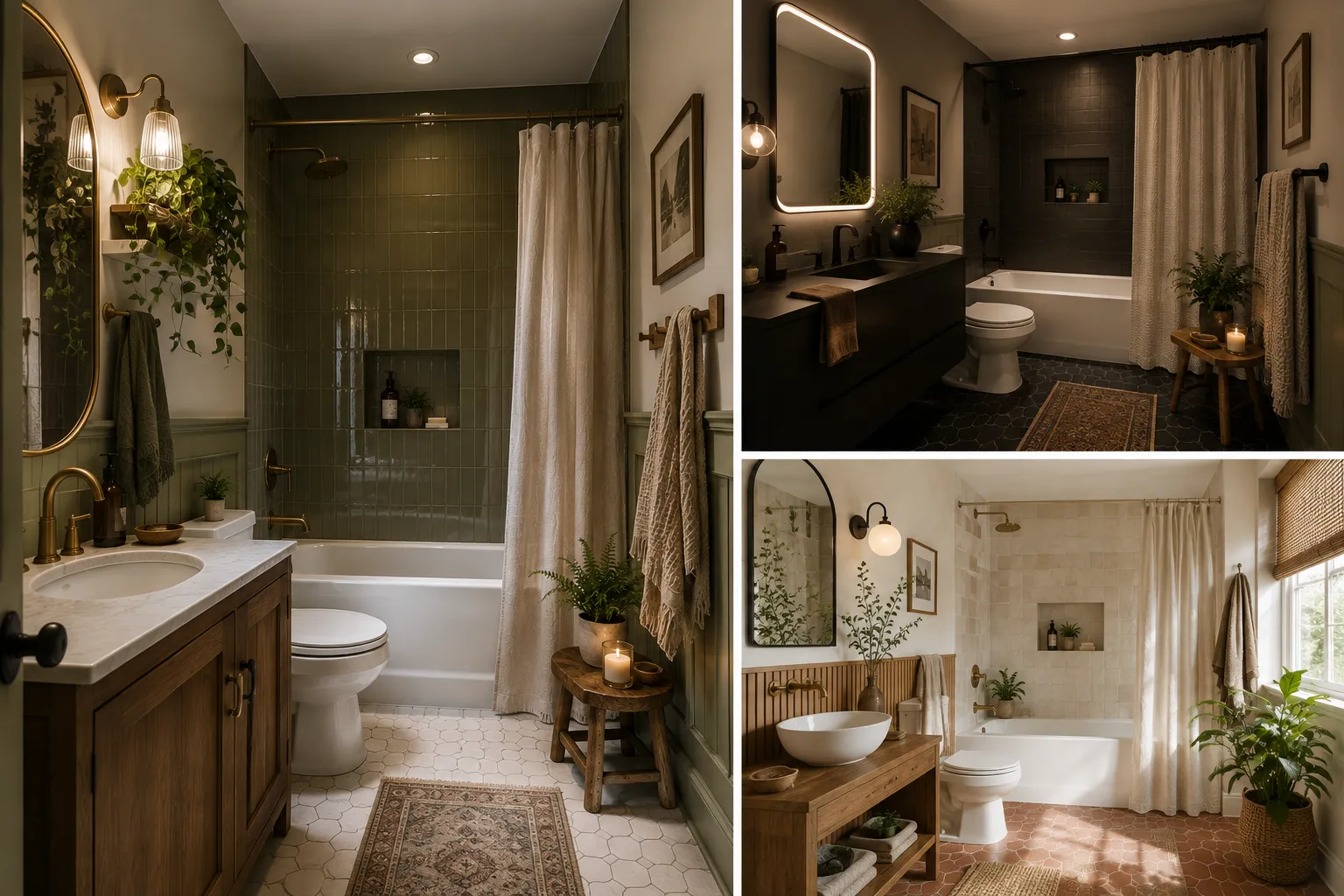
Swapping the faucet and shower trim from dated chrome to brushed brass or matte black is the change people register before they even notice the tile. Pick one metal and commit, because mixing finishes is advanced and easy to get wrong in a small room. Brushed brass warms a yellow-beige bathroom, while matte black adds crisp contrast to either undertone. Brushed-brass or matte-black fixture swap kits bundle the faucet, handles, and shower trim in one matched finish so nothing clashes. A basic faucet swap is a 30-minute job with a wrench, and the shower trim is often just a new escutcheon and handle over the valve you already have.
13. Cabinet and drawer hardware in your one chosen metal
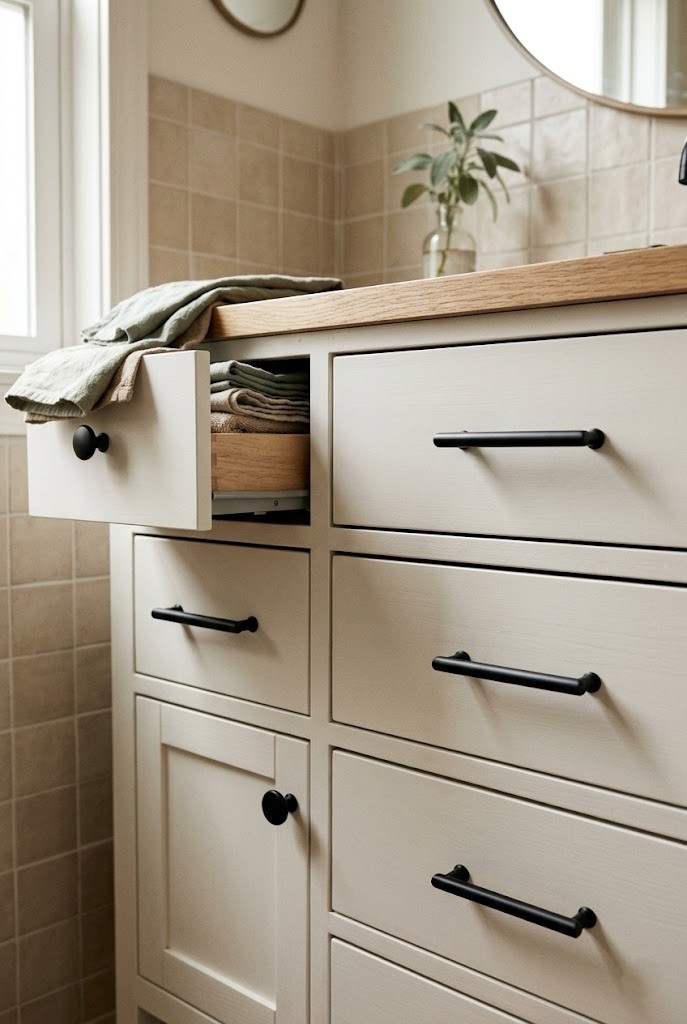
Cabinet and drawer hardware in the same finish you chose in idea 12 ties the vanity into the new metal story for a few dollars a knob. Unscrew the old builder pulls and replace them with brushed brass or matte black in the identical finish family, not a close-enough cousin that reads slightly off. This is a 20-minute upgrade that makes a beige vanity look updated with no paint and no new doors. Measure your existing hole spacing before you buy anything, since a mismatch means drilling fresh holes and filling old ones, which turns a quick swap into an afternoon.
14. A framed mirror in the same metal as your fixtures
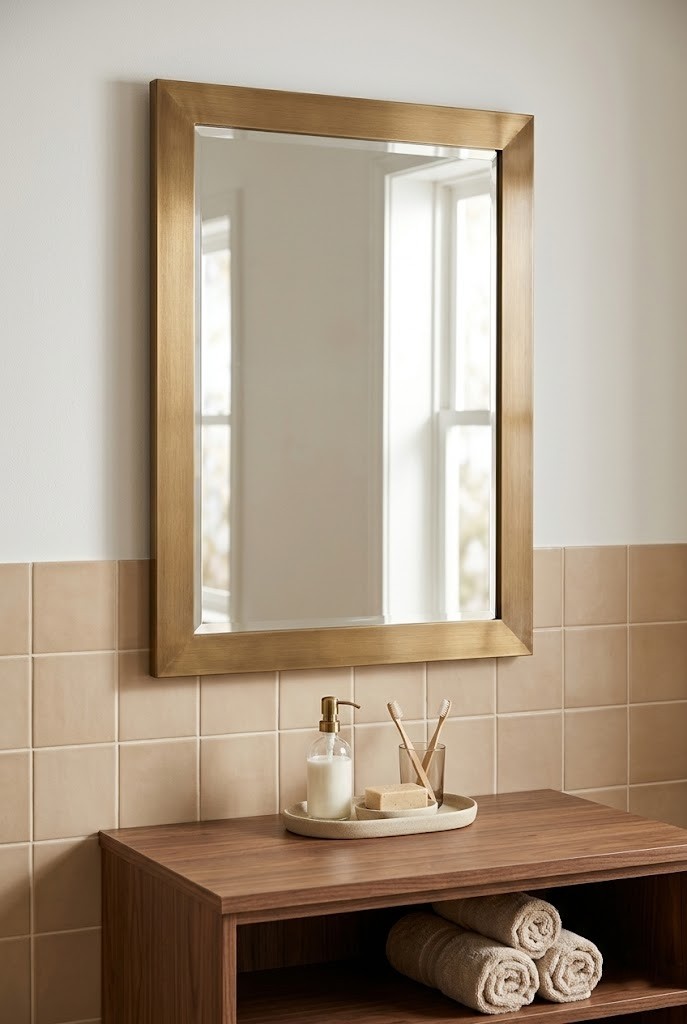
Trading the frameless builder mirror for one framed in the metal you chose in idea 12 gives the vanity wall a real focal point and repeats the finish at eye level. A mirror framed in brushed brass or matte black instantly reads more finished than the glued-on rectangle most beige bathrooms shipped with. If prying the old mirror off the wall feels risky, a stick-on mirror frame kit in the right metal wraps the existing glass and skips the demolition entirely. Hang or center the new mirror so its metal lines up visually with the faucet finish directly below it, which is what sells the intentional look.
15. Towel bars, hooks, and a robe hook matched to the faucet
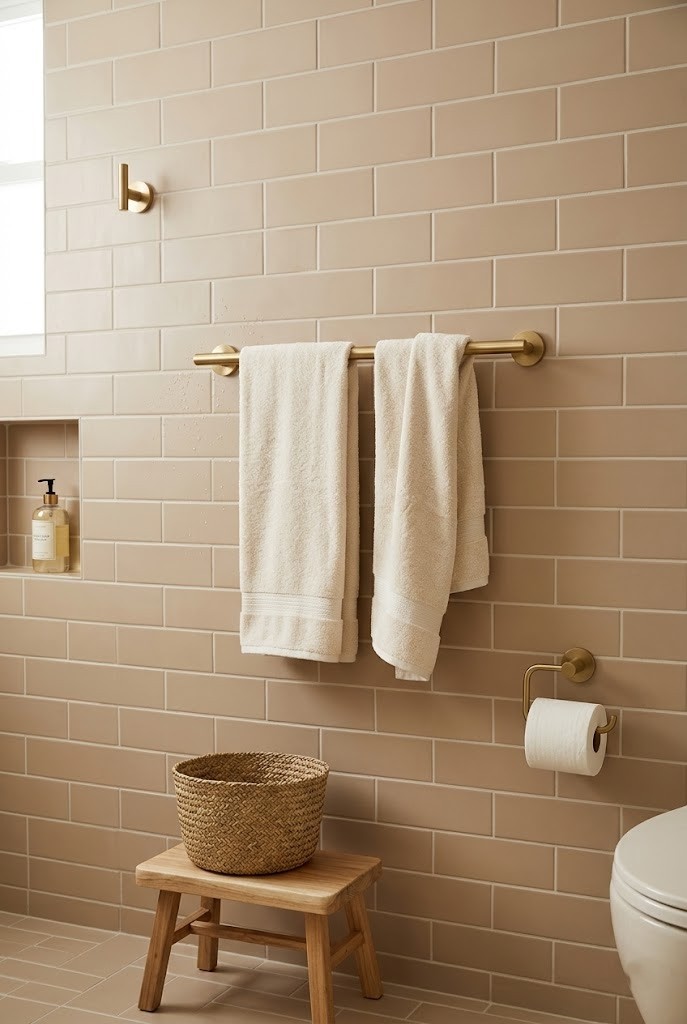
Matching the towel bar, hooks, and robe hook to your faucet finish is the detail that makes a room look designed rather than assembled slowly over years. Swap every visible piece of bathroom hardware to one metal, right down to the toilet paper holder, so the eye reads a single intentional finish instead of a timeline of past owners. These pieces mount over existing screw holes most of the time, which keeps the swap fast and reversible for renters. Buy a coordinated set rather than singles from different lines, because that is the only reliable way to guarantee the finish actually matches across every piece.
16. Coordinated accessories that also settle an almond toilet
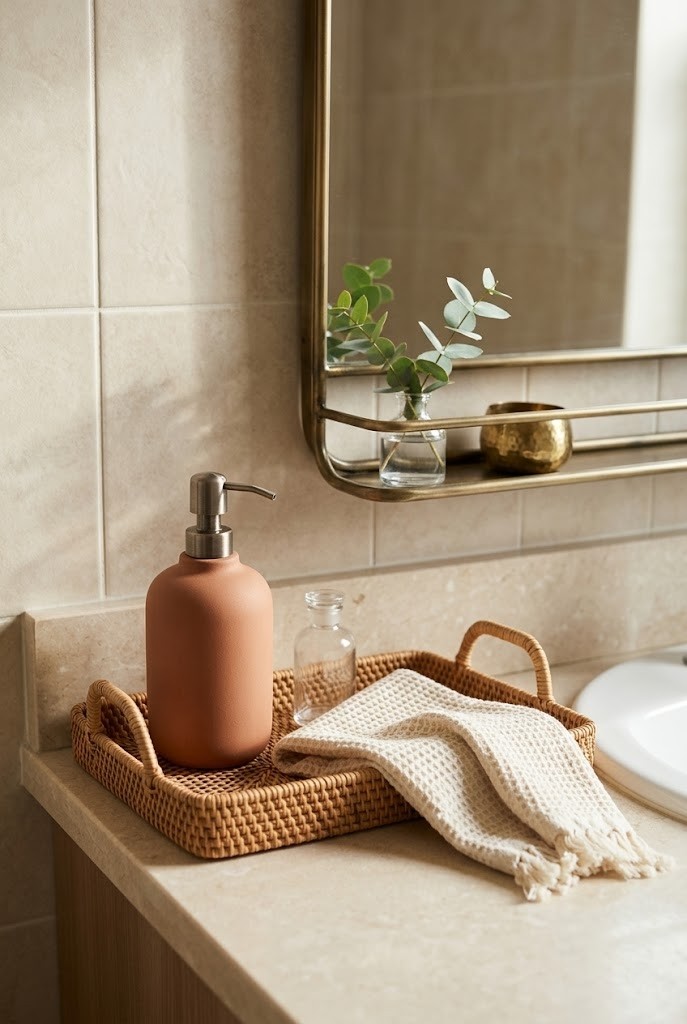
Small accessories in your accent color and metal finish are the final ten percent that makes beige look styled, and they are where you quietly deal with an almond toilet if you have one. A soap dispenser, tray, and cup in coordinated tones, plus a metal-framed shelf, give the counter a reason to look intentional instead of cluttered. If the toilet is also almond, do not fight it, and instead repeat a warm metal and a warm textile nearby so it reads as part of the palette rather than an eyesore stranded in the corner. Keep counter clutter to three or four objects that share the scheme, since more just reads as mess.
17. Replace the builder vanity light fixture
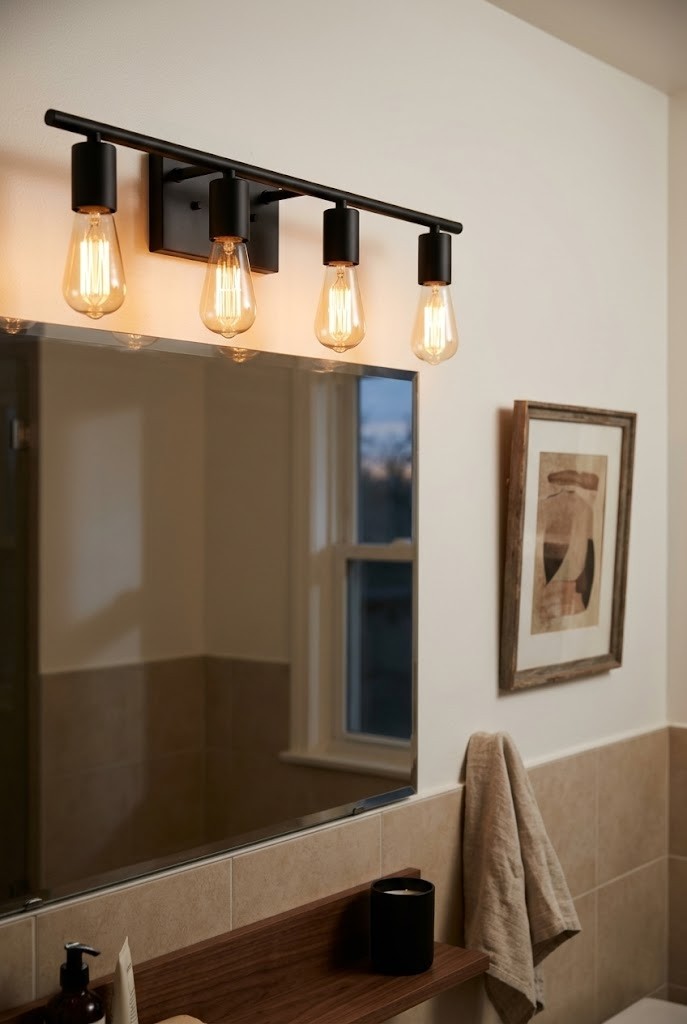
Replacing the vanity light fixture is the single change that resets how every other color in the room reads. Builder-grade beige bathrooms usually came with a chrome or brass-tone Hollywood bar that dates the entire wall, and a fixture in your chosen metal finish updates it while reinforcing the palette. Pick a fixture rated for damp locations and wide enough to span most of the mirror below it. This is real electrical work, so cut the breaker first and confirm the wires are dead before touching them. If wiring is not your thing, this is the one swap genuinely worth paying an electrician an hour to handle for you.
18. Warm bulbs that stop your almond tile looking green
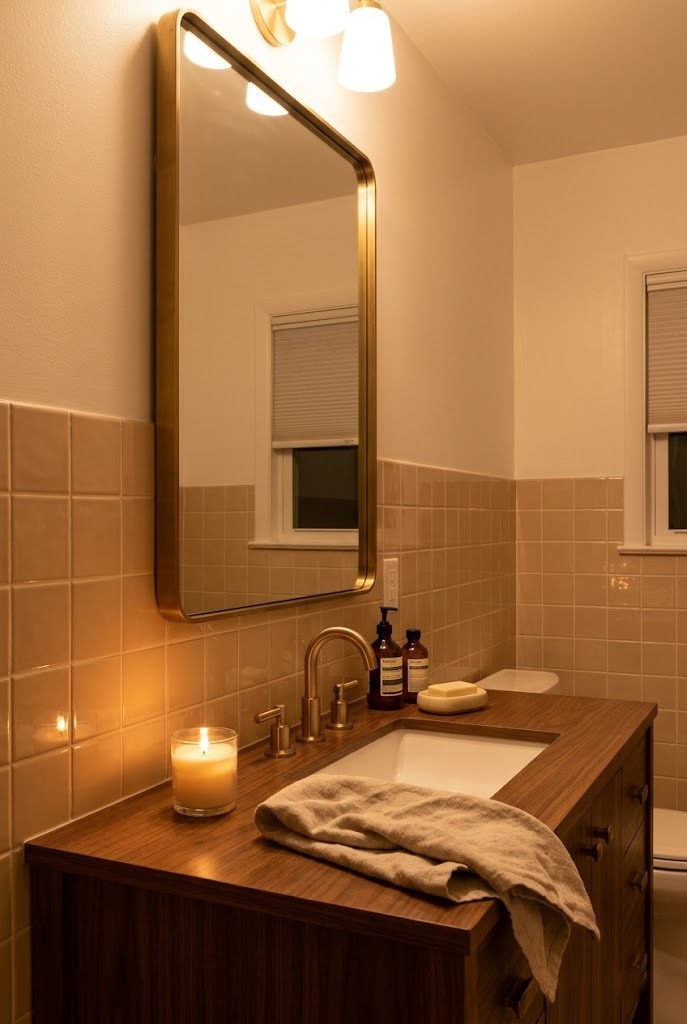
The wrong bulb color temperature is why your almond tile looks slightly green, and it is a five-dollar fix. Cool daylight bulbs above 4000K push yellow-beige and almond toward green and make pink-beige look sickly, while warm bulbs around 2700K let the undertone you found in idea 1 read true. Buy a soft-white bulb in the 2700K to 3000K range for every fixture in the room and match them all, because mixed temperatures are their own particular kind of ugly. This single swap often does more for how the beige reads than any paint color you spend a weekend auditioning on the wall.
19. Sconces flanking the mirror for even, flattering light
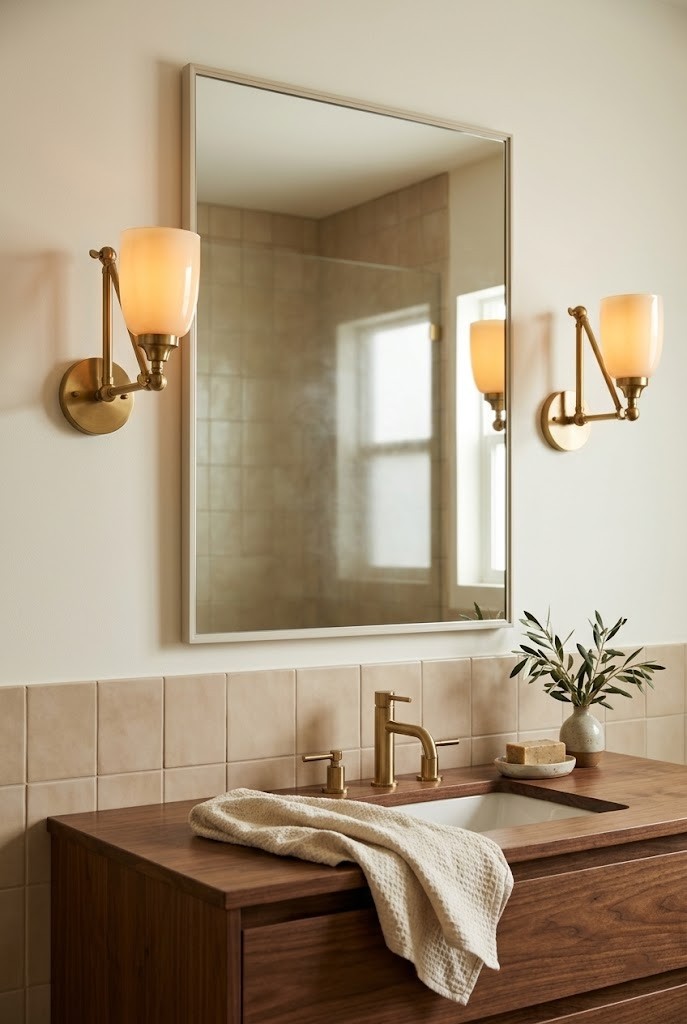
Adding a sconce on each side of the mirror gives even, flattering light and breaks up the beige wall with two points of your chosen metal. Side lighting beats a single overhead bar for faces because it fills shadows instead of casting them down, and the matched pair reinforces the finish you committed to at the faucet and hardware. If you have no wiring on the sides, plug-in sconces with a cord channel or battery LED sconces get most of the look without an electrician on the calendar. Mount them at roughly eye level, about 60 to 66 inches from the floor, so the light lands where your face actually is.
20. A dimmer and a second light source for evening mood
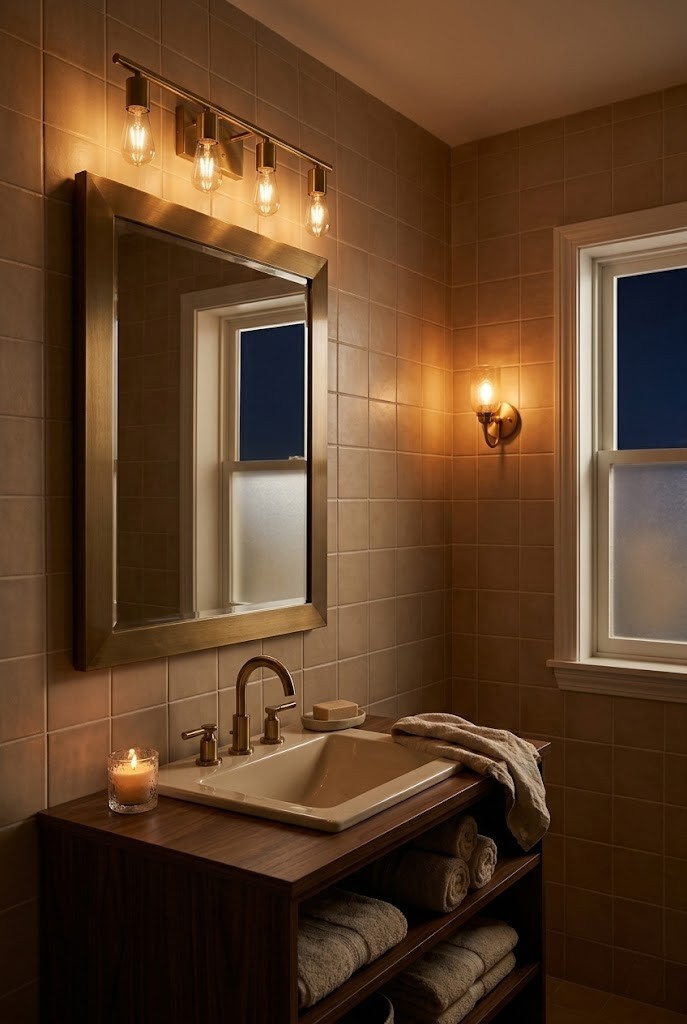
A dimmer plus a second light source lets one beige bathroom do both bright morning and soft evening, which is what actually makes it feel finished. Put the vanity fixture from idea 17 on a dimmer and add a small second source, a sconce, a plug-in puck, or a warm nightlight, so the room is never just one flat sheet of ceiling glare. Layered, dimmable, warm light flatters beige far more than a single bright fixture ever will. Dimming also lets a contrast wall or the darker accents from earlier ideas go genuinely moody at night without you repainting a single surface.
21. Peel-and-stick vinyl floor tile laid over the beige floor
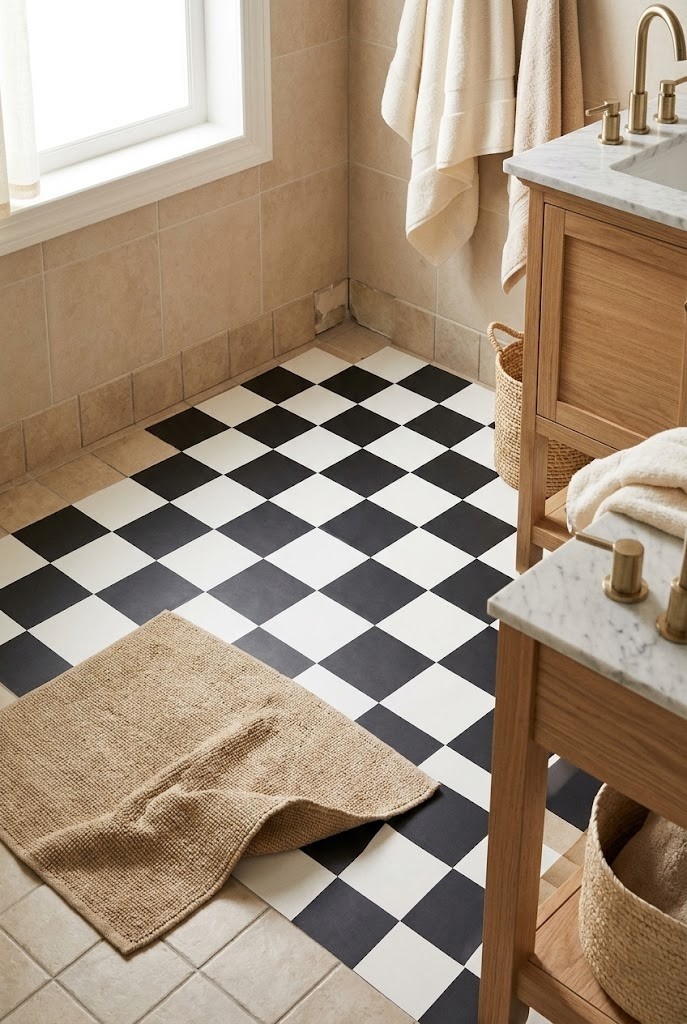
Peel-and-stick vinyl floor tile lays directly over beige floor tile and is the biggest visual change you can make in this room without a demo crew. Choose a pattern, matte black-and-white checker, a warm terrazzo, a stone look, that carries your palette, and the floor stops dragging the whole room back to beige. Clean and dry the existing tile thoroughly, then set the vinyl, and over textured or heavily grooved tile a thin skim of embossing leveler first gives a far flatter result. Peel-and-stick vinyl floor tile is fully reversible for renters and runs a small fraction of real retiling, which is the entire appeal.
Final Thoughts
The tile was never the problem, and now you have twenty-one ways to prove it: name your undertone with a sheet of paper, then work outward by surface so every choice agrees with the beige instead of apologizing for it. Start with the two cheapest, highest-impact moves, warm bulbs and a bold shower curtain, before you touch a paintbrush or a wrench, because they change how everything else reads. Pick one metal, run it everywhere, and let the almond become a supporting neutral rather than the loudest thing in the room. Save this to Pinterest so the undertone test and the surface order are with you the next time you shop.
Frequently Asked Questions
how do I tell if my beige tile is pink or yellow undertoned?
Hold a sheet of plain white printer paper flat against a dry tile in daylight with the lights off. If the tile looks rosy or mauve next to the pure white, it is pink-beige. If it looks gold, tan, or faintly green, it is yellow-beige or almond. That one test decides every paint, metal, and textile choice that follows.
what paint color goes with almond bathroom tile?
A warm white or a muted clay, judged under warm 2700K bulbs rather than daylight ones. Almond is a yellow-beige, so cool grays turn it green and make it look dated. A soft warm white keeps the room light, while a muted clay or warm putty adds enough color that the almond looks chosen instead of leftover. Test samples in the evening under your real bulbs.
can you update a beige tile bathroom without replacing the tile?
Yes, and it is mostly a styling problem, not a demolition one. The dated feeling usually comes from beige-on-beige with no second color and cool bulbs, not the tile itself. Swap to warm 2700K bulbs, add one accent color through the shower curtain and towels, move every metal fixture to one finish, and the same tile reads intentional.
how much does it cost to make a beige bathroom look updated?
You can shift the whole room for roughly 100 to 250 dollars if you stick to renter-friendly swaps. Warm bulbs cost a few dollars, a shower curtain and towels add an accent color, a fixture swap kit and matched hardware handle the metals, and peel-and-stick options cover walls or floors. Skipping demo and a color consultant is where the savings live.